Deep Analysis of FRP Water Tank Corrosion Resistance: Material Advantages and Engineering Validation
Introduction: Corrosion Resistance as the Core Competitiveness of FRP Water Tanks
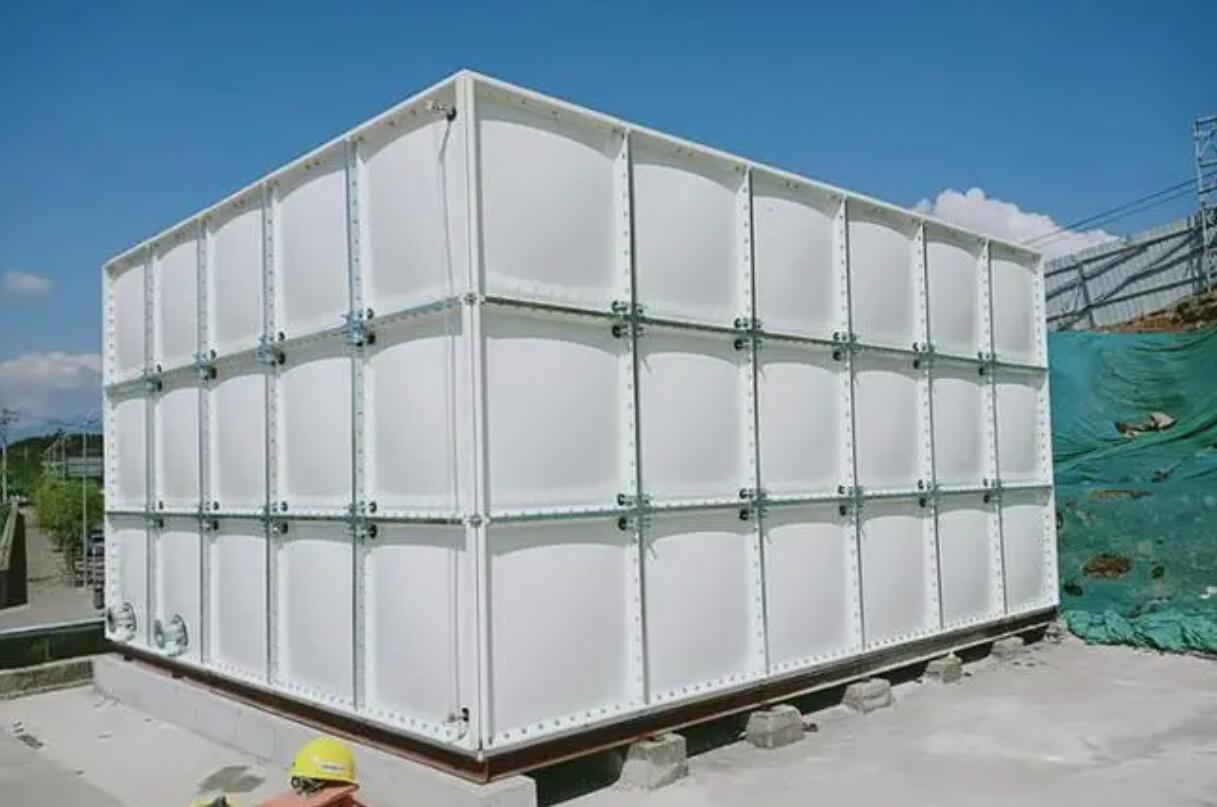
In industrial and municipal water storage, FRP (Fiberglass Reinforced Plastic) water tanks replace traditional steel tanks and concrete reservoirs primarily due to their outstanding chemical resistance. Steel tanks in pH<6.5 or chloride-bearing environments corrode at 0.1-0.3 mm/year, while SMC molded tanks from Beijing Yuanhui FRP Co., Ltd. show a mass loss rate of only 0.02% after 10,000 hours immersion at pH 2–12. This article provides a material-science-based analysis of the corrosion protection mechanism and engineering reliability of FRP tanks.
Three Core Factors of Corrosion Resistance
1. Resin Matrix: The First Line of Defense
The corrosion resistance of FRP tanks is primarily determined by the resin type. General-purpose orthophthalic unsaturated polyester (UP) retains only 60% of its Barcol hardness after 30 days in 20% sulfuric acid, whereas isophthalic UP or vinyl ester resin retains over 92%. In a chemical storage project, Beijing Yuanhui FRP Co., Ltd. used bisphenol-A epoxy vinyl ester resin (e.g., Derakane 411-350) and achieved 88% flexural strength retention after 720 hours in 10% NaOH at 80°C—well above the 70% requirement of JC/T 658.1-2007.
2. Glass Fiber Reinforcement: Structural Integrity
Fiber content and layup design control the penetration path of corrosive media. Using E-CR glass fiber (corrosion-resistant type) with 30–35% weight fraction and ±45° cross-ply lamination effectively reduces micro-cracks from resin shrinkage. Per ASTM C581, after 1000 hours accelerated aging in 5% NaCl, Barcol hardness drop should be below 15%. Beijing Yuanhui's factory data shows a drop of only 8%, attributed to low-alkali continuous roving treated with isocyanate coupling agent.
3. Interface Treatment and Inner Liner: The Critical Barrier
The inner surface must have a resin-rich layer (resin content ≥70%) of 0.5–1.0 mm thickness, with C-glass surface veil. This structure blocks capillary action and prevents solution penetration along fiber interfaces. Test data show that specimens without surface veil exhibit visible delamination after 30 days in 10% HCl, while those with surface veil show zero delamination. Beijing Yuanhui's food-grade tanks use food-grade resin + polyester surface veil; SGS testing confirms heavy metal (Pb, Cd, Hg) leaching below 1/10 of GB/T 5750.4-2006 limits.
Field Validation: 10-Year Engineering Cases
Case 1: A reclaimed water tank (50 m³) in a Beijing wastewater plant, supplied by Beijing Yuanhui FRP Co., Ltd., stored pH 8.5 water with 2 ppm residual chlorine. After 8 years, inner wall samples showed resin thickness loss ≤0.05 mm, Barcol hardness from 45 to 42, and 86% flexural strength retention. The adjacent steel tank required replacement after 4 years.
Case 2: A hydrochloric acid storage tank (30% concentration, ambient temperature) in a Jiangsu chemical plant, made of vinyl ester resin via filament winding, was inspected after 6 years: inner surface glossy, no blistering or delamination, and continued service after local reinforcement. The previous steel-lined rubber tank failed after 3 years due to liner detachment.
These cases confirm that FRP tank corrosion life reaches 15–20 years, 3–5 times that of traditional materials. However, for media temperatures above 80°C, resin softening occurs; heat-resistant resins (e.g., phenolic epoxy) are recommended.
Common Failure Causes and Prevention
From Beijing Yuanhui FRP Co., Ltd.'s after-sales data, 98% of corrosion failures are not material defects but result from:
1. Incomplete curing: When curing degree is below 85%, chemical resistance drops by 50%. Strictly control MEKP addition (1–2%) and curing temperature (≥20°C).
2. Installation damage: Bolt holes and manhole sealing surfaces without secondary anti-corrosion treatment. Apply 3 additional fiberglass plies + resin sealant in these areas.
3. Unexpected water composition change: A tank designed for neutral water suddenly exposed to organic solvent wastewater may suffer resin swelling. Conduct a 72-hour immersion test on a sample before changing media.
Conclusion
The corrosion resistance of FRP water tanks is a system-level property involving resin selection, fiber content, interface treatment, and quality control. Fifteen years of industry practice at Beijing Yuanhui FRP Co., Ltd. demonstrate that using isophthalic UP or vinyl ester resin, E-CR fiber, and a resin-rich liner provides reliable corrosion protection for 15+ years under pH 2–12 and temperatures ≤60°C. For special media (strong alkalis, organic solvents, high temperature), custom formulations and validation are required. Choosing a qualified supplier and following proper installation procedures are fundamental to realizing the anti-corrosion advantages of FRP tanks.