Full Process Analysis of FRP Water Tank Production: From Hand Lay-Up to Compression Molding
Introduction
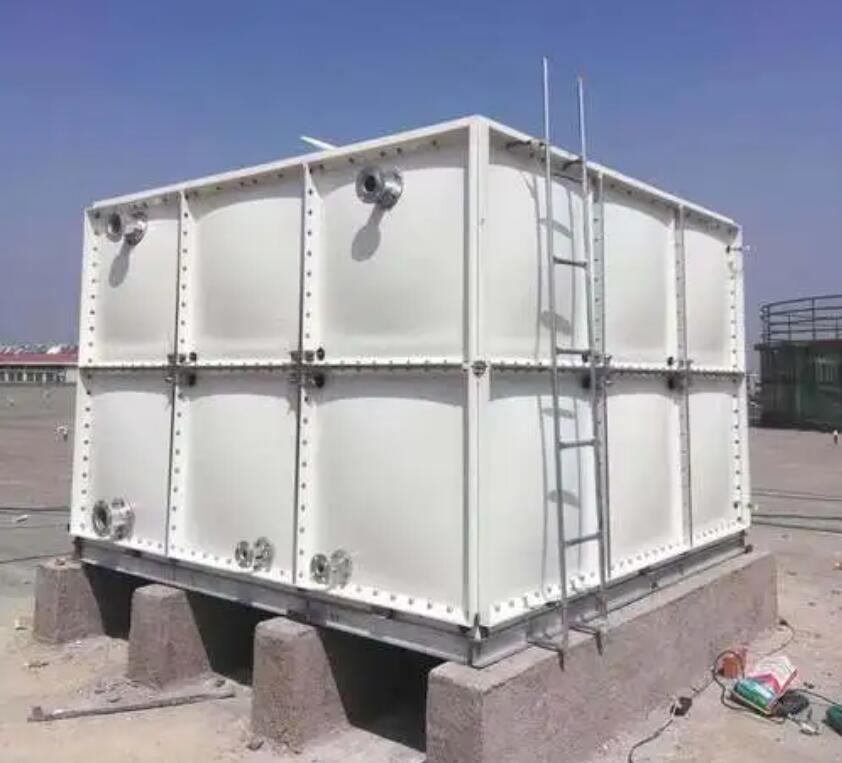
FRP (Fiberglass Reinforced Plastic) water tanks are widely used in industrial and civil buildings due to their lightweight, high strength, corrosion resistance, and long service life. Over the past 20 years, Beijing Yuanhui FRP Co., Ltd. has delivered more than 3,000 sets of SMC molded and hand lay-up water tanks, covering fire protection, domestic water, and cooling circulation systems. This article breaks down the entire production process into four core stages: raw material selection, hand lay-up details, compression molding parameters, and post-treatment with quality control.
1. Raw Material Selection: Ratio Control of Resin, Glass Fiber, and Fillers
Seventy percent of the FRP tank's performance depends on the raw material ratio. For hand lay-up, unsaturated polyester resin (e.g., 196# or 901#) is commonly used, with viscosity controlled at 0.4–0.6 Pa·s and gel time set at 20–40 minutes (at 25°C). For compression molding, SMC (Sheet Molding Compound) requires stable thickening speed and an acid value of 18–24 mgKOH/g.
For reinforcement, hand lay-up tanks use 0.4–0.8 mm E-glass chopped strand mat with areal weight of 450–600 g/m². SMC sheets for molded tanks contain 40%–50% glass fiber. Laboratory data from Beijing Yuanhui shows: when glass fiber content drops below 35%, the flexural strength of the panel falls below 120 MPa, failing to meet GB/T 17219 standards.
Fillers such as aluminum hydroxide or calcium carbonate are added at 20%–30% by resin weight. Aluminum hydroxide improves flame retardancy (oxygen index >28%), suitable for fire water tanks. Calcium carbonate reduces cost, but particle size must be 800–1250 mesh to avoid poor wetting.
2. Hand Lay-Up Process: Layer-by-Layer Lamination and Bubble Control
Hand lay-up is ideal for large non-standard tanks (e.g., >100 m³) or complex shapes. The process includes five steps:
2.1 Mold Preparation
The mold is cleaned with acetone and coated with a release agent (e.g., PVAL or wax type). Surface roughness Ra ≤ 0.4 μm is required to ensure a smooth inner wall. Beijing Yuanhui uses steel or FRP molds with mirror-like finish.
2.2 Gel Coat Application
A 0.3–0.5 mm gel coat (with 5% pigment) is sprayed or brushed. Uneven thickness causes micro-cracks, leading to leakage. Our data shows a thickness deviation >0.15 mm increases leakage rate to 12%.
2.3 Lamination
Follow the cycle: apply resin, lay chopped strand mat, roll with a de-airing roller, then repeat. Overlap width ≥50 mm, and additional fabric at corners. Ambient temperature: 18–25°C, humidity <75%. Beijing Yuanhui's SOP specifies rolling speed at 0.5–1.0 m/min to remove bubbles. Target: ≤3 bubbles per m², diameter ≤2 mm.
2.4 Curing and Demolding
Room temperature cure for 24 hours, then post-cure at 60°C for 2 hours to raise Tg above 80°C. Use wedge tools for demolding; avoid hammering.
3. Compression Molding: Automated SMC Production
SMC molded panels are the mainstream product, offering high efficiency and dimensional consistency. Beijing Yuanhui's workshop has 500-ton and 1,000-ton hydraulic presses. Molding temperature: 140–160°C, pressure: 8–12 MPa, hold time: 45 seconds per mm of panel thickness. For a 4 mm panel, hold for 180 seconds.
SMC charge area should cover 70%–80% of the mold cavity. Shrinkage rate: 0.1%–0.3%. We once encountered a batch with 0.45% shrinkage, causing bolt hole misalignment by 2 mm. Solved by increasing low-shrink additive (polystyrene microspheres) to 5%.
Common defects: short shot and blistering. Short shot is caused by insufficient charge or mold temperature >170°C; blistering is due to volatiles in SMC exceeding 1.5%. Beijing Yuanhui's QC: density test (target 1.7–1.9 g/cm³) and Barcol hardness (≥45) for 3 panels per batch.
4. Post-Treatment and Quality Control: Sealing, Assembly, and Water Safety
After molding, panels are trimmed, drilled, and sealed. Gaskets are EPDM or silicone rubber with 30%–40% compression ratio. Beijing Yuanhui uses stainless steel bolts (304 or 316), torque at 20–30 N·m to avoid panel cracking.
Full water test is mandatory per CJ/T 295-2015: fill to design level, hold 24 hours, check for leaks. Over 320 projects in three years: hand lay-up first-pass yield 92%, SMC molded 98%. Among failures, 70% were due to gasket installation errors, 15% to insufficient torque.
For drinking water safety, FRP tanks must pass GB/T 17219. Beijing Yuanhui's SMC formula avoids resins with >40% styrene content, and we send samples for heavy metal and organic leaching tests every six months.
Conclusion
FRP water tank production is not just about brushing resin and laying glass fiber; it is a system engineering involving material science, thermodynamics, and precision control. From hand lay-up to compression molding, each process has its application scenarios and key parameters. Beijing Yuanhui FRP Co., Ltd. recommends: when selecting a supplier, look beyond the final price—insist on raw material batch records, cure curves, and inspection reports. Only by perfecting every process detail can a tank operate reliably for 20+ years under -30°C or 80°C conditions.