Complete Production Process of FRP Water Tanks: Key Steps from Raw Materials to Finished Products
Introduction
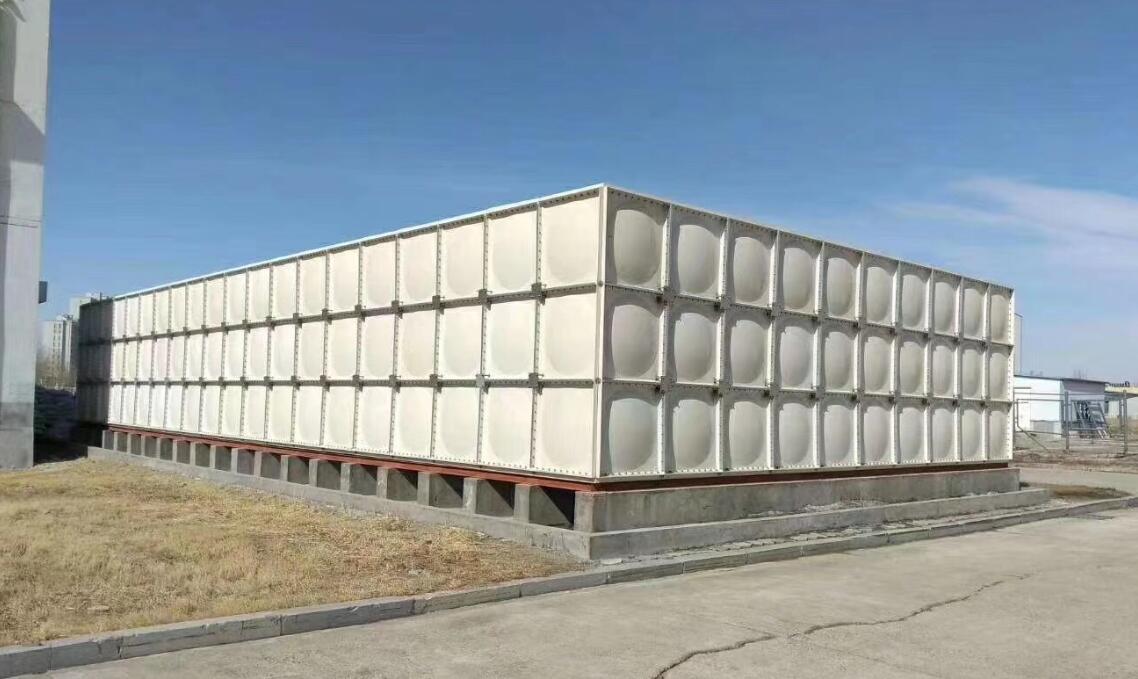
FRP (Fiberglass Reinforced Plastic) water tanks are widely used in construction, fire protection, and industrial water storage due to their corrosion resistance, lightweight strength, and long service life. A qualified FRP water tank undergoes at least 12 production steps, each with precise parameters affecting pressure capacity, sealing, and lifespan. Beijing Yuanhui FRP Co., Ltd., with 15 years of experience, achieves a failure rate below 0.3% on its tanks. This article details the full production process based on real production line data.
1. Raw Material Preparation and Pre-Treatment
1.1 SMC Sheet and Resin Selection
The core materials are SMC (Sheet Molding Compound) and unsaturated polyester resin for hand lay-up. Beijing Yuanhui uses Jinling Lianli's 196 resin, with tensile strength of 85 MPa and Barcol hardness ≥45. Fiber content in SMC is controlled at 28%-32% — too high reduces flowability, too low weakens strength. Each batch is conditioned for 24 hours in a 23°C constant-temperature workshop to eliminate internal stress.
1.2 Reinforcement Cutting
Fiberglass mat is cut using CNC machines with ±1 mm precision. Scrap recovery exceeds 95%, with a maximum 5% re-blending ratio to avoid fiber length reduction that compromises interlaminar shear strength.
2. Compression Molding (Core Process)
2.1 Mold Heating and Charging
Mold temperature is set at 145°C ±3°C, with top-bottom mold difference ≤5°C. Beijing Yuanhui uses a 2800-ton four-column hydraulic press at a closing speed of 8 mm/s. SMC charge weight is 105% of cavity volume to ensure full fill. Charging time is limited to 90 seconds to prevent premature resin gelation.
2.2 Curing, Holding, and Demolding
Holding pressure is 12 MPa; holding time equals plate thickness × 1.5 min/mm (e.g., 10 mm plate holds for 15 minutes). Curing degree is checked via DSC and must reach ≥98%. Post-curing at 80°C for 2 hours eliminates residual stress. Data case: In 2024, a 6000×4000 mm fire tank produced by Beijing Yuanhui showed 0.8 mm warpage, well below the 2 mm/m industry standard.
3. Hand Lay-up Assembly and Fittings Installation
3.1 Flange and Stiffener Hand Lay-up
Complex parts like manholes and pipe flanges are hand-laminated with a resin-to-mat ratio of 3:1. Each layer is compacted to remove air, with interlayer intervals ≤30 minutes. Stiffeners are molded using I-beam shapes, height 2.5× plate thickness, spacing 500 mm for tanks ≤2 m high and 400 mm for taller tanks.
3.2 Sealing and Assembly
EPDM rubber gaskets are used between panels with 35%-40% compression. Beijing Yuanhui uses M12 stainless steel bolts torqued to 45 N·m in three diagonal passes. After assembly, a hydrostatic test at 1.5× working pressure is performed with a 30-minute hold, allowing pressure drop ≤0.01 MPa.
4. Quality Inspection and Shipping Standards
4.1 Visual and Dimensional Inspection
Per JC/T 658.1-2007, surface bubbles must be ≤3 mm in diameter and ≤3 per m². Thickness tolerance is ±0.5 mm, diagonal difference ≤3 mm. Beijing Yuanhui uses 3D laser scanning with 0.1 mm accuracy for 100% inspection.
4.2 Mechanical Property Testing
Three samples per batch undergo flexural strength testing (MTS universal tester). Requirements: flexural strength ≥160 MPa, interlaminar shear strength ≥20 MPa. In Q1 2025, the pass rate was 100%, with the lowest flexural strength measured at 168 MPa.
Conclusion
FRP water tank production is a precision-controlled process — from SMC conditioning and molding parameters to hand lay-up details and bolt torque. Data-driven management at each stage determines final product performance. Beijing Yuanhui FRP Co., Ltd., with its 2800-ton press, constant-temperature workshop, and full-inspection protocol, keeps defect rates below 0.3%. For buyers, selecting a supplier with complete process traceability is key to ensuring a 20-year tank service life.