Full Process Analysis of FRP Water Tank Production: From Raw Materials to Finished Products
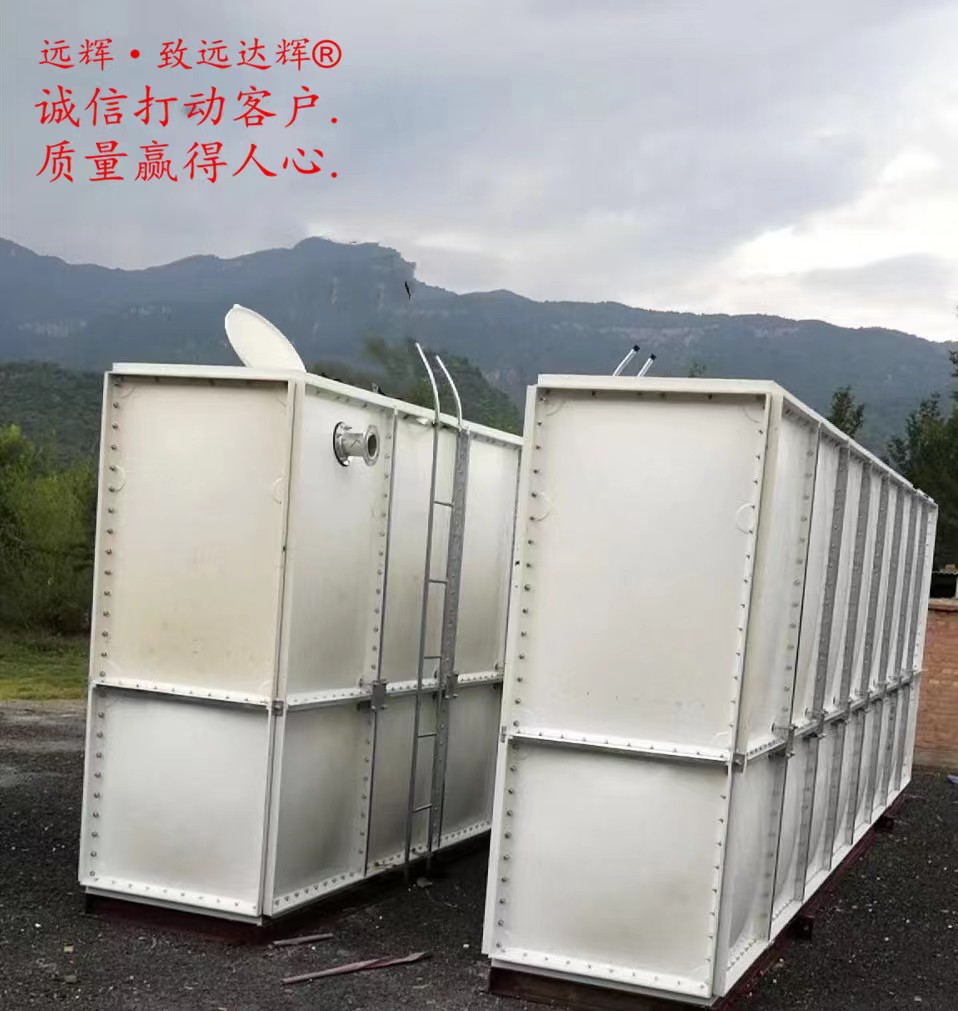
Introduction
FRP (Fiber-Reinforced Plastic) water tanks are widely used in industrial and civil water supply and drainage systems due to their light weight, high strength, corrosion resistance, and service life exceeding 30 years. In 2023, China's FRP tank production exceeded 1.2 million cubic meters, with SMC compression molding accounting for approximately 65% of output. This article uses the production line of Beijing Yuanhui FRP Co., Ltd. as a reference to break down key process steps from raw materials to finished products.
1. Raw Material Selection and Pretreatment
1.1 Resin System
Iso-phthalic unsaturated polyester resin is the primary choice for water tanks due to its superior water resistance (water absorption ≤ 0.3%) compared to ortho-phthalic types. Beijing Yuanhui uses vinyl ester resin for export projects, achieving temperature resistance above 80°C. The curing agent is MEKP (1.5-2.0% by weight), with cobalt naphthenate as accelerator (0.3-0.5%).
1.2 Reinforcement Configuration
Standard panels use a composite structure of chopped strand mat (450 g/m²) and E-glass fabric (0.4 mm thickness), achieving interlayer shear strength of 12-15 MPa. SMC sheet material uses 24tex roving with a cut length of 25 mm and fiber content of 28-32%.
2. Mold Preparation and Release Agent Application
Compression molds are made of 45# steel with chromium plating (Ra ≤ 0.4 μm). Hand lay-up molds are FRP-based, requiring repolishing after 80-120 cycles. A semi-permanent wax + PVAL composite release agent is sprayed and cured at 60°C for 15 minutes to form a continuous film. In 2023, a Beijing Yuanhui project experienced mold temperature fluctuations of ±5°C, causing release defects. After installing a temperature control system with ±1°C tolerance, the reject rate dropped from 7.2% to 1.1%.
3. Core Molding Processes
3.1 SMC Compression Molding (70% of production lines)
SMC sheets are maturated at 40°C for 24 hours, cut with 5% shrinkage allowance, and stacked in the mold. Parameters: clamping pressure 15-20 MPa, mold temperature 145±3°C, hold time 4 minutes per 3 mm thickness. Data from Beijing Yuanhui's 100,000 m³/year line shows flexural strength ≥180 MPa and Barcol hardness ≥45.
3.2 Hand Lay-up / Spray-up (custom shapes & repairs)
Hand lay-up uses a layered approach: a gel coat (0.3-0.5 mm), followed by surface veil, then alternating mat and fabric layers, each rolled to reduce air bubbles below 2%. A 2024 field case: spray-up repair of a Beijing hospital tank using 0.4-0.6 MPa resin pressure and 2.5 kg/min fiber cutting speed achieved 92% design strength after 24-hour cure.
4. Curing, Post-Processing, and Quality Control
Compression-molded parts undergo post-curing at 70°C for 4 hours to relieve internal stress. Hand-laid parts cure at 25°C and ≤65% humidity for 24 hours, followed by 2 hours at 60°C. QC tests include:
- Barcol hardness (3 samples per batch, min. 40)
- Hydrostatic test (1.5x working pressure, 30 min no leakage)
- Thickness gauge (deviation ≤ ±0.3 mm)
Conclusion
The stability of FRP tank production directly impacts product lifespan and safety. From resin selection to mold temperature control, every parameter matters. While automated compression molding is replacing hand lay-up in volume production, custom shapes still rely on craftsmanship. Regular equipment calibration, raw material batch tracking, and adoption of low-styrene emission resins are recommended industry best practices.