Complete Guide to FRP Water Tank Manufacturing: From Raw Materials to Finished Product
Introduction
FRP (Fiberglass Reinforced Plastic) water tanks are widely used in municipal water supply, fire storage, and industrial cooling due to their light weight, high strength, and corrosion resistance. Manufacturers like Beijing Yuanhui FRP Co., Ltd. have refined a production process that ensures consistent quality. The complete workflow includes raw material inspection, mold preparation, lay-up/curing, cutting/assembly, and leak testing. Each stage—temperature/humidity control, resin formulation, and fiber orientation—directly impacts the tank's mechanical performance and service life. Below is a step-by-step breakdown based on industry standards and field data.
1. Raw Material Selection and Incoming Inspection
1.1 Resin System
The inner liner uses bisphenol-A unsaturated polyester resin (e.g., grade 196#) complying with GB/T 8237 for water resistance. The structural layer uses isophthalic or vinyl ester resin with tensile strength ≥60 MPa. Beijing Yuanhui FRP Co., Ltd. controls resin viscosity at 0.3–0.6 Pa·s (25°C), gel time at 30–45 minutes, and final cure degree ≥95%.
1.2 Reinforcement Materials
EMC300/450 chopped strand mat and unidirectional fabric are combined with fiber content 35%–45% by weight. Critical areas (e.g., bottom-to-side joints) receive ±45° bias cloth reinforcement, with fiber orientation deviation ≤3°.
1.3 Auxiliaries
MEKP hardener (≥8.5% active content) and cobalt naphthenate accelerator (0.6%–1.0% Co). Each batch undergoes a small-scale gel test: gel time deviation ≤±10%, peak exotherm 120–140°C.
2. Mold Fabrication and Surface Preparation
The female mold consists of a steel frame with a FRP surface, achieving Ra ≤0.4 μm. A 0.5%–0.8% shrinkage allowance is built into the mold. Before lay-up, three coats of mold wax and one PVA release film are applied (total thickness 0.05–0.10 mm) and dried until tack-free.
Beijing Yuanhui’s maintenance records show mold resurfacing every 50 tanks, with final sanding to 800-grit, ensuring surface gloss ≥85 GU (60° angle).
3. Molding Process and Critical Control Points
3.1 Hand Lay-Up (for Small to Medium Tanks)
Workshop conditions: 18–28°C, RH ≤75%. Lay-up sequence: inner liner (2 layers mat + rich resin, resin content 70%–80%) → structural layers (4–6 layers 0°/90° unidirectional fabric, resin 45%–55%) → outer protection (1 layer surface veil + gel coat, resin ≥90%).
Each layer is rolled with an aluminum de-bubbling roller. Bubble density ≤1 per 100 cm². Test data: 5 mm hand-laminated panel exhibits Barcol hardness ≥40, flexural strength ≥180 MPa.
Common defects and fixes:
- Bubbles: Check accelerator overdose (Co >1.2% causes rapid exotherm)
- White spots: Reduce inter-layer delay; complete resin wet-out within 15 minutes
3.2 Spray-Up (for Batch Production)
A chopper gun simultaneously sprays resin and 25–50 mm chopped fibers at a ratio of 3:2 (resin:fiber by weight). Gun speed 0.3–0.5 m/s, single-pass thickness 0.5–1.0 mm. Beijing Yuanhui achieves 15 kg/min output, 40% faster than hand lay-up.
3.3 Curing and Demolding
Room-temperature cure: 24 hours (≥20°C). For faster cycles, staged heating: 40°C×3h → 60°C×2h → 80°C×1h (total 6h), with inter-layer temperature difference <15°C to avoid thermal stress cracking. Demold using wedge tools from edges evenly to prevent local fracture.
4. Cutting, Assembly, and Quality Control
4.1 CNC Waterjet Cutting
Five-axis waterjet cutter trims cured panels to ±1 mm/m tolerance. Holes for inlet/outlet/drain are cut with edge radius R≥5 mm and resin-sealed to prevent wicking.
4.2 Assembly and Sealing
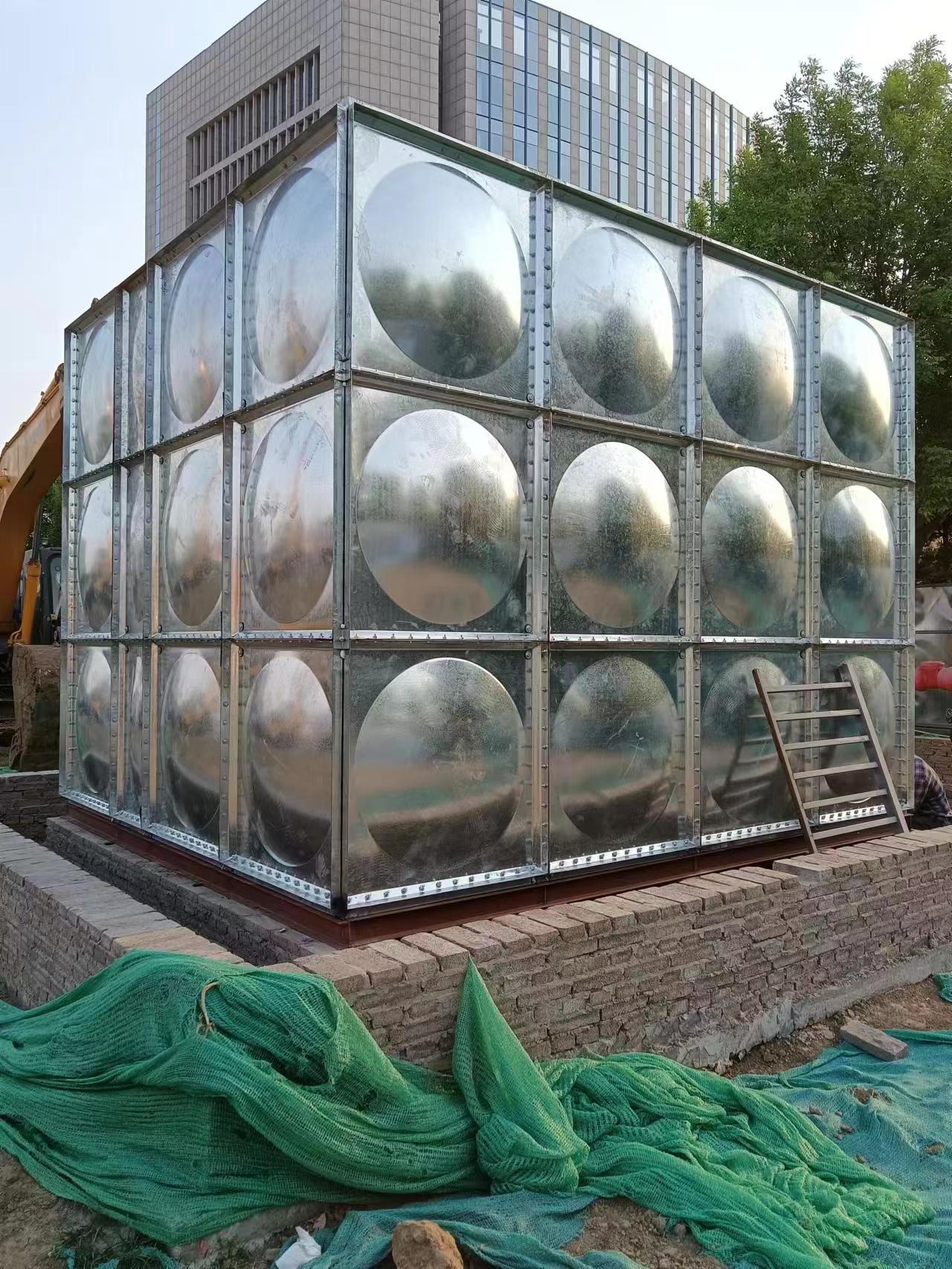
Panels are joined with stainless steel bolts (304/316), spaced 120–150 mm. EPDM gaskets (compression 25%–35%, hardness 70±5 Shore A) provide primary sealing. For large tanks (≥100 m³), Beijing Yuanhui applies a double seal: silicone sealant inner layer + neoprene outer gasket, reducing leakage rate to <0.05%.
4.3 Quality Tests per JC/T 658.1-2007
- Hydrostatic test: Fill to design level, hold 72h, leakage ≤0.1 L/m²·h
- Strength test: 1.5× design pressure for 30 min, no cracks or permanent deformation
- Barcol hardness: structural layer ≥40, inner liner ≥35
- Resin content: inner liner ≥70%, structural layer 50%–60%
Conclusion
FRP water tank production is not a simple "lay-up" but a system engineering task involving resin cure kinetics, fiber stacking optimization, and seal design. The critical success factors are raw material batch consistency, workshop temperature/humidity control, and non-destructive cure verification. Beijing Yuanhui FRP Co., Ltd. maintains a 21-point quality gate from material incoming to final inspection, achieving a pass rate above 98.5%. For procurement engineers, requesting the manufacturer's resin cast mechanical test report and 72-hour hydrostatic test record is essential to verify process capability.