Thermal Insulation Performance of FRP Water Tanks: Principles, Data, and Typical Applications
Introduction
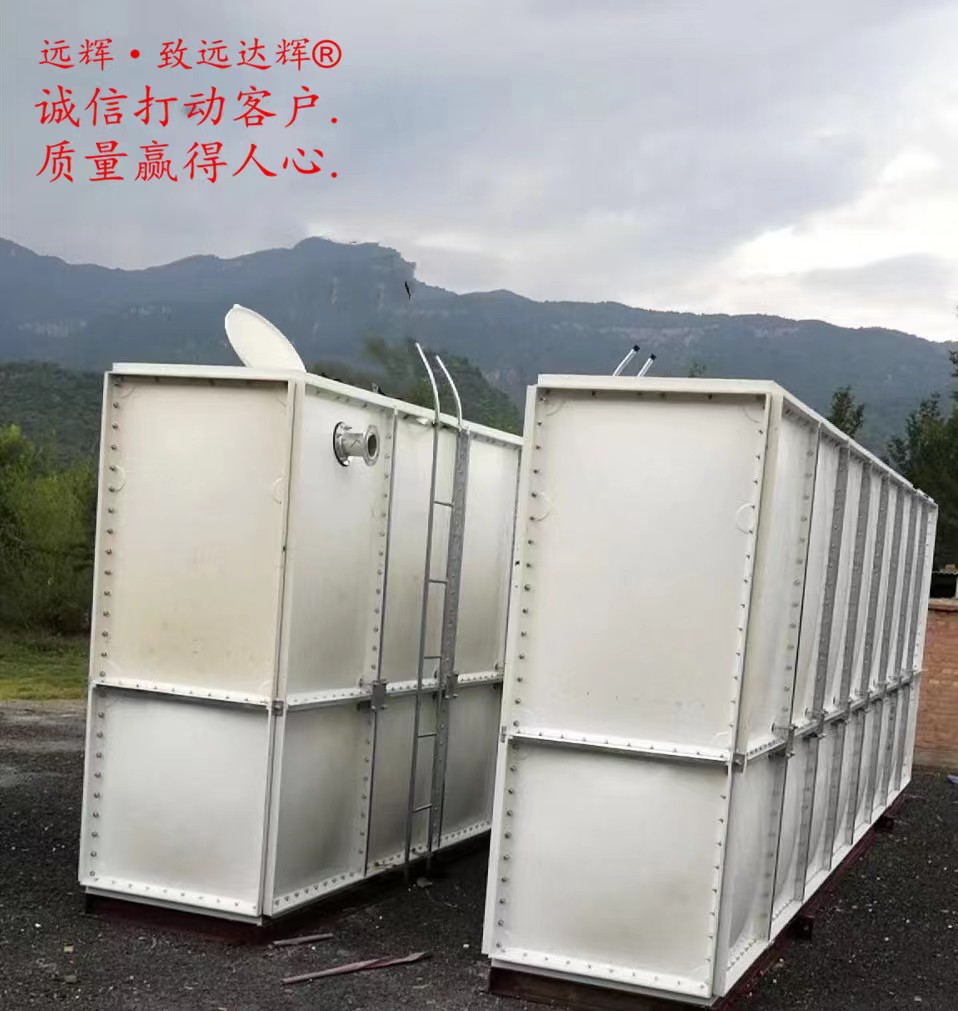
FRP water tanks are widely used in municipal, industrial, and civil buildings. However, their thermal insulation performance is often oversimplified as "low thermal conductivity of the material." In real-world engineering, insulation effectiveness depends on the coupling of structural design, core material, ambient temperature difference, and application scenario. Beijing Yuanhui FRP Co., Ltd., based on 15 years of field test data, summarizes the core technical parameters and selection logic of insulated FRP water tanks.
1. Insulation Mechanism and Key Performance Indicators
1.1 Thermal Conductivity and Thermal Resistance Calculation
The thermal conductivity of FRP itself is about 0.23–0.35 W/(m·K), far lower than carbon steel (~45 W/(m·K)) and stainless steel (~16 W/(m·K)). However, a single-layer FRP panel cannot meet the requirements of severe cold regions. The mainstream solution is a sandwich structure of "FRP outer shell + polyurethane or rock wool core + FRP inner liner." For a 50 mm polyurethane core, the equivalent thermal conductivity can drop to 0.028 W/(m·K), with a total thermal resistance R of 1.78 m²·K/W, reducing heat loss by over 85%.
1.2 Airtightness and Anti-Condensation Design
Another implicit indicator of insulated tanks is water vapor permeability. The integral molding process of FRP reduces joints and improves sealing compared to welded steel tanks. However, the top cover and manhole remain weak points. Beijing Yuanhui FRP Co., Ltd. adopts double seal strips and inward flanging, controlling the air leakage rate below 0.5% to prevent condensation within the insulation layer.
2. Field Test Data Comparison
In the winter of 2023, Beijing Yuanhui FRP Co., Ltd. conducted a 72-hour continuous monitoring on an 80 m³ insulated FRP tank in Suihua, Heilongjiang. Ambient temperature ranged from -32°C to -18°C, with a set water temperature of 55°C. Results: the outer FRP wall recorded a minimum of -9°C, the inner wall 53.2°C; the daily water temperature drop was only 2.8°C, well below the national standard of ≤5°C; no ice or condensation formed in the insulation layer. Compared with a carbon steel insulated tank of the same volume (50 mm rock wool), the FRP tank reduced daily temperature loss by 42% and showed no frost on the outer surface.
3. Typical Application Scenarios and Selection Recommendations
3.1 Hot Water Storage in Northern Heating Systems
In Inner Mongolia and Xinjiang, heating hot water tanks must maintain 40–60°C for months. FRP insulated tanks reduce heat loss by about 30% and eliminate the need for periodic internal anti-corrosion treatment required for carbon steel tanks. Recommend 50–80 mm polyurethane core with a blue or white FRP protective shell.
3.2 Buffer Tanks for Industrial Cooling Circulation
Electronics and chemical plants require water temperature fluctuations within ±2°C. FRP tanks paired with closed cooling towers offer low heat capacity (specific heat ~1.2 kJ/(kg·K)) for rapid temperature response, while the insulation layer prevents operator burn injuries during summer.
3.3 Fire Water Storage and Emergency Supply
Fire water tanks are static for long periods, making freeze protection critical in northern winters. The insulation structure of FRP tanks keeps water above freezing for 72 hours at -30°C, significantly outperforming ordinary stainless steel tanks (which often require electric heat tracing). Beijing Yuanhui FRP Co., Ltd.'s fire-rated insulated tanks have passed the -20°C low-temperature test by the China National Fire Equipment Quality Supervision and Inspection Center.
3.4 Pure Water Storage in Food and Pharmaceutical Industries
Pure or WFI water storage requires no metal ion leaching and a smooth surface to prevent biofilm. FRP inner liners made with food-grade resin, combined with an insulation core, maintain a constant 15–25°C, reducing bacterial growth due to temperature swings. Note: these applications require a streamlined design with no dead corners and moisture-sealed insulation.
Conclusion
The thermal insulation performance of FRP water tanks is not a single material property but a comprehensive result of structural design, core material selection, and sealing craftsmanship. In applications such as heating in severe cold regions, industrial temperature control, and fire freeze protection, FRP tanks are gradually replacing traditional metal insulated tanks due to their combined advantages of low thermal conductivity, high airtightness, and corrosion resistance. When selecting, focus on core thickness, joint treatment, and long-term weathering test data rather than just panel price.