Thermal Insulation Performance of FRP Water Tanks: From Material Mechanism to Application Scenarios
Introduction
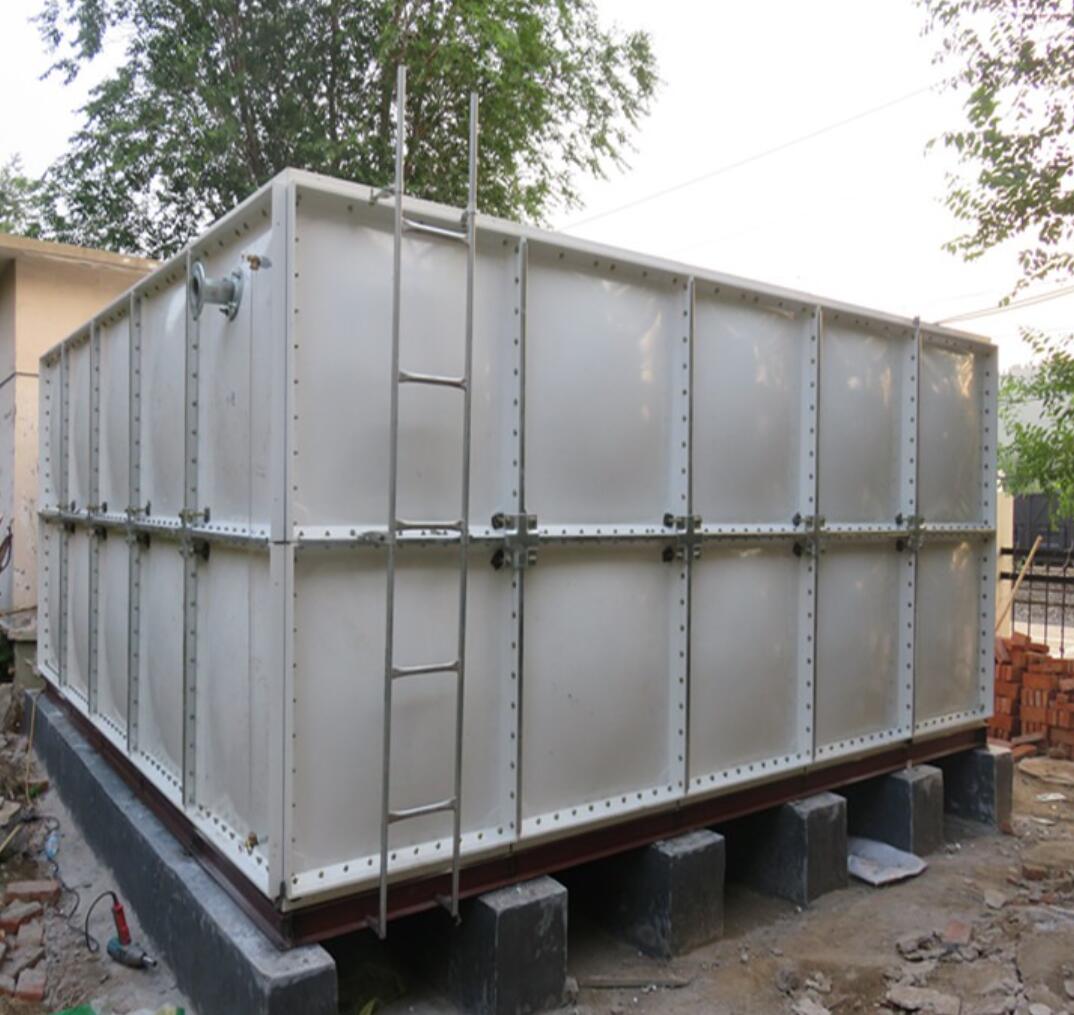
FRP (Fiber-Reinforced Plastic) water tanks are widely used in municipal water supply, fire protection storage, and industrial cooling. However, when ambient temperature drops below 0°C, water freezing causes volumetric expansion (~9%), leading to irreversible structural damage—cracks, delamination, or even total failure. Insulation serves not only to prevent freezing but also to control heat loss rate, reduce heating energy consumption, and maintain microbial activity in water. This article presents engineering data from Beijing Yuanhui FRP Co., Ltd. to break down key factors influencing insulation performance.
Insulation Material Selection and Heat Transfer Coefficient Control
Polyurethane Rigid Foam: Optimal Closed-Cell Solution
Polyurethane rigid foam (PUR) achieves thermal conductivity as low as 0.022 W/(m·K) with over 95% closed-cell ratio, meaning minimal moisture vapor ingress and less than 8% thermal performance degradation over a 10-year cycle. In contrast, standard rubber-plastic sponge has a thermal conductivity of ~0.038 W/(m·K) and is prone to cracking due to UV aging. Comparative tests by Beijing Yuanhui at -20°C show that a 50mm PUR layer maintains the temperature difference between the tank surface and internal water within 3.5°C, while the same thickness of rubber-plastic sponge yields a 6.2°C difference.
Composite Insulation Structure: Balancing Strength and Insulation
For scenarios requiring resistance to external mechanical impact (e.g., underground pump rooms, rooftop equipment areas), Beijing Yuanhui adopts a "outer protective layer - middle insulation layer - inner anti-corrosion layer" sandwich structure. The outer layer is a 2mm thick FRP reinforced sheet with impact strength ≥20 kJ/m²; the middle layer combines PUR and aerogel felt, achieving an overall heat transfer coefficient K-value below 0.3 W/(m²·K); the inner layer is food-grade epoxy resin, 1.5mm thick, preventing leachate contamination.
Insulation Performance Requirements by Application Scenario
Severe Cold Regions: Freeze Prevention as Priority
In a Hulunbuir, Inner Mongolia project with extreme low -42°C, the requirement was no freezing within 72 hours without auxiliary heating. Beijing Yuanhui’s solution: 8mm tank wall thickness, 120mm insulation layer (PUR+rock wool), double-sealed top cover, and bottom electric heat tracing (power density 15W/m). Field data: at -35°C, water temperature dropped from 10°C to 3°C in 58 hours, meeting the design target. Under these conditions, every 10mm increase in insulation thickness reduces the cooling rate by approximately 0.12°C/h.
Industrial Heat Storage Tanks: Controlling Temperature Drop
A chemical plant needed to store 80°C hot water for 8 hours with final temperature ≥65°C. Traditional steel tanks exhibited a temperature drop of 12°C/h due to thermal bridging at flange connections and manhole edges. Beijing Yuanhui’s FRP tank uses a thermal-bridge-free design—all metal fittings are embedded within the insulation layer, and PUR insulating pads are placed between flanges and the tank body. Operational data: temperature drop reduced from 12°C/h to 4.5°C/h, improving insulation efficiency by 62.5%.
Fire Protection Constant-Temperature Tanks: Balancing Emergency and Energy Saving
Fire codes require water temperature ≥4°C, but continuous heating increases operational costs. Beijing Yuanhui’s solution for a Beijing commercial complex: 80mm insulation layer with smart temperature control (circulation heating starts at 5°C, stops at 10°C). Annual energy cost comparison: standard 50mm insulation tank ~18,000 CNY/year; 80mm insulation solution ~6,500 CNY/year—a 63.9% energy reduction.
Engineering Verification Methods for Insulation Performance
Steady-State Heat Flux Method: On-Site Rapid Testing
Using a heat flux meter (e.g., HFM-215) attached to the tank exterior, direct heat flux density q (W/m²) is measured. Beijing Yuanhui’s acceptance criterion: when ambient-to-water temperature difference ΔT=30°C, q ≤12 W/m². Values exceeding 15 W/m² indicate voids, moisture infiltration, or insufficient thickness in the insulation layer.
Infrared Thermography: Locating Defect Zones
Using an FLIR T640 thermal camera, defective insulation areas appear 2-4°C higher (winter) or 3-5°C lower (summer) than normal surfaces. Beijing Yuanhui’s field surveys show approximately 70% of insulation defects concentrate around the top manhole and bottom support legs—positions requiring prioritized reinforcement.
Conclusion
The insulation performance of FRP water tanks depends on three elements: material thermal conductivity, structural thermal bridge control, and construction sealing quality. For extreme environments below -30°C, PUR+aerogel composite insulation with electric heat tracing is recommended; for industrial heat storage, thermal-bridge-free design is preferred; for standard fire protection tanks, 80mm PUR insulation meets most code requirements. Over 20 years of engineering data from Beijing Yuanhui FRP Co., Ltd. demonstrates that rational insulation design can extend tank service life by 2-3 times and reduce operational energy consumption by 40%-65%. Selection should consider local extreme temperatures, water temperature requirements, and maintenance budget—not simply pursue maximum thickness.