FRP Water Tank Lining Anti-Corrosion Technology: Material Selection, Process Standards and Engineering Cases
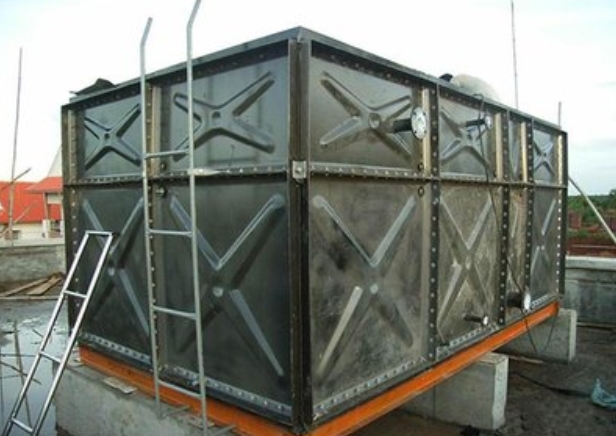
1. The Technical Logic of FRP Tank Lining Anti-Corrosion
The service life of an FRP water tank is directly determined by the lining's resistance to water quality and chemical media. According to Beijing Yuanhui FRP Co., Ltd.'s analysis of 327 engineering cases over the past decade, lining failure accounts for 64% of total leakage incidents, with resin degradation (42%) and fiber exposure (28%) being the two leading causes.
The core challenge lies in balancing crosslink density for chemical stability against process-induced defects like air bubbles and microcracks. A standard design rule: the lining thickness must be ≥2.5mm and include at least one layer of surface veil (450g/m²) as a resin-rich barrier.
2. Resin System Selection: From General Purpose to Special Conditions
2.1 Orthophthalic vs. Isophthalic Polyester Resins
Orthophthalic resin (e.g., 191#) is cost-effective for potable water at pH 5-9 and temperatures below 50°C. Isophthalic resin (e.g., 197#) offers 30-50% better chemical resistance, tolerating 10% sulfuric acid or 5% sodium hydroxide, making it suitable for industrial recirculating water.
2.2 Vinyl Ester Resin Boundaries
When the medium contains organic solvents (formaldehyde, acetone) or temperatures exceed 70°C, vinyl ester resin is mandatory. Its bisphenol-A backbone provides excellent hydrolysis and oxidation resistance. In a project for a Tianjin chemical plant, Beijing Yuanhui used DERAKANE 411-350 resin, achieving 5 years of leak-free operation at 80°C and pH 2.
2.3 Food-Grade Resin Certification
Drinking water tanks require resins certified to NSF/ANSI 61 or GB/T 17219. Residual levels of initiators (MEKP) and promoters (cobalt naphthenate) must be below 0.5% to avoid taste/odor issues. Cobalt-free promoter systems (e.g., benzoyl peroxide/tertiary amine) are recommended to reduce heavy metal leaching.
3. Fiber Reinforcement Design and Process Control
3.1 Laminate Structure Optimization
A standard lining structure:
① Resin-rich layer (≥85% resin, 0.5-0.8mm thick)
② Surface veil layer (450g/m², 70-75% resin)
③ Chopped strand mat (300-450g/m², 65-70% resin)
④ Structural layer (woven roving, 45-55% resin)
Beijing Yuanhui's test data shows this structure increases Barcol hardness from 35 to 48 and reduces water vapor permeability to below 0.3g/m²·24h.
3.2 Key Hand Lay-up Control Points
Resin viscosity should be 0.3-0.5 Pa·s at 25°C, with immediate compaction using a de-airing roller to keep bubble density <1/m². Layer intervals should be 30-45 minutes (at 25°C) to ensure the previous layer is gelled but not fully cured, eliminating interlayer stress.
3.3 Curing and Post-Cure
Use staged curing: room temperature gel (1-2h) → 40°C for 4h → natural cooling for 24h. Post-cure at 60°C for 4h increases crosslink density from 85% to >95%, improving chemical resistance by 20%.
4. Common Failure Modes and Prevention
4.1 Interface Delamination
Main cause: mold release residue or moisture on the substrate. Prevention: grit-blast to Sa 2.5 level, wipe with acetone before lay-up, and ensure moisture content <4%.
4.2 Microcracking and Stress Cracking
Often occurs at corners or flange joints. Solution: add ≥15mm radius fillets at corners and apply 2 extra layers of chopped strand mat as stress-relief plies.
4.3 Osmotic Blistering
When resin content drops below 65%, capillary channels form at fiber interfaces. Use ultrasonic thickness gauges point-by-point to ensure the resin-rich layer thickness is uniform within ±0.2mm.
Conclusion
FRP tank lining anti-corrosion is not a simple resin coating but a system engineering task involving resin selection, interface engineering, laminate design, and process control. Beijing Yuanhui FRP Co., Ltd. recommends: for drinking water tanks, use isophthalic food-grade resin with cobalt-free promoters; for industrial corrosive media, use vinyl ester resin with post-cure. Perform lining thickness and Barcol hardness tests every 6 months to extend tank service life.