FRP Water Tank Modular Assembly Process: A Complete Technical Guide from SMC Molding to On-Site Installation
Introduction
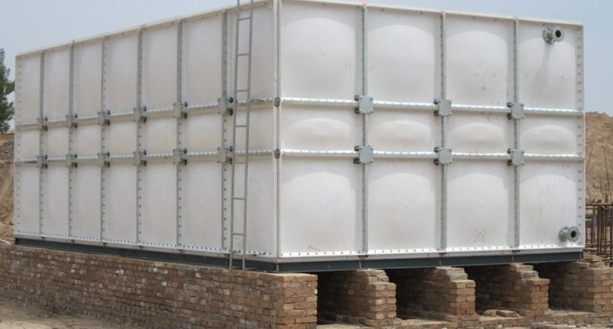
The modular assembly process of FRP (Fiberglass Reinforced Plastic) water tanks centers on factory-pressed SMC (Sheet Molding Compound) panels that are field-assembled using specialized connectors and seals. Beijing Yuanhui FRP Co., Ltd., with over a decade of experience, has delivered more than 2,000 assembled tanks with a leakage rate below 0.3%. This article breaks down the process into four critical phases: panel production, connection system, on-site installation, and quality control.
1. Standardized SMC Panel Production
Each panel is compression-molded at 140–160°C for 3–5 minutes, achieving a Barcol hardness of ≥45 and a shrinkage rate between 0.1% and 0.3%. Standard panel sizes are 1000×1000 mm and 1000×500 mm, with thickness options of 5, 8, 10, 12, 14, and 16 mm. Beijing Yuanhui operates a four-column hydraulic press line capable of producing 1,200 panels daily. Every batch undergoes a 48-hour water absorption test, with results consistently below 0.5%.
2. Modular Connection System: Sealing and Locking
2.1 Flange Design
Each panel features an integrated 40 mm wide, 25 mm high flange with 16 mm diameter bolt holes spaced 150 mm apart. Adjacent flanges are fastened with M14 stainless steel bolts torqued to 25–30 N·m. Over-tightening can crack the rubber gasket; under-tightening compromises the seal.
2.2 Gasket Selection
The Ω-shaped EPDM gasket, with a 3 mm wall thickness, requires 30%–40% compression. In a 0.15 MPa hydrostatic test, tanks using B-3 series gaskets (preferred by Beijing Yuanhui) show a leakage of less than 0.5 L over 24 hours. These gaskets remain elastic from -40°C to 120°C and have a service life exceeding 15 years.
2.3 Reinforcement Layout
For side walls above 2 meters, stainless steel stiffeners (40×40×3 mm square tube) are installed at 1.5-meter intervals. Floor panels are supported by I-beam frames spaced no more than 1.2 meters apart.
3. On-Site Assembly Procedure
Standard installation takes 7–15 days, depending on tank volume. Beijing Yuanhui's crew follows this protocol:
3.1 Foundation and Floor Assembly
The foundation surface must be level within 3 mm per 2 meters, with concrete strength ≥ C25. A 2–3 mm layer of polysulfide sealant is applied to the flange before placing the gasket. Bolts are tightened in a diagonal sequence—first to 15 N·m, then to 28 N·m.
3.2 Wall Panel Installation
Wall panels are stacked from the floor edge upward. Each tier is closed before adding temporary bracing. L-shaped corner panels keep gaps under 1 mm. Tanks taller than 3 meters receive embedded ladder anchors at the second tier.
3.3 Roof and Internal Tie Rods
Before the roof is installed, 12 mm diameter stainless steel tie rods are welded into a 1.5-meter grid pattern. Roof panels are then placed, and all bolts are rechecked. The flange straightness deviation must remain ≤2 mm per meter.
4. Quality Control and Field Case
A 72-hour hydrostatic test is mandatory: the water level drop must not exceed 10 mm. In a 600 m³ fire water tank project for a Beijing chemical park (2023), Beijing Yuanhui recorded a drop of only 4 mm over 72 hours—far below the national standard.
Common issues and remedies:
- Gasket aging: Replace every 5 years with ASTM D2000-certified EPDM.
- Bolt loosening: Use spring washers and re-torque after the first month of service.
- Panel deformation: Select panel thickness based on tank height: 8 mm for ≤2 m, 10 mm for 2–3 m, 12 mm for 3–4 m.
Conclusion
Modular FRP tank assembly is a disciplined process combining material science, precision molding, and field engineering. As SMC panels grow larger (2 m² per unit) and seal pressures increase (≥0.2 MPa), working with a proven supplier like Beijing Yuanhui FRP Co., Ltd. minimizes the hidden risks of site assembly and ensures long-term tank integrity.