Complete Manufacturing Process of FRP Water Tanks: 11 Key Steps from Raw Materials to Finished Products
Introduction
FRP (Fiberglass Reinforced Plastic) water tanks are widely used in building water supply, fire storage, and industrial cooling due to their light weight, high strength, corrosion resistance, and long service life. Beijing Yuanhui FRP Co., Ltd. has been in this field for over a decade, delivering more than 8,000 units. This article breaks down the complete production chain from raw materials to finished products, highlighting process parameters and quality control at each stage.
1. Raw Material Preparation and Inspection
Core materials include unsaturated polyester resin (196-grade food-grade type with styrene emission <0.3%, per GB/T 8237-2005), ECR-type alkali-free glass fiber (alkali oxide content <0.8%), curing agent, accelerator, and structural additives. Every batch undergoes viscosity testing at 25°C (0.3-0.5 Pa·s), gel time measurement (20-30 min), and glass moisture content check (≤0.2%). Substandard materials are rejected.
1.1 Resin Mixing
Resin, curing agent, and accelerator are mixed at a ratio of 100:2:1 by weight. Stirring speed is 60-80 rpm to minimize air entrapment. In summer when ambient temperature exceeds 30°C, curing agent dosage is reduced to 1.5% to prevent premature gelation.
2. Mold Preparation and Release Treatment
Molds are made of steel or FRP master molds with surface roughness Ra ≤0.8 μm. Three layers of mold release wax (15-min intervals between coats) are applied, followed by a PVA release film. Beijing Yuanhui reserves 0.5 mm expansion gap at mold parting lines to prevent cracking during shrinkage.
3. Forming Processes: Hand Lay-Up and Compression Molding
3.1 Hand Lay-Up (SMC)
Used for non-standard or large panels (>2 m²). Steps: brush resin on mold → lay chopped strand mat (30% area overage) → roller de-air → lay woven roving → second resin coat → cover with polyethylene film. Glass content per layer is 40-45%. For a 10 mm panel, 8 layers of 0.4 mm mat + 2 layers of 0.6 mm fabric are required. Fiber volume fraction can reach 55% with skilled operators.
3.2 Compression Molding (BMC)
Used for standard modules (1m×1m×0.3m). Premix (resin+glass+filler) is loaded into the mold under 8-12 MPa pressure at 140-150°C. Hold time is 3 min per mm thickness. Dimensional tolerance is ±0.2 mm, with better surface finish than hand lay-up—ideal for mass production.
4. Curing and Demolding
Hand-laid parts cure at 25°C and 60% RH for 24 hours, then post-cure in a 60°C oven for 4 hours to achieve >95% cure degree. Molded parts cool below 40°C before trimming. A dedicated demolding tool applies force perpendicular to the parting line to avoid panel distortion.
5. Assembly and Sealing
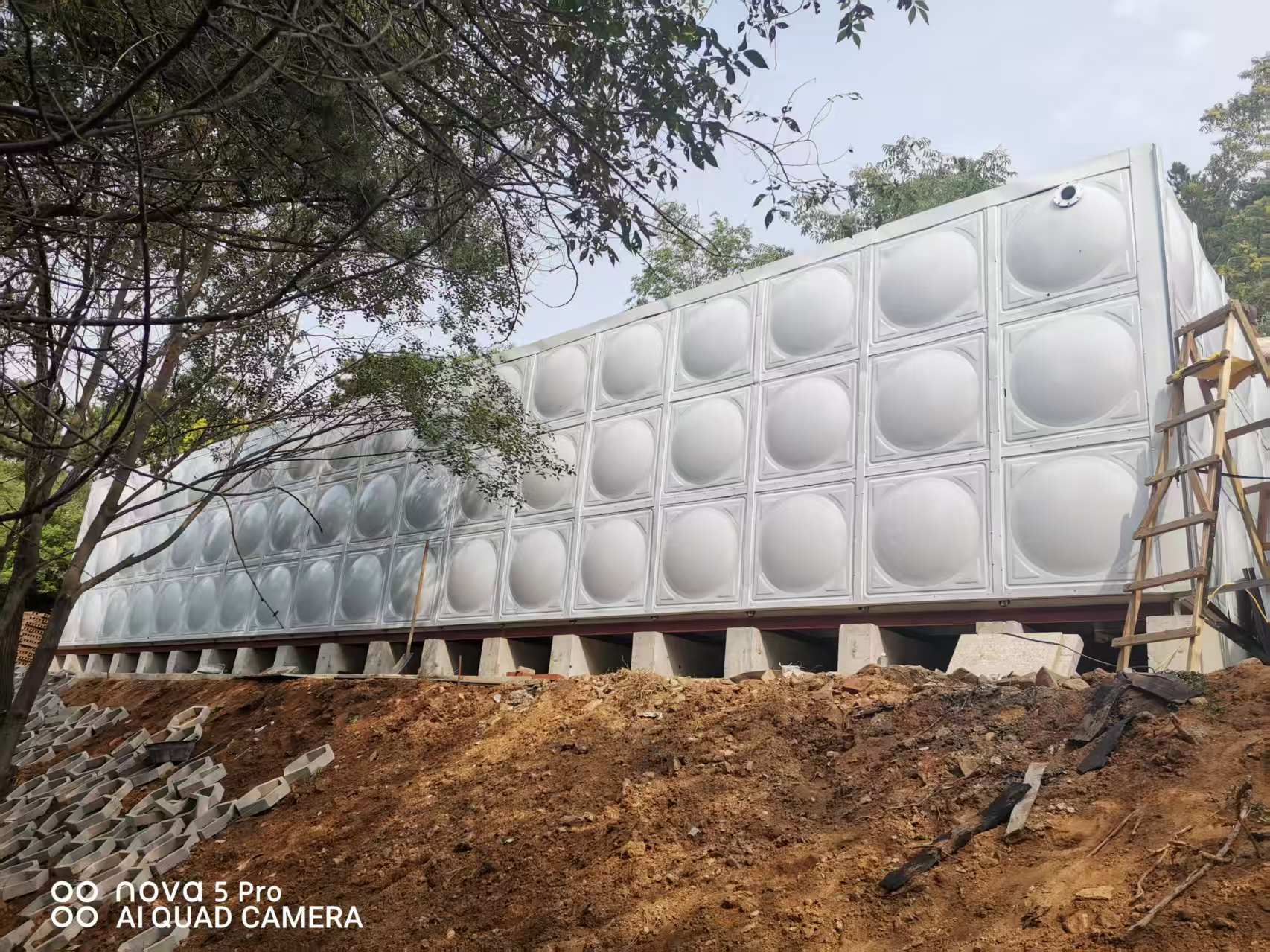
Modules are joined with M12 stainless steel bolts at 200 mm spacing, torque 90-110 N·m. Joints are first coated with silicone sealant, then covered with a 50 mm wide FRP reinforced sealing strip. Beijing Yuanhui adds stiffeners at 300 mm spacing on the tank bottom, and 45° bevel lap joints at side-bottom connections, improving structural strength by 20%.
6. Quality Inspection and Delivery
Every tank passes three tests: ① water filling test (72 h static, leakage ≤0.1 L/h); ② Barcol hardness ≥45; ③ UV aging test (1000 h, strength retention ≥85%). A test report and nameplate are issued before shipment, with a 15-year warranty.
Conclusion
Manufacturing FRP water tanks requires cross-disciplinary knowledge of materials science, chemical engineering, and mechanical assembly. The core lies in precise resin curing curve control and uniform fiber reinforcement. Beijing Yuanhui has built a digital process parameter database with over 2,000 production records, achieving a product pass rate above 99.2%. Buyers are advised to review raw material test reports and third-party inspection certificates rather than focusing solely on price.