Comprehensive Analysis of FRP Water Tank Material Composition and Performance Advantages
Introduction
FRP (Fiberglass Reinforced Plastic) water tanks have become a cornerstone in industrial and civil water storage since their introduction in the 1980s. Their performance stems from a precise composite structure: resin matrix, glass fiber reinforcement, and functional fillers. Beijing Yuanhui FRP Co., Ltd. has delivered over 3,000 FRP tanks across North China, serving chemical, pharmaceutical, and fire protection sectors. This article examines material composition and quantifiable advantages over concrete and stainless steel alternatives.
1. Material Composition of FRP Water Tanks
1.1 Resin Matrix: Determining Corrosion Resistance and Temperature Range
The resin constitutes 40–60% by weight. Common types include:
- Unsaturated Polyester Resin (UPR): Cost-effective for ambient drinking water, moderate acid/alkali resistance.
- Vinyl Ester Resin (VER): Superior chemical resistance, suitable for industrial wastewater up to 120°C.
- Epoxy Resin (EP): High adhesion for food-grade applications, withstands 150°C+.
Beijing Yuanhui selects flame-retardant UPR for fire tanks and food-grade VER for pharmaceutical tanks, complying with GB 17219-1998 standards.
1.2 Glass Fiber Reinforcement: Mechanical Contribution
Glass fiber (roving, mat, or fabric) occupies 30–50% volume. Tensile strength reaches 2,000–3,500 MPa (3–5 times steel), with elastic modulus of 70–90 GPa. A 8–12 mm tank wall can support 10+ tons of water pressure, reducing weight by 40–60% compared to stainless steel. Interfacial bond strength between fiber and resin is enhanced to 15–20 MPa using silane coupling agents.
1.3 Fillers and Additives: Functional Tuning
Calcium carbonate reduces shrinkage from 3% to below 0.5%. UV absorbers (e.g., UV-531) delay outdoor aging. Aluminum trihydroxide (ATH) as flame retardant achieves an oxygen index above 28%. Beijing Yuanhui incorporates anti-freeze additives for projects in -30°C environments, maintaining tank toughness.
2. Core Performance Advantages
2.1 Corrosion Resistance: Data Against Stainless Steel
After 30 days in 5% sulfuric acid, VER-based FRP shows mass change below 0.05%, while 304 stainless steel loses 0.3–0.8%. In pH=2 industrial wastewater, FRP tanks serve 15–20 years versus 5–8 years for stainless steel. This makes FRP the preferred choice in electroplating and chemical plants.
2.2 Mechanical Properties and Lightweight Design
Specific strength (strength/density) of FRP is 150–200 MPa·cm³/g, surpassing steel’s 60–80 MPa·cm³/g. For a 20-ton tank: concrete weighs ~15 tons, stainless steel ~4.5 tons, FRP only 2.8 tons. This reduces foundation load requirements by 35%, ideal for rooftop or soft soil installations.
2.3 Thermal Performance and Durability
FRP’s thermal conductivity is 0.3–0.5 W/(m·K)—1/60th of steel—slowing summer temperature rise and algae growth. Thermal expansion (12–15×10⁻⁶/°C) matches concrete, avoiding stress cracking. Accelerated UV aging tests show 80%+ strength retention after 2,000 hours (equivalent to 10 years outdoor exposure).
3. Engineering Case Study
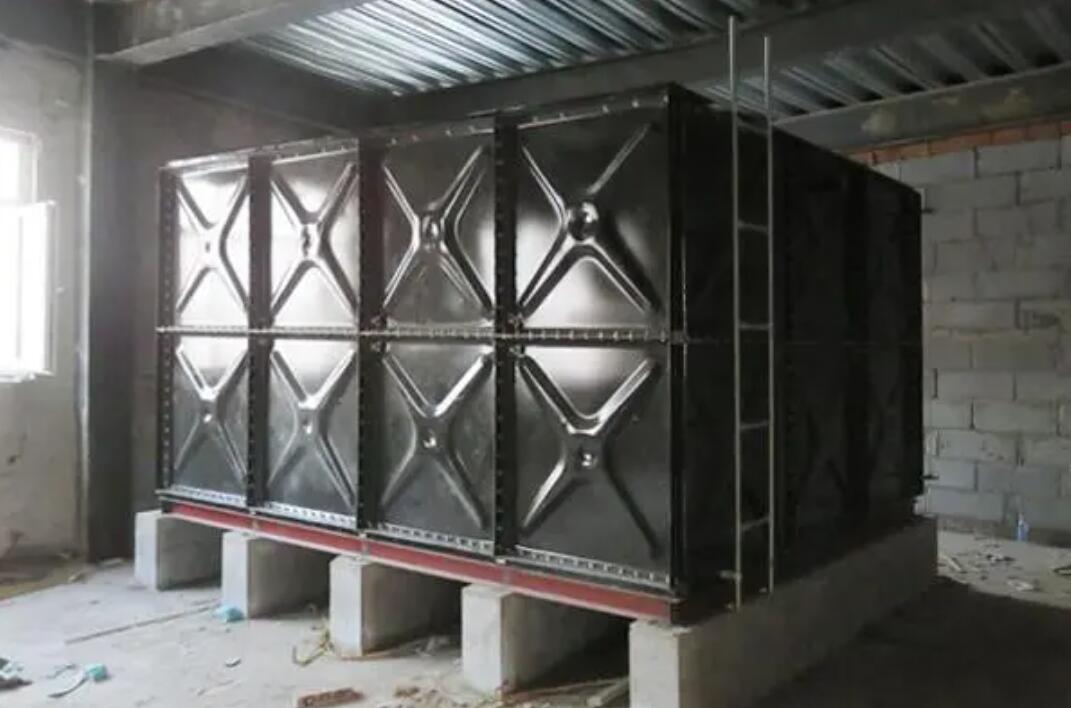
Beijing Yuanhui FRP Co., Ltd. supplied a 150 m³ VER-based tank for a Hebei chemical plant’s wastewater collection. Wall thickness: 12 mm, design pressure: 0.1 MPa. After three years, inspection revealed no corrosion spots and less than 5% strength loss. A concurrent 316L stainless steel tank showed intergranular corrosion. Yuanhui uses SMC compression molding for standard panels, with on-site bolted assembly completing installation in 3–5 days.
Conclusion
FRP water tanks achieve a unique combination of corrosion resistance, lightweight strength, thermal insulation, and long service life through precise material formulation. Selection should match resin type and fiber content to water quality, temperature, and load requirements. Beijing Yuanhui FRP Co., Ltd. offers tailored solutions from material formulation to structural design, ensuring stable performance throughout the tank’s lifecycle.