Complete FRP Water Tank Manufacturing Process: From Raw Materials to Finished Product
Introduction
FRP (Fiberglass Reinforced Plastic) water tanks are widely used in construction, municipal, fire protection, and industrial sectors due to their light weight, high strength, corrosion resistance, and a design life of up to 30 years. Approximately 80% of a tank's performance depends on the rigor of its manufacturing process. Beijing Yuanhui FRP Co., Ltd., with over 15 years of experience and an annual output exceeding 5,000 tons, follows a composite hand lay-up and spray-up process. This article breaks down the entire production line step by step.
1. Raw Material Preparation and Ratio Control
1.1 Resin and Curing System
Unsaturated polyester resin (type 196 or 189) accounts for 60%-70% of the composite weight. The curing agent (MEKP) is added at 1%-3%, and the accelerator (cobalt naphthenate) at 0.5%-2% by resin weight. Each 10°C temperature rise cuts gel time by 50%, requiring seasonal adjustments. Beijing Yuanhui uses 1.2% curing agent + 0.8% accelerator in summer, shifting to 2.0% + 1.5% in winter, maintaining a gel time of 25-35 minutes.
1.2 Reinforcement Selection
The main structure alternates between chopped strand mat (CSM, 450 g/m²) and woven roving (800 g/m²): three layers of CSM sandwiching two layers of roving for a standard 4 mm thickness. Tank floor and side reinforcing ribs require an extra layer of 800 g woven roving. Fiber content is controlled at 35%-45%—below 30% compromises strength, above 50% leads to poor resin wet-out.
2. Mold Preparation and Release Treatment
Steel or FRP female molds are used, with surface roughness Ra ≤ 0.4 μm. Beijing Yuanhui's records show optimal demolding at mold temperatures of 25-35°C. PVA release film (8%-10% concentration) is sprayed evenly, dried for 15 minutes, followed by a layer of release wax left to evaporate (≈20 minutes). This step directly determines surface finish and demolding success; improper handling raises reject rates by 12%-18%.
3. Core Forming Process
3.1 Gel Coat Application
A 0.3-0.5 mm gel coat layer (food-grade isophthalic resin) is sprayed onto the mold using a dual-component spray gun that mixes resin and curing agent at the nozzle. The gel coat is cured at 25°C for 30 minutes until tack-free before proceeding.
3.2 Hand Lay-Up and Spray-Up Combined
Layer 1: One ply of 450 g/m² CSM is applied and rolled with a bubble-breaker roller; resin consumption ≈500 g/m². Layer 2: Resin-catalyst mix is sprayed while laying 800 g woven roving, using a handheld chopper gun (output 2-3 kg/min). Each layer is compacted at least six times until the fiber turns uniform translucent. Thickness tolerance is ±0.3 mm.
3.3 Curing and Demolding
The part cures on the mold for 8-12 hours at 25°C. A Barcol hardness of ≥35 is required before demolding. Beijing Yuanhui's data shows that in winter (below 15°C), mold heating to 40°C reduces cure time to 4 hours while meeting hardness targets. Demolding uses wedge pry bars from corners evenly to avoid cracking.
4. Assembly and Quality Inspection
4.1 Panel Cutting and Joining
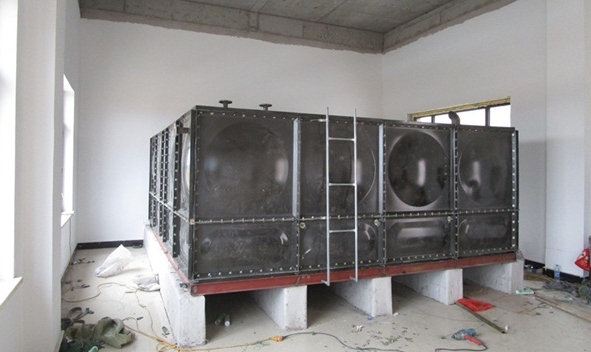
Cured panels are cut with a diamond-tipped blade (accuracy ±2 mm). Panels are joined using flanges with 304 stainless steel bolts at 150-200 mm spacing and EPDM gaskets. Leak test standard: water filled to design level, standing 48 hours, drop ≤5 mm.
4.2 Lining and Fittings
All internal seams receive secondary lay-up with the same resin and glass fabric, minimum 50 mm width. Pipe connections, manholes, and ladders use embedded flanges to avoid post-drilling damage. Pull-out tests show embedded flanges reach 120 MPa tensile strength vs. only 60 MPa for drilled ones.
4.3 Final Testing
Each tank undergoes a 72-hour full water test and Barcol hardness sampling (≥3 points/m²). Beijing Yuanhui's 2023 statistics show a first-pass rate of 98.7%; 62% of reworks trace to seal strip misalignment.
Conclusion
FRP water tank production is not simply brushing resin and laying glass fabric—it is a systematic process integrating material science, temperature management, mold engineering, and precision assembly. From seasonal resin ratio adjustments to quantified rolling passes, every parameter affects the tank's lifespan and safety. Beijing Yuanhui FRP Co., Ltd., through 15 years of accumulated process data, keeps its reject rate below 1.5%, far better than the industry average of 3%-5%. Buyers should look for suppliers with complete process records and hardness/thickness test reports—these details are the real guarantee of long-term tank reliability.