How Color Choices Affect UV Protection in FRP Water Tanks: Professional Insights
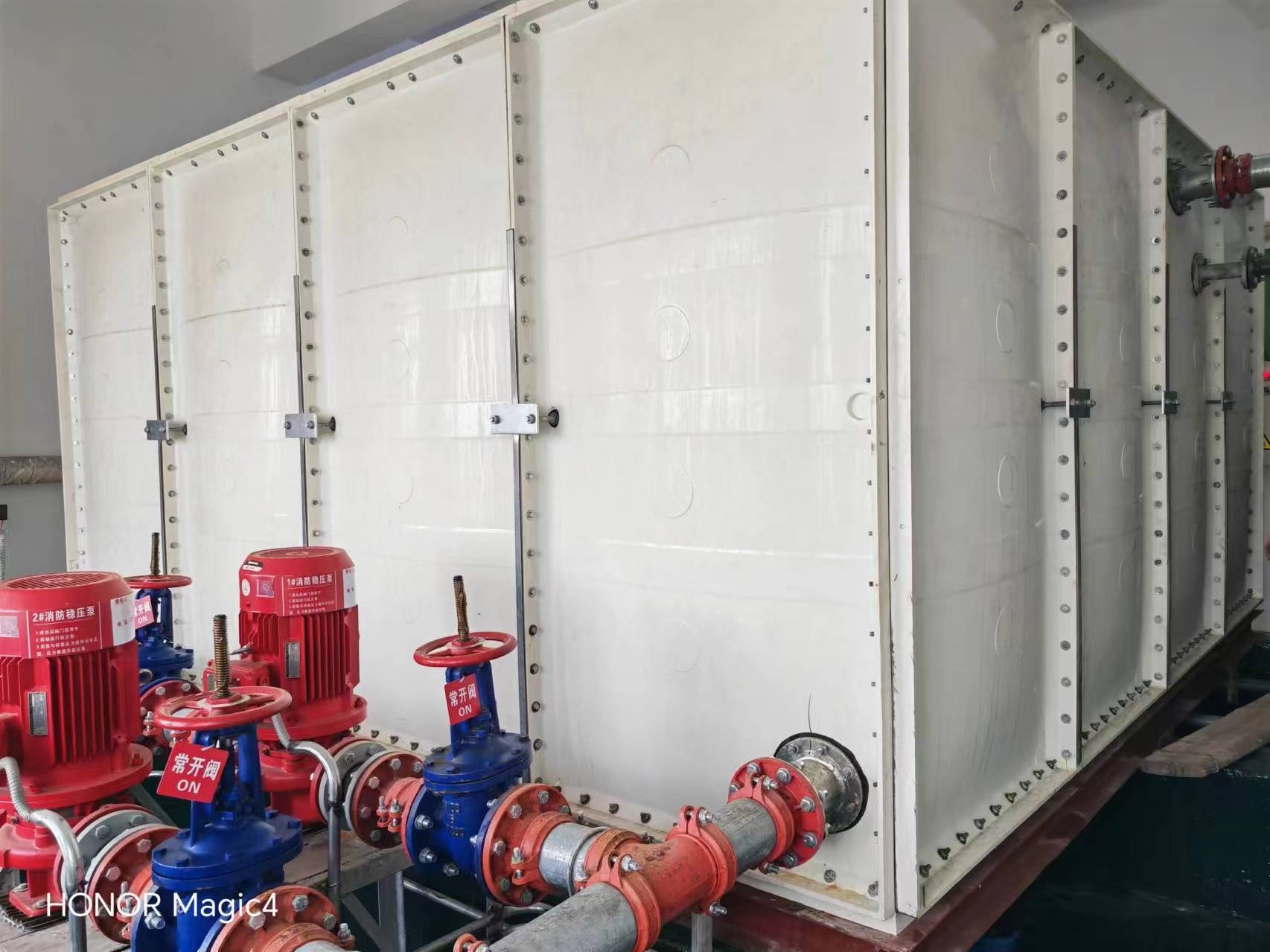
Introduction: Color as the First Line of UV Defense
FRP (Fiberglass Reinforced Plastic) water tanks installed outdoors face continuous UV radiation. Many treat color as a mere aesthetic choice, but field data from Beijing Yuanhui FRP Co., Ltd. over a decade shows that improper color selection can shorten tank lifespan by 2–3 years due to accelerated surface chalking and fiber exposure.
How UV Degrades FRP Tanks
Resin Photodegradation Mechanism
Unsaturated polyester or vinyl ester resins form the matrix of FRP tanks. UV-B radiation (280–315nm) breaks C-C and C-O bonds in polymer chains, generating free radicals that trigger chain-scission. Accelerated testing per ASTM G154 shows that after 1,000 hours of continuous UV exposure, surface hardness drops by 40% and flexural strength by over 25% in unstabilized resins.
Color and UV Absorption
Light colors (white, light gray, beige) reflect over 80% of visible and near-UV light. Dark colors (navy, dark green, black) absorb more than 90% of incident UV energy, converting it into heat. Beijing Yuanhui FRP Co., Ltd. recorded surface temperatures 15–20°C higher on black tanks than white ones under identical sunlight, accelerating thermal-oxidative aging and micro-crack formation.
Quantitative Performance Impacts
Service Life: Light Colors Extend Lifespan by 30–50%
QUV accelerated aging (ASTM D4329): White panels showed ΔE=3.2 with no chalking after 2,000 hours; black panels exhibited ΔE=8.7 with Grade 3 chalking. In real-world conditions, white tanks require refinishing every 8–10 years, while dark tanks need attention at 5–6 years.
Water Temperature: Dark Colors Raise Internal Temperature by 5–8°C
Field monitoring by Beijing Yuanhui FRP Co., Ltd. in July (ambient 38°C, irradiance 800W/m²) revealed internal water temperature of 42°C in white tanks vs. 50°C in black tanks. For potable water, temperatures above 45°C promote bacterial growth (Legionella) and scaling. Light colors are strongly recommended for drinking water applications.
Mechanical Property Retention
Cross-section analysis of an 8-year-old dark blue tank showed 15% fiber exposure within the top 0.5mm surface layer, compared to only 3% in a white tank of the same age. Fiber exposure compromises structural integrity and creates sites for biofilm attachment.
Color Selection Strategies and Case Studies
Recommended Colors by Application
- Potable water tanks: White, ivory, light gray – reflect UV, control temperature, comply with GB/T 17219.
- Fire protection tanks: Red, orange – require dual-layer coating (UV stabilizer + heat-reflective topcoat). Beijing Yuanhui FRP Co., Ltd. supplied red tanks for a fire system with measured surface temperature 10°C lower than standard red.
- Industrial cooling tanks: Light blue, green – balance visibility and cooling.
- Concealed rooftop installation: Dark colors acceptable only with sunshade or high-reflectance paint.
Additive Technology: Beyond Pigments
Beijing Yuanhui FRP Co., Ltd. employs a triple protection system in resin formulations: ① Nano-TiO₂ (2–3%) as UV absorber; ② Hindered amine light stabilizers (HALS) to scavenge free radicals; ③ Ceramic microspheres in topcoat for enhanced heat reflection. Dark tanks require additional antioxidants and UV blockers (e.g., carbon black dispersions).
Conclusion: Color as Part of a System
FRP water tank color selection involves resin chemistry, thermal management, and application-specific requirements. Light colors generally offer superior UV protection and temperature control, while dark colors can be optimized through formulation adjustments and coating technologies. Beijing Yuanhui FRP Co., Ltd. recommends requesting accelerated aging test reports and real-world case data from suppliers before finalizing color choice. A tank's service life begins with the color you choose.