Complete Production Process of FRP Water Tanks: 12 Key Steps from Raw Materials to Finished Products
Introduction
The FRP water tank industry demands precision at every stage—from resin selection to final assembly. This article, based on the technical practice of Beijing Yuanhui FRP Co., Ltd., breaks down the 12 critical steps in manufacturing FRP water tanks, with quantitative parameters and real-case data to guide engineers and procurement specialists.
1. Raw Material Preparation and Ratio Control
1.1 Resin System
For potable water tanks, food-grade unsaturated polyester resin (orthophthalic or isophthalic) must comply with GB/T 17219. For structural layers, general-purpose resin is acceptable. In a fire-fighting tank project, Beijing Yuanhui used vinyl ester resin to withstand temperatures above 80°C.
1.2 Glass Fiber and Additives
E-glass fiber roving (ECT-2400tex) is used with a weight fraction of 30%-35%. Fiber orientation is alternated at 90° for balanced strength. Curing agent (MEKP) is dosed at 1%-2% by resin weight, and cobalt naphthenate accelerator at 0.5%-1%. Workshop conditions: 25±2°C, relative humidity ≤70%.
2. Mold Preparation and Release Agent
2.1 Mold Accuracy
Steel or FRP molds require surface roughness ≤Ra3.2μm and seam gaps ≤0.5mm. For a 200m³ tank, Beijing Yuanhui used segmented molds (max 3m×2m per piece) for easy demolding.
2.2 Release Agent Application
Three coats of PVA release agent are applied at 15-20 minute intervals, followed by wax polishing. Film thickness: 0.1-0.15mm.
3. Molding Process: Hand Lay-Up vs. Spray-Up
3.1 Hand Lay-Up
Resin application → fiber placement → roller debulking. Fiber weight per layer: 300-450g/m². Lay-up speed: 0.5-1m²/person·hour. Grooved steel rollers apply ≥0.3MPa pressure to eliminate air bubbles.
3.2 Spray-Up
Deposition rate: 5-8kg/min. For standardized tanks below 2m³, Beijing Yuanhui improved productivity by 40% with spray-up, achieving fiber distribution deviation ≤5%.
4. Curing, Demolding, and Finishing
4.1 Curing Schedule
Room-temperature curing for 24 hours (Barcol hardness ≥35). At ambient temperature below 15°C, heating to 40-50°C for 4 hours is required. Curing degree is verified by acetone immersion: no whitening or softening after 2 hours.
4.2 Demolding and Trimming
Wedge-shaped copper tools are used to pry evenly along mold edges. Burrs are removed with pneumatic grinders to Ra≤6.3μm.
5. Assembly and Leak Testing
5.1 Panel Joining
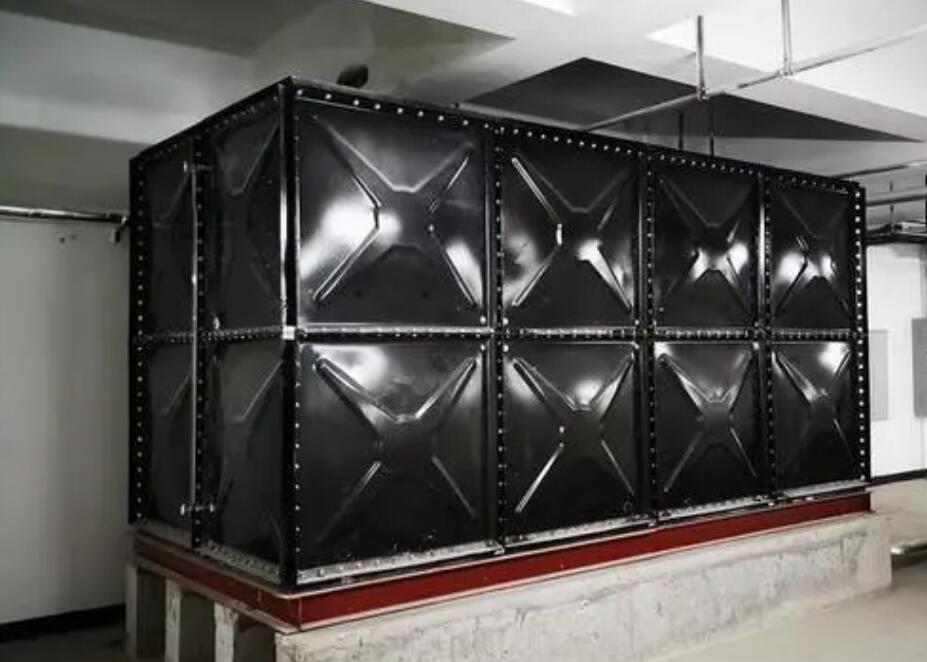
Stainless steel bolts at 150-200mm spacing with 4mm EPDM gaskets. Beijing Yuanhui applies injection-type polyurethane sealant at joints. Hydrostatic test: 0.15MPa for 30 minutes with zero leakage.
5.2 Final Inspection
Per CJ/T 306-2009: full water test (72 hours static), dimensional deviation (±2mm length/width, ±1mm height), surface defects (bubbles ≤3mm diameter, ≤3 per m²).
Conclusion
Every production step—from gel time control (±3min) to fiber content accuracy (±2%) and curing temperature (±2°C)—directly impacts FRP tank longevity. Beijing Yuanhui FRP Co., Ltd. achieves a mean time between failures (MTBF) of over 15 years through rigorous process control. Buyers should prioritize curing records and sealing test data over price alone.