Seismic Performance and Design Standards of FRP Water Tanks: From Structural Mechanics to Engineering Practice
Introduction
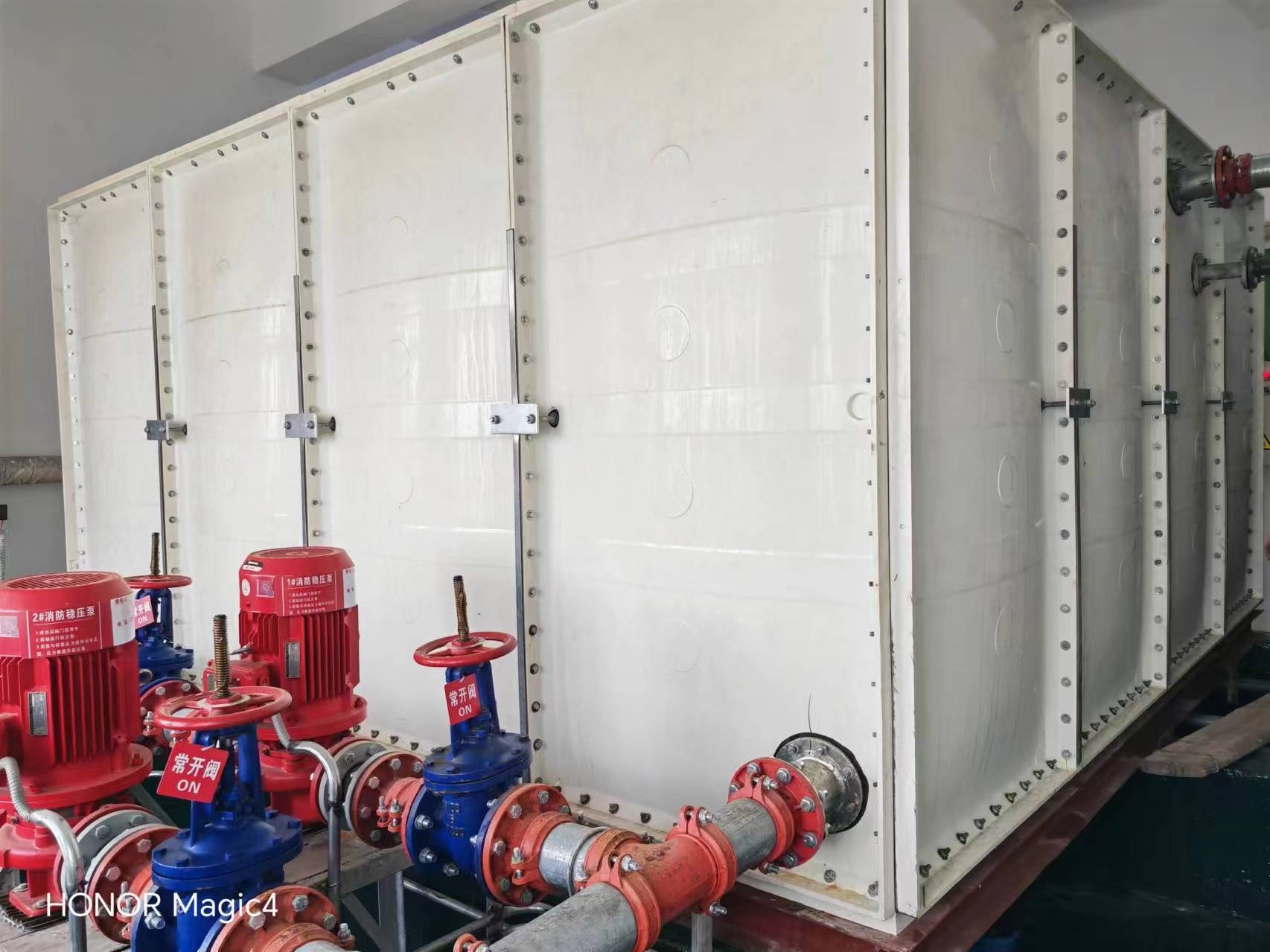
After an earthquake, the integrity of water storage facilities directly determines the availability of fire-fighting and emergency water supply. FRP (Fiberglass Reinforced Plastic) water tanks are widely used in building plumbing and industrial water storage due to their light weight, corrosion resistance, and monolithic molding. However, their laminated structure responds differently under horizontal seismic loads compared to steel or concrete tanks. Beijing Yuanhui FRP Co., Ltd. has accumulated extensive seismic test data over a decade of production. This article translates that knowledge into actionable design guidelines.
1. Material Advantages and Weaknesses for Seismic Resistance
1.1 Specific Strength and Damping Ratio
FRP has a density only 1/4~1/5 of steel, with tensile strength reaching 300~600 MPa. Under a seismic intensity of 7 degrees, the horizontal inertial force of an FRP tank is over 40% lower than that of a steel tank of the same volume. More importantly, the internal damping ratio of FRP laminates (0.03~0.05) is 3~10 times that of steel (0.005~0.01), meaning seismic energy dissipates faster within the structure.
1.2 Anisotropy and Critical Zones
FRP's mechanical properties are highly anisotropic – strong along fiber directions, but weak perpendicularly where only the resin matrix bears load. In a 2018 shake-table test at Beijing Yuanhui FRP, micro-cracks appeared at corner joints under 0.3g horizontal acceleration. Therefore, local reinforcement at internal corners, external corners, and pipe connections is mandatory in seismic design.
2. Core Requirements from Design Codes
2.1 GB 50011-2010 (2016 Edition) Clauses
Although GB 50011 targets building structures, Chapter 13 on non-structural components directly governs tanks:
- Clause 13.2.2: Water storage equipment must be verified under seismic loads, with gravity load taken as 100% of the full tank weight.
- Clause 13.4.3: Connection joints must accommodate deformation at least 1.5 times the yielding displacement of the main structure.
In practice, Beijing Yuanhui FRP controls bolt pre-tension at 80% of design value and uses slotted holes with spring washers to ensure sealing within ±15mm displacement.
2.2 GB/T 17219-1998 Supplementary Requirements
Though primarily a sanitary standard, Clause 5.3 requires anti-slip measures between the tank base and foundation. For seismic fortification intensity of 8 or above, we recommend shear keys plus chemical anchors instead of simple expansion bolts.
3. Key Structural Design Parameters and Cases
3.1 Optimized Layer Thickness
Conventional designs use uniform wall thickness (e.g., 8mm or 10mm). In a 2022 data center project in Tianjin, Beijing Yuanhui FRP adopted a graded lamination scheme: base plate 14mm (3 layers chopped strand mat + 4 layers woven roving), lower side wall 12mm, upper side wall 10mm. Fluid-structure interaction analysis under 0.4g seismic input showed maximum stress of 65 MPa at the base-side wall junction, yielding a safety factor of 4.6.
3.2 Stiffener Layout Logic
For tanks larger than 50 m³, internal tie rods or external ring stiffeners are essential. We recommend tie-rod spacing of 1.2~1.5m, with second moment of area at least 1.2 times that of the adjacent wall panel. In a 2019 project in Xinjiang, using FRP I-beam tie rods instead of conventional round bars prevented buckling during a simulated magnitude-7.5 earthquake.
4. Installation Anchoring and Joint Details
4.1 Foundation and Anchors
Concrete foundation grade must be at least C25, with surface flatness ≤3mm/2m. For seismic intensity ≥7, Beijing Yuanhui FRP mandates:
- Minimum 4 anchors per base panel, diameter ≥M16.
- Anchor embedment depth ≥100mm, verified by pull-out tests.
4.2 Flexible Pipe Connections
All inlet/outlet pipes must be connected to the tank via flexible joints (rubber compensators or metal bellows), with compensation capacity covering ±20mm displacement. A 2020 project in Chengdu suffered flange leakage after a magnitude-4 earthquake precisely because flexible connectors were omitted – a costly lesson.
Conclusion
Seismic design of FRP water tanks cannot be copied from steel or concrete tank practices. Beijing Yuanhui FRP Co., Ltd. recommends:
1. Perform fluid-structure interaction analysis under full-water + seismic loading, not static equivalence;
2. Add local laminates (at least 2 layers of woven roving) at stress concentration zones like corners and pipe openings;
3. Conduct joint deformation capacity tests during installation.
Only by integrating material properties, code requirements, and engineering details can true seismic resilience be achieved.