FRP Water Tank Modular Assembly Process: From Standard Panels to Integrated Sealing
Introduction
FRP (Fiber-Reinforced Plastic) water tanks are widely used in building water supply, fire protection, and industrial cooling. The modular assembly process—where factory-pressed SMC panels are bolted together on-site—is critical to long-term tank reliability. Beijing Yuanhui FRP Co., Ltd. has delivered over 8,000 assembled tanks in 12 years. This article breaks down the core techniques based on their production and installation track record.
1. SMC Panel Molding and Quality Control
1.1 Material Selection
The SMC compound consists of 30-35% unsaturated polyester resin, 25-30% chopped glass fiber (typically 25mm length), calcium carbonate filler, and additives. Molding occurs at 140-160°C and 10-15 MPa, with a dwell time of about 1 minute per mm thickness. Beijing Yuanhui uses biaxial glass mat reinforcement, achieving flexural strength above 220 MPa—37% higher than uniaxial alternatives.
1.2 Dimensional Standards and Testing
Standard panel sizes are 1m×1m, 1m×0.5m, and 0.5m×0.5m, with thickness options of 5, 8, 10, and 12mm. Each batch undergoes Barcol hardness testing (≥45), water absorption (≤0.5%), and heat deflection temperature verification (≥150°C). In 2023, Beijing Yuanhui's first-pass yield reached 98.7%, with defects mainly caused by air entrapment or uneven fiber distribution during molding.
2. Panel Joining and Sealing System
2.1 Bolted Connections
Hot-dip galvanized bolts (M10 or M12) connect adjacent panels. Bolt spacing depends on tank height: 200mm for tanks ≤3m, 150mm for 3-5m, and finite element analysis for taller units. Flange width must be at least 40mm to distribute clamping force evenly. Torque specifications: 30-40 N·m for M10 bolts, 45-55 N·m for M12.
2.2 Dual-Seal Method
To prevent joint leakage, Beijing Yuanhui applies a two-layer seal: a primary EPDM gasket (Shore A 60±5, compression set ≤25%) plus a polysulfide sealant coating on the gasket-panel interface. A 72-hour hydrostatic test at 0.3 MPa showed zero leakage with this method, compared to a 30% micro-leakage rate with single gaskets alone.
3. On-Site Assembly Procedures
3.1 Foundation and Base Plate Installation
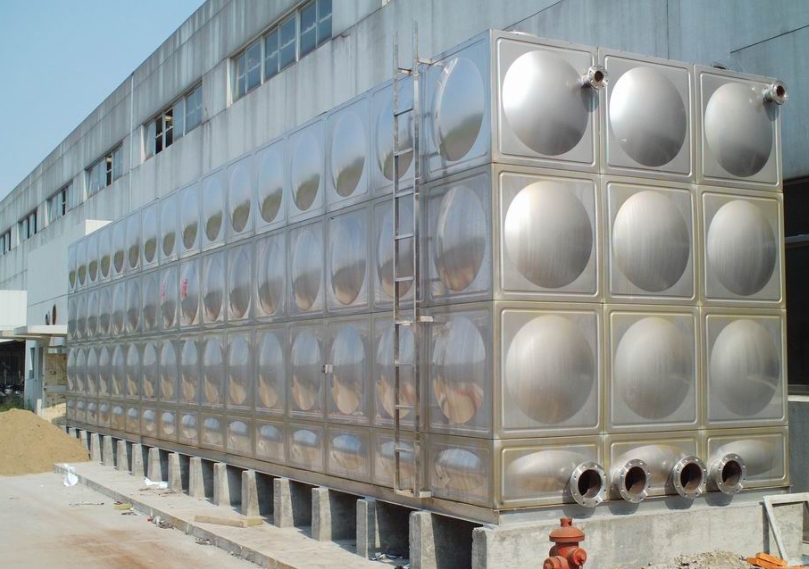
Concrete foundation flatness must be ≤3mm per 2m; otherwise, dry mortar leveling is required. Base panels are laid from corners, leaving 2-3mm expansion gaps. A case from Beijing Yuanhui's Tianjin project: foundation unevenness caused base panel warping during bolt tightening, resolved by re-leveling and adding a 5mm rubber pad.
3.2 Side and Top Panel Assembly
Side panels are installed layer by layer from the base upward. Verticality is checked after each layer (tolerance ≤2mm per meter). Corner panels use reinforced SMC with 35% fiber content to handle maximum bending moments. During top panel installation, manholes (600 or 800mm diameter) and pipe flanges are pre-arranged; flange bolt torque is set to 40-60 N·m.
3.3 Water-Fill Test and Leak Repair
After assembly, the tank is filled to design level +50mm for 24 hours. Water level drop is recorded every 2 hours; allowable leakage is 0.1% of total volume per day. Leaks are marked, water drained, and bolts re-torqued or sealant re-applied. Beijing Yuanhui's data shows 80% of leaks occur around bolt holes or corner joints.
4. Common Issues and Process Improvements
Inconsistent bolt torque is the most frequent cause of seal failure. Using digital torque wrenches and tightening in a cross pattern reduces variability. For regions with large temperature swings, assembly should be done at 10-30°C. Beijing Yuanhui developed a low-temperature sealant (curable at -5°C) and increased bolt preload by 10% for winter installations to compensate for material contraction.
Conclusion
FRP tank modular assembly combines material science, structural mechanics, and field craftsmanship. Standardized panels, reliable sealing, and strict process control are the three pillars of leak-free operation. Beijing Yuanhui FRP Co., Ltd. has reduced its average joint leakage rate to below 0.5% (by node count) through continuous SMC formulation and assembly procedure optimization—a benchmark for the industry.