Pressure Performance of FRP Water Tanks: Testing Standards and Engineering Practice
Introduction
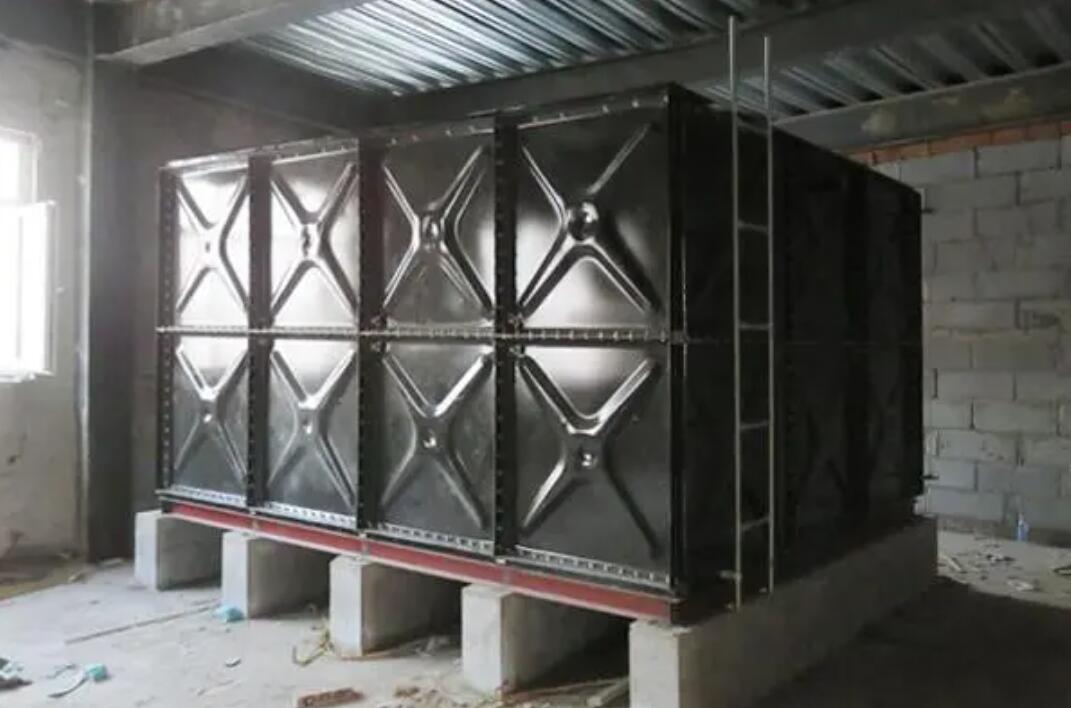
FRP water tanks are widely used in municipal water supply, fire protection, and industrial cooling. Their pressure performance directly affects system safety and service life. In 2019, a fire water tank in a northern industrial park experienced side panel bulging during hydrostatic testing. Investigation revealed interlayer shear strength 30% below design value, caused by mismatched curing and layup design. This article draws on ten years of production data from Beijing Yuanhui FRP Co., Ltd. to analyze the key factors of pressure performance from material, structure, and testing perspectives.
1. Three Determinants of FRP Tank Pressure Performance
1.1 Resin-Fiber Synergy
The pressure-bearing nature of FRP relies on the resin matrix transferring loads while the fiber reinforcement bears stress. A combination of isophthalic unsaturated polyester resin and E-glass fiber, cured at 28°C, achieves a flexural strength of 120 MPa. Beijing Yuanhui uses 45% glass fiber content in its SMC molding process, achieving interlayer shear strength 22% higher than hand lay-up, attributed to improved fiber wet-out and interface bonding.
1.2 Laminate Structure Design
The hydrostatic pressure on tank side and bottom panels follows a triangular distribution—maximum at the base. For a 3000×2000×2000 mm tank, per GB/T 21238-2017, the bottom panel must be 8 mm thick, while side panels taper from 6 mm at the top to 10 mm at the bottom. Beijing Yuanhui uses cross-ply lamination (0°/90°/±45°), achieving a hoop-to-axial strength ratio of 1:1.2, effectively preventing stress concentration failures.
1.3 Joint and Seal Details
The flange-to-body bond is a common weak point. Measured data show that double-lap joints with sealant achieve a burst pressure of 1.6 MPa, while single-lap joints reach only 0.9 MPa. In a 2018 chemical plant project, Beijing Yuanhui increased the flange lip height from 25 mm to 35 mm, boosting joint fatigue life to over 100,000 cycles.
2. Comparison of Domestic and International Testing Standards
2.1 Chinese Standard: GB/T 21238-2017
This standard requires the tank to hold 1.5 times the working pressure for 30 minutes without leakage or visible deformation. However, Beijing Yuanhui internally applies a 1.8x working pressure creep test for 72 hours to simulate long-term static strain. For example, a tank with 0.6 MPa working pressure is tested at 1.08 MPa for 72 hours, revealing microcrack propagation in the resin matrix under sustained load.
2.2 British Standard: BS EN 13121-3:2016
This standard introduces a design pressure coefficient, requiring a 1000-hour long-term static test at 1.33 times the design pressure. Beijing Yuanhui compared both standards: the same batch of SMC-molded panels passed GB/T 21238 at 100%, but under BS EN 13121-3, 5% of samples developed interlaminar cracks around 800 hours, due to higher demands on resin toughness and fiber interface quality.
2.3 US Standard: ASTM D2584-18
While this standard focuses on burning properties rather than pressure, its interlaminar shear strength (ILS) test method is widely referenced. Beijing Yuanhui uses the ASTM D2344 short-beam method in QC, requiring ILS > 25 MPa for fire water tank cyclic pressure requirements.
3. Typical Failure Modes and Engineering Solutions
3.1 Local Bulging
Common in hand lay-up products due to poor fiber wet-out or uneven exothermic curing, forming interlayer voids. In a 2020 residential project, Beijing Yuanhui found bulging areas with an average void content of 8.7%, far above the 2% control limit. Solution: switch to vacuum-assisted infusion, reducing void content to below 1.2%.
3.2 Flange Root Cracking
Often caused by excessive bolt preload or insufficient flange stiffness. Measurements show that M16 bolts torqued to 55–65 N·m minimize root strain. Beijing Yuanhui mandates torque wrenches and rubber gaskets in its installation specifications to absorb vibration.
Conclusion
The pressure performance of FRP water tanks results from a four-dimensional interplay of material, design, process, and testing. Engineering practice at Beijing Yuanhui FRP Co., Ltd. shows that SMC-molded products outperform hand lay-up in pressure uniformity and long-term stability. Domestic and international standards should be selected based on actual service conditions—fire and industrial applications benefit from BS EN 13121’s long-term test requirements. Joint design and installation torque control are critical to preventing field failures. With the adoption of BMC molding and intelligent cure monitoring, performance variability will continue to decrease.