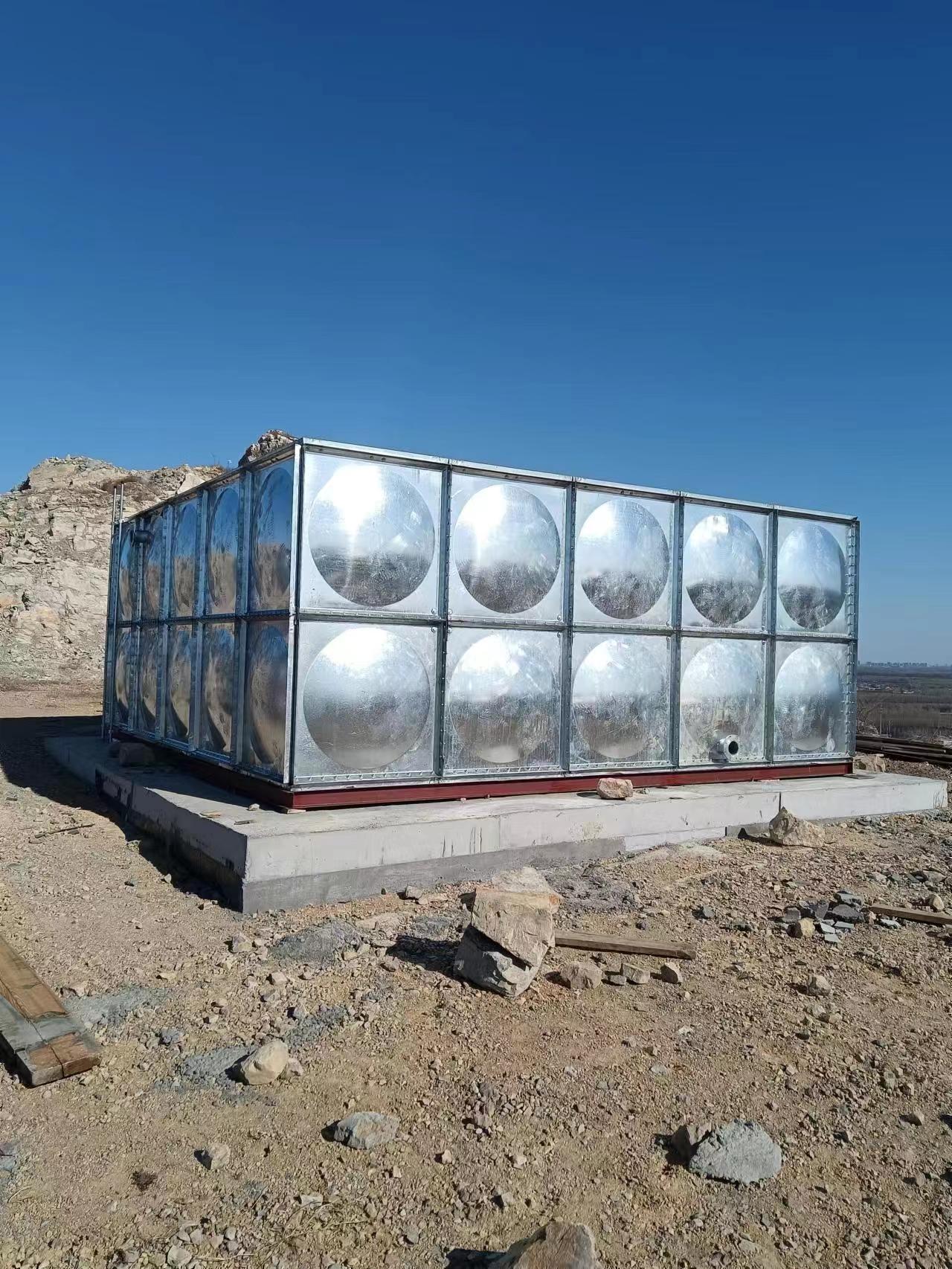
Thermal Insulation Performance of FRP Water Tanks: Technical Insights and Practical Applications
Introduction: Why Insulation Matters for FRP Water Tanks
Temperature retention is a critical factor in water storage systems, directly impacting energy consumption, equipment longevity, and process stability. While FRP (Fiberglass Reinforced Plastic) tanks are already valued for their lightweight, corrosion resistance, and high strength, their true differentiator lies in the customizable thermal insulation achievable through structural design and material formulation. Beijing Yuanhui FRP Co., Ltd. has observed over two decades that users often prioritize capacity and mechanical strength while overlooking how insulation affects long-term operational costs. This article presents data-driven insights into the technical fundamentals and application logic of FRP tank insulation.
1. Technical Foundations of FRP Tank Insulation
1.1 Material Level: Thermal Conductivity and Closed-Cell Ratio
Insulation performance depends on the core material—commonly polyurethane (PUR/PIR) or modified phenolic foam. Measured data show that polyurethane rigid foam achieves a thermal conductivity as low as 0.022 W/(m·K), while phenolic foam, despite better fire resistance, typically ranges at 0.035 W/(m·K). Closed-cell ratio is equally critical: a ratio ≥95% prevents moisture ingress, avoiding long-term degradation. Beijing Yuanhui FRP Co., Ltd. employs high-pressure foaming to ensure uniform density (40–60 kg/m³) and a stable closed-cell ratio above 96%.
1.2 Structural Level: Thermal Bridge Elimination
Material alone cannot solve thermal bridging. Metal tank supports and pipe connections act as heat conduits, causing local condensation or freezing. FRP tanks have an inherent advantage: the base material (GFRP) is a poor conductor (≈0.3 W/(m·K)), far below steel’s 50 W/(m·K). Beijing Yuanhui further optimizes the design by installing rubber insulation pads between the tank and foundation, and using flanged break-bridge connections for all pipes—reducing overall thermal bridge losses by over 40%.
2. Application Scenarios and Energy Savings Data
2.1 Severe Cold Regions: Freeze Prevention and Cost Reduction
Case: A livestock farm in Inner Mongolia, with winter lows of -35°C. An uninsulated stainless steel tank consumed 120 kWh/day for electric heat tracing. After replacing it with a 100-ton double-layer insulated FRP tank (100mm polyurethane) from Beijing Yuanhui, heat tracing runtime dropped 70%, to 36 kWh/day. At 0.6 CNY/kWh, annual savings reach 18,000 CNY per tank, with a payback period under 18 months. Key factor: the insulation is integrally molded with the tank shell, eliminating field joint gaps.
2.2 Industrial Hot Water Systems: Temperature Drop Control
A textile mill stores 85°C water in a 50-ton insulated FRP tank. With ambient temperature at 10°C, the measured 24-hour temperature drop was only 4.2°C (compared to 12.7°C for a standard steel tank). This performance stems from high-density polyurethane insulation (80mm thickness) and a mirror-finished inner surface (reducing radiative heat transfer). The mill also noted that the tank’s external surface was only 5–8°C above ambient, significantly lowering workshop HVAC load.
2.3 Fire Protection and Emergency Supply: Long-Term Standby Reliability
Fire water tanks remain static for years, where insulation aims to prevent pipe freezing rather than maintain high temperature. Per GB 50974-2014, tanks in cold climates require freeze protection. Beijing Yuanhui’s fire-rated insulated tanks feature a triple-layer structure: inner food-grade SMC panel, closed-cell polyurethane core, and UV-resistant FRP outer shell. Tests by the China Academy of Building Research showed that the tank maintained ≥4°C internal water temperature for 72 hours at -30°C without auxiliary heating.
3. Selection Guidelines and Common Misconceptions
3.1 Misconception: Thicker Insulation is Always Better
Beyond a critical thickness (typically 80–120mm), additional insulation yields diminishing returns. In Beijing’s climate, 100mm polyurethane reduces heat loss by 82%, while increasing to 150mm only adds 5%. Recommended thickness: 100–120mm for severe cold zones, 70–80mm for temperate regions like the Yangtze River basin.
3.2 Key Parameters: Compressive Strength and Dimensional Stability
Insulation must withstand hydrostatic and wind loads. Beijing Yuanhui uses polyurethane foam with compressive strength ≥200 kPa (per ASTM D1621), ensuring no deformation under 15m water column. Linear shrinkage must remain below 1% to prevent delamination—a hidden cause of thermal bridging.
3.3 Installation Best Practices: Sealing and Moisture Barrier
Wet insulation can multiply thermal conductivity. A vapor barrier (e.g., aluminum foil + polypropylene film) should be applied externally, with all joints sealed using butyl tape. Beijing Yuanhui provides factory-integrated sealing, eliminating on-site work.
Conclusion
FRP water tank insulation is not merely “adding a layer of foam”—it is a system-level engineering challenge involving material selection, structural design, joint treatment, and installation protocol. With rising energy costs and tightening environmental regulations, life-cycle energy optimization through precision insulation has become an industry trend. Beijing Yuanhui FRP Co., Ltd. recommends that users request thermal conductivity and closed-cell ratio test reports (per ASME or GB standards) and perform heat loss calculations based on actual operating conditions. As next-generation insulants like aerogels become cost-competitive, the insulation limits of FRP tanks will continue to expand.