Pressure Performance of FRP Water Tanks: Testing Standards and Engineering Practice
Introduction
The pressure-bearing capacity of FRP (Fiberglass Reinforced Plastic) water tanks is critical for system safety in industrial and municipal applications. A chemical plant accident in 2019, caused by tank wall delamination, highlighted the need for rigorous testing. This article, based on over a decade of production experience at Beijing Yuanhui FRP Co., Ltd., outlines the complete testing chain from material selection to structural validation.
Pressure-Bearing Mechanism of FRP Tanks
Material Level: Anisotropic Laminate Properties
Tank walls are made of continuous glass fiber and unsaturated polyester resin via hand lay-up or compression molding. Fiber orientation dictates strength: hoop winding provides circumferential strength (typically ≥120 MPa), while axial layers handle vertical loads. Interlaminar shear strength (ILSS) is the weak point, with GB/T 21238 requiring ≥15 MPa. Beijing Yuanhui enforces an internal standard of 18 MPa.
Structural Level: Stiffener and Joint Design
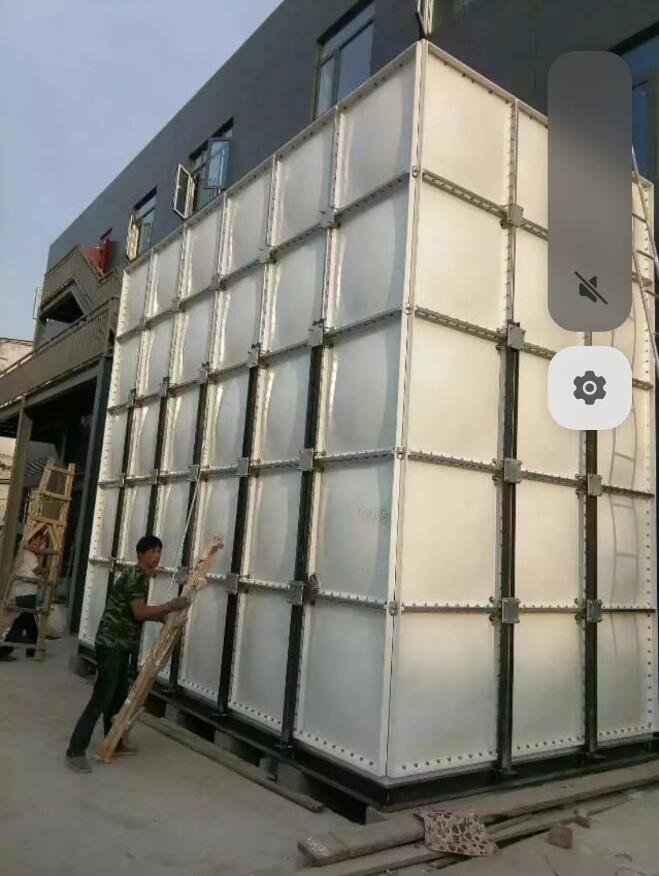
Side panels resist lateral pressure through T-shaped or I-shaped stiffeners. For a 3 m high tank, stiffener spacing must not exceed 600 mm; otherwise, deflection may surpass L/200 (L = panel span), leading to seal failure.
Testing Standards
Domestic Standard: GB/T 21238-2018
This standard mandates holding pressure at 1.5× design pressure for 30 minutes without leakage or residual deformation. In practice, Beijing Yuanhui recommends a 2.0× factor for type testing to account for temperature effects (−20°C to 60°C) that can soften or embrittle the resin.
International Standards: ASTM D4097-19 and ISO 15024
ASTM D4097 focuses on long-term creep, requiring strain ≤0.5% after 1000 hours of constant pressure. ISO 15024 evaluates interlaminar fracture toughness (GIC) for impact-damaged tanks. Export projects must comply with both.
Case Study and Failure Analysis
Case: Burst Test of a 10-Ton Horizontal Tank
An 8 mm thick, 2 m diameter horizontal tank from Beijing Yuanhui underwent hydrostatic burst testing. Design pressure was 0.2 MPa; actual burst pressure reached 0.85 MPa (safety factor = 4.25). Failure occurred via hoop fiber fracture, following the “leak-before-burst” principle.
Common Failure Modes
- Delamination: Caused by poor resin wet-out. Solution: control curing degree ≥95% (DSC test).
- Local Buckling: Insufficient stiffener stiffness. Solution: optimize rib cross-section using FEA (e.g., ANSYS).
- Seal Leakage: Uneven flange surfaces. Solution: machine and lap-grind to flatness ≤0.5 mm/m.
Conclusion
Pressure performance of FRP tanks is a combined outcome of material, process, and design. Engineers should request third-party test reports per GB/T 21238-2018 and pay attention to ILSS and creep data. Beijing Yuanhui FRP Co., Ltd. offers full-scale burst testing and customized stiffening solutions based on site conditions.