Thermal Insulation Performance of FRP Water Tanks: Materials, Data and Application Scenarios
Introduction
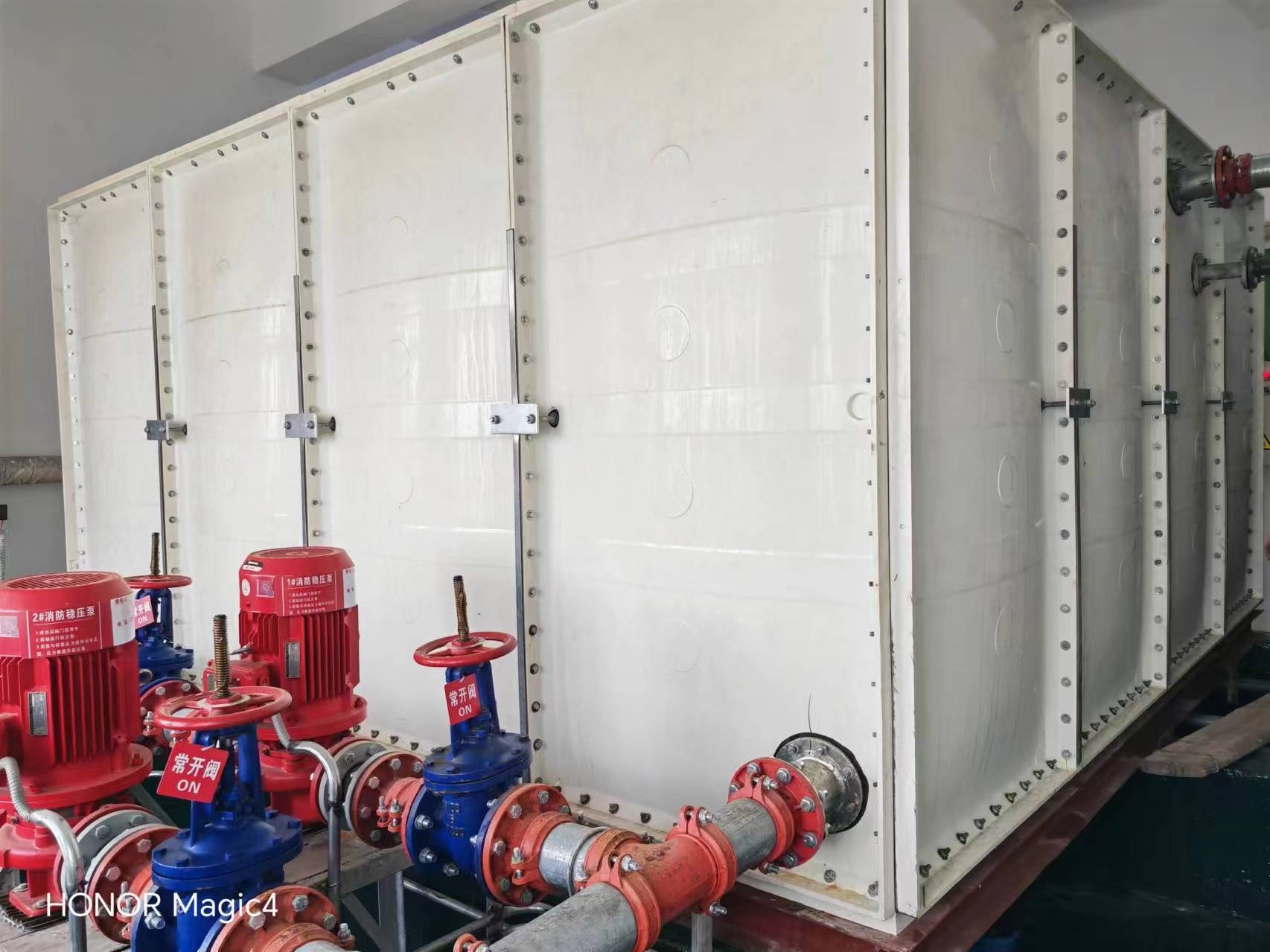
The thermal insulation performance of an FRP water tank determines its viability in cold climates and specialized applications. Unlike steel tanks, FRP (Fiberglass Reinforced Plastic) has a thermal conductivity of only 0.23–0.46 W/(m·K) — roughly 1/100th of steel’s 50 W/(m·K). This inherent property reduces natural heat loss by an order of magnitude under ambient conditions. However, for reliable operation at -30°C in northeastern forests or inside 70°C solar storage systems, the insulation design and installation details matter far more than the base material alone.
Beijing Yuanhui FRP Co., Ltd. has delivered over 8,000 insulated FRP tanks in the past 15 years, spanning climate zones from Mohe (China’s coldest point) to tropical Sanya. The following sections break down insulation performance from three perspectives: material selection, structural thermal-bridge treatment, and application-specific engineering.
1. Material Selection and Thickness Calculation
1.1 Polyurethane Foam: The Mainstream Solution
Rigid polyurethane (PU) foam is the industry standard for external insulation of FRP tanks. With a closed-cell ratio above 95% and thermal conductivity of 0.022–0.028 W/(m·K), a 50–60 mm layer is adequate for most of northern China (temperature differential ΔT=40°C per GB/T 4272-2008), while 80–100 mm is required for the severe cold of Heilongjiang and Inner Mongolia.
Case in point: Beijing Yuanhui supplied a 50 m³ fire-fighting tank to a forestry bureau in Heilongjiang. With 80 mm PU foam and an aluminum-foil reflective layer, the tank’s internal water temperature dropped from 10°C to 5°C over 72 hours during a -38°C extreme cold snap in January 2023 — an average daily temperature loss of only 1.7°C.
1.2 Rock Wool and Rubber Foam: Niche Alternatives
Rock wool (λ≈0.040–0.050 W/(m·K)) is chosen for high-fire-risk industrial environments, but its insulation performance degrades sharply after moisture absorption unless a vapor barrier is installed. Nitrile rubber (NBR/PVC) foam is flexible and suitable for irregular tank shapes and pipe connections, but prolonged exposure above 80°C accelerates aging — not recommended for high-temperature storage systems.
2. Thermal Bridge Prevention and Anti-Condensation Design
Insulation failure most often originates at thermal bridges — metal flanges, bolts, supports, and manhole frames that conduct heat 2,000 times faster than PU foam. A single untreated galvanized bolt can cause localized condensation, corrosion, and eventually delamination of the insulation layer.
Beijing Yuanhui’s structural approach includes three measures: (a) all metal connectors (flanges, bolts, brackets) are isolated with nylon pads or rubber thermal spacers; (b) a 20 mm XPS extruded-polystyrene board is laid between the tank bottom and its foundation; (c) the manhole cover is fitted with an EPDM gasket and the neck is wrapped with a 50 mm prefabricated PU collar.
At a 2024 data-center project in Beijing (ambient 35°C, 85% RH), the tank’s outer surface temperature remained at least 3°C above the dew point throughout the summer, with zero condensate observed.
3. Application Scenarios and Field Data
3.1 Domestic Water Tanks in Severe Cold Regions
In Inner Mongolia, Heilongjiang, and Xinjiang, where winter temperatures routinely drop below -20°C, a combination of 100 mm PU insulation + stainless steel inner liner (to avoid low-temperature embrittlement) + electric heat tracing (only on inlet/outlet pipes) allows year-round operation inside unheated pump rooms. A 15 m³ tank installed by Beijing Yuanhui at a border station in Altay, Xinjiang, has completed three winters without freeze damage; the average daily heat loss during the coldest month was 2.3 kWh.
3.2 Solar Thermal and Air-Source Heat Pump Storage
Solar storage tanks require 20–30% thicker insulation to retain heat overnight. At a livestock farm in Shandong: a 30 m³ tank with 100 mm PU foam reached 65°C after a sunny day; after 16 hours of natural cooling the temperature dropped to 52°C (ΔT=13°C), sufficient for next-morning cleaning needs.
For water temperatures above 70°C, PU foam faces accelerated aging. Beijing Yuanhui’s solution for such cases is a dual-layer structure — an inner 50 mm phenolic foam (rated for 150°C) plus an outer 80 mm PU layer, totaling 130 mm. This design has been in stable operation for four years at a printing and dyeing plant in Jiangsu.
3.3 Fire-Protection Constant-Temperature Tanks
Per GB 50974-2014, fire water tanks in cold climates must be freeze-protected. An insulated FRP tank paired with an automatic electric heater (setpoint 4–7°C) consumes roughly 30% less energy than a conventional steel tank with heat tracing. Beijing Yuanhui supplied a 36 m³ fire tank to a logistics park in Shijiazhuang; with 90 mm PU insulation, its average monthly winter electricity bill was 65% that of a comparable steel tank.
4. Installation and Acceptance Criteria
Factory-pre-fabricated insulation (PU foam sprayed inside a FRP or stainless steel outer jacket) achieves far better thickness uniformity (±2 mm) than field-applied spray foam. On-site installation notes: (1) joints must be staggered and sealed with expanding foam; (2) the protective cladding should be 0.8–1.2 mm FRP color sheet or stainless steel to resist UV and bird damage; (3) acceptance inspection should use a thermal imaging camera — any area with a temperature deviation >3°C across the tank wall must be reworked.
Conclusion
The thermal insulation performance of an FRP water tank is not a single-parameter advantage but the result of correct material selection, thorough thermal-bridge isolation, scenario-based thickness engineering, and precise installation. In extreme cold down to -40°C, a properly designed insulated FRP tank can operate reliably. Data from Beijing Yuanhui FRP Co., Ltd. across thousands of projects confirms that a well-engineered insulated FRP tank reduces total heat loss by 40–60% compared to conventional steel tanks — making it the preferred solution for cold-climate water storage.