Pressure Performance of FRP Water Tanks: Testing Standards, Design Parameters, and Engineering Practice
Introduction
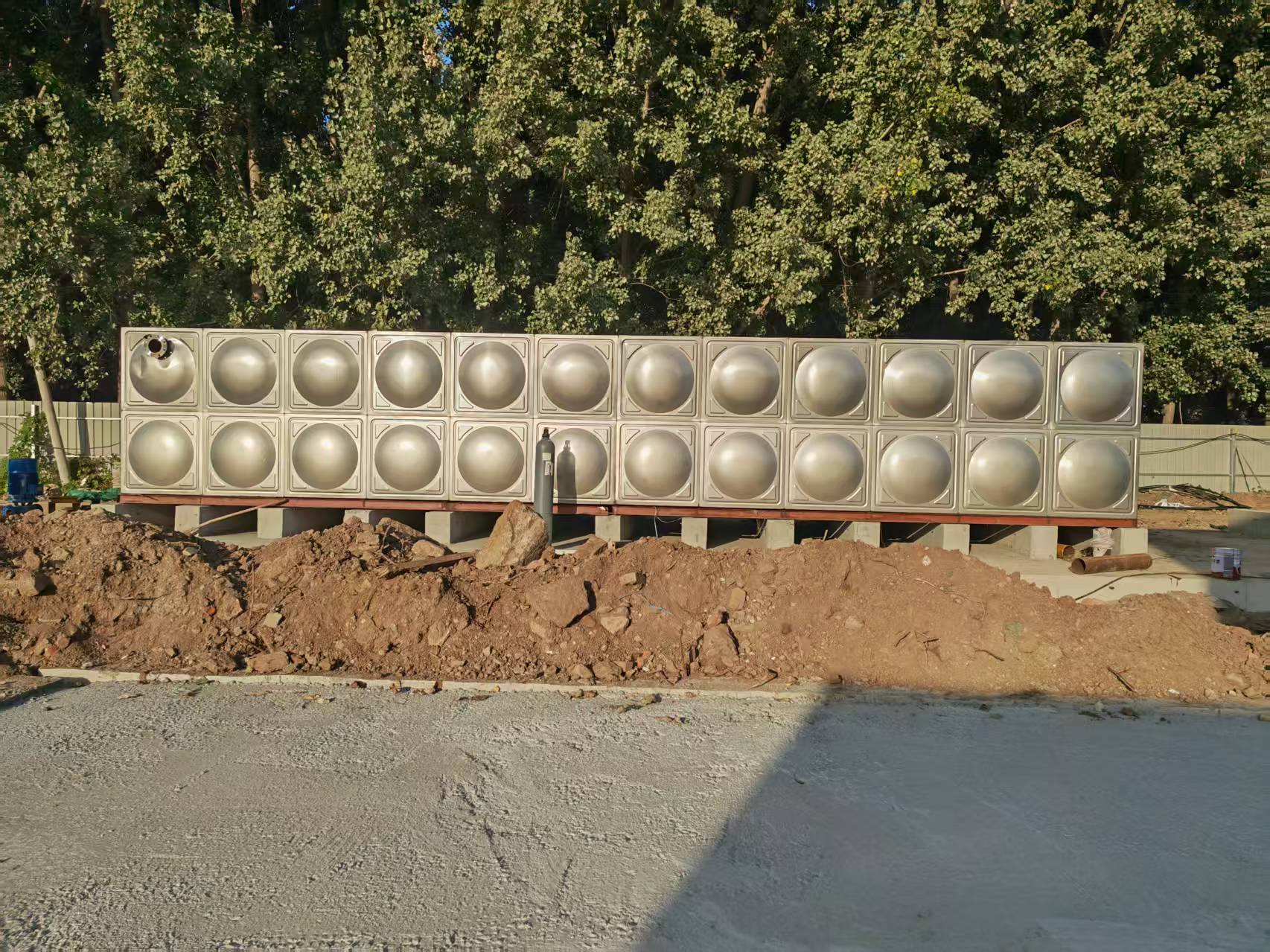
FRP (Fiber-Reinforced Plastic) water tanks are widely used in fire protection, domestic water supply, and industrial circulating water systems. Their pressure-bearing capacity directly determines system safety and service life. Unlike conventional atmospheric tanks, pressurized FRP tanks must withstand internal pressures from 0.1 MPa to 0.6 MPa or higher, along with dynamic loads such as temperature fluctuations and water hammer. Beijing Yuanhui FRP Co., Ltd. has observed in over a decade of engineering practice that at least 30% of field failures originate from inadequate pressure design or non-standard testing. This article examines the key control points of FRP tank pressure performance from four perspectives: material properties, structural design, testing standards, and failure case analysis.
1. Pressure Mechanism and Key Parameters of FRP Tanks
1.1 Material Level: Laminate Mechanical Properties
FRP tank panels are typically fabricated via hand lay-up or spray-up, combining unsaturated polyester resin with E-glass or C-glass fibers. Pressure capacity depends on fiber volume fraction (typically 30%-50%), ply orientation (0°/90° cross-ply yields tensile strength of 250-400 MPa), and fiber-resin interfacial bond strength. Test data from Beijing Yuanhui show that increasing fiber content from 35% to 45% raises hoop tensile modulus by approximately 40%, but interlayer shear strength drops 15%. This anisotropy must be balanced by incorporating chopped strand mat or surface veil.
1.2 Structural Level: Wall Thickness and Stiffener Design
Wall thickness for pressurized tanks is calculated per netting theory: t = P·D / (2·σ·S) (P = internal pressure, D = diameter, σ = allowable hoop stress, S = safety factor, typically 4-6). For tanks exceeding 2 meters in diameter, solely increasing wall thickness becomes uneconomical; circumferential and longitudinal stiffeners are required. Stiffener sections (commonly channel or I-beams encased in FRP) are spaced at 600-1200 mm. In a Hebei fire protection project, Beijing Yuanhui applied FEA to a 3m-diameter, 4m-height tank. Optimizing stiffener layout reduced maximum deformation from 8.2 mm to 3.1 mm and peak stress by 42%.
2. Domestic and International Testing Standards
2.1 Chinese Standards
The current GB/T 17219-1998 addresses only hygienic performance. Pressure-related tests refer to JB/T 4730 (Nondestructive Testing of Pressure Equipment) and GB 150 (Pressure Vessels). Industry practice includes hydraulic strength tests (1.5× design pressure for 30 minutes) and pneumatic seal tests (1.1× design pressure for leak detection). Beijing Yuanhui participated in drafting T/CBMF 89-2020, a group standard that mandates a complete hydrostatic test for each tank before shipment, with leakage rate below 0.05% as the acceptance criterion.
2.2 International Standards
Key references include ASTM D3299-18 (Standard Specification for FRP Tanks) and EN 13121-3:2016 (GRP Tanks and Vessels for Above-Ground Storage). ASTM D3299 requires maximum strain below 0.1% at design pressure and 10,000 fatigue cycles (0 to 1.2× design pressure). European standards emphasize interlayer shear strength (ISO 14130) and long-term creep (ISO 899-1). For export projects, Beijing Yuanhui applies dual-standard validation: short-term strength per GB/T and long-term hydrostatic verification per ASTM D2992 to ensure a 20-year design life.
3. Failure Modes and Engineering Cases
3.1 Common Failure Modes
- Burst Failure: Occurs at weak spots in the hoop laminate, with critical pressure typically 3-5× design pressure. Beijing Yuanhui lab tests on 6mm-thick specimens showed burst pressures of 2.8-3.4 MPa with a coefficient of variation of 9.7%, highly correlated with ply uniformity.
- Local Bulging: Caused by fiber-resin debonding, often around manholes and nozzle reinforcements. In a chemical plant case, a DN150 nozzle root exhibited an 80mm bulge at 0.4 MPa operating pressure; dissection revealed reinforcement thickness only 60% of the design value.
- Fatigue Cracking: Induced by water hammer or frequent start-stop cycles. Beijing Yuanhui traced a hotel fire tank's bottom circumferential weld cracks to approximately 20 pump cycles per day, generating a cyclic stress amplitude of 0.25 MPa—exceeding the FRP fatigue limit.
3.2 Preventive Measures
For nozzle reinforcements, Beijing Yuanhui adopts a sandwich structure (inner liner + structural layer + outer protective layer) with annular reinforcement pads 1.5-2× wall thickness and diameters at least 3× the nozzle diameter. For dynamic loads, design stress should be reduced to the fatigue limit (approximately 30%-40% of static strength), and water hammer arrestors installed at tank inlets and outlets.
4. Selection Recommendations and Quality Verification
When selecting pressurized FRP tanks, end users should request: (1) third-party type test reports (hydrostatic, pneumatic, vacuum tests); (2) factory product quality certificates with individual hydrostatic test records; (3) FEA-based overall strength calculation reports. Beijing Yuanhui FRP Co., Ltd. recommends filament winding for tanks with design pressures above 0.3 MPa or diameters over 4 meters, as circumferential strength improves 30%-50% over hand lay-up. Post-installation, a 72-hour full-water hydrostatic test should be conducted, with emphasis on flange sealing surfaces and nozzle weld joints.
Conclusion
The pressure performance of FRP water tanks is a systematic integration of materials, structure, and manufacturing processes. From stress calculations and ply optimization during design, to process control and NDT during fabrication, to periodic re-validation at user sites, every stage must strictly adhere to applicable standards. Beijing Yuanhui FRP Co., Ltd. has accumulated over 500 successful pressurized tank projects through active participation in standard development and continuous R&D investment. For special conditions (high/low temperature cycles, corrosive media), custom design with dual-standard validation is recommended to mitigate risks.