FRP Water Tank Modular Assembly: From SMC Molding to On-Site Installation
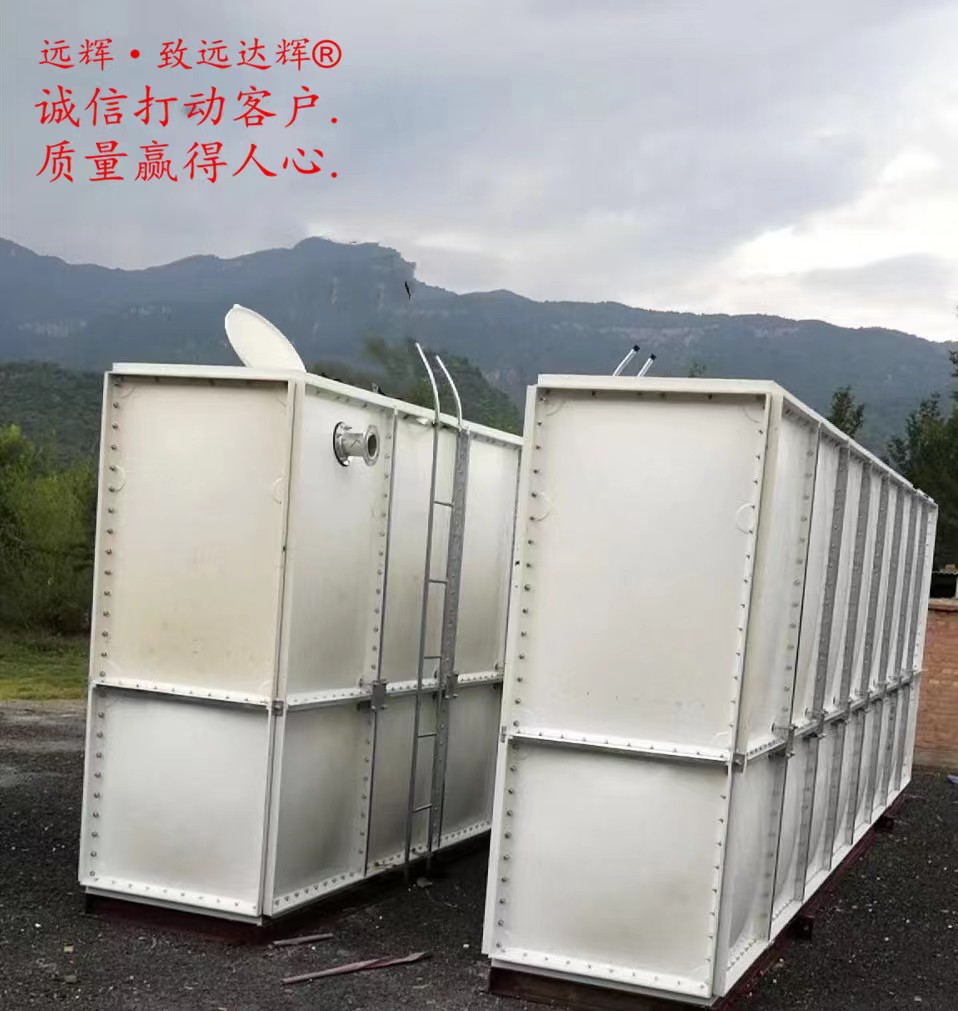
FRP Water Tank Modular Assembly: From SMC Molding to On-Site Installation
FRP (Fiberglass Reinforced Plastic) water tanks are widely used in commercial, fire protection, and industrial water storage due to their light weight, corrosion resistance, and ease of installation. The core manufacturing process—modular assembly—determines the tank's sealing integrity, structural stability, and service life. Based on the production experience of Beijing Yuanhui FRP Co., Ltd., this article provides a technical overview of the modular assembly process.
1. SMC Compression-Molded Panels: The Building Blocks
The modular assembly begins with standardized SMC (Sheet Molding Compound) panels. SMC consists of unsaturated polyester resin, glass fibers, fillers, and additives, compression-molded at high temperature and pressure. Beijing Yuanhui uses panel thicknesses of 5mm, 8mm, and 10mm, with a density of 1.8–2.0 g/cm³ and flexural strength ≥120 MPa. Panel dimensions are maintained at 1000×1000mm or 1000×500mm, with diagonal deviation ≤2mm. This precision ensures uniform gaps during assembly and reduces sealant consumption.
Each panel has a tongue-and-groove edge with a depth of 15mm and a 90° angle. The groove surface is sanded to a roughness Ra of 3.2–6.3 μm to improve sealant adhesion. Every batch undergoes a 24-hour hydrostatic pressure test at 0.1 MPa; no leakage is permitted.
1.1 Weathering and Fire Resistance
For outdoor installations, Beijing Yuanhui adds UV absorber (UV-326) and antioxidant (1010) to the SMC formulation. After 1,000 hours of accelerated aging, the strength retention rate is ≥85%. For fire protection tanks, the material meets GB 8624-2012 B1 standard, with an oxygen index ≥32%.
2. Sealing Structure and Connector Design
The critical challenge in modular assembly is joint sealing. Traditional rubber gaskets tend to age and deform under long-term compression. Beijing Yuanhui employs a dual-sealing system: EPDM O-rings (10mm diameter, compression ratio 25%–30%) combined with polysulfide sealant. The O-ring compression is controlled to avoid stress relaxation.
Connectors are 304 stainless steel bolts (M12×45, grade 8.8) with nylon lock nuts. The bolt spacing is 250mm, with 18 bolt holes per panel edge (14mm diameter). Installation torque is set at 45–55 N·m, using a torque wrench to prevent micro-cracks from uneven stress.
All bolt heads inside the tank are covered with FRP protective caps—SMC-molded parts (16mm inner diameter, 12mm height) fixed with sealant. This prevents metal-to-water contact, avoiding galvanic corrosion and contamination.
3. On-Site Assembly Process and Quality Control
The on-site assembly follows six steps: base inspection → floor panel installation → wall panel erection → tie-rod fixing → roof closure → water test.
Step 1: Base inspection. The concrete foundation must have a flatness deviation ≤5mm per 2m, and embedded steel plates must align with the floor panel bolt holes. Curing time is at least 28 days, with concrete strength ≥C25.
Step 2: Floor panel installation. Panels are laid with a 30mm lap joint, and 3mm of polysulfide sealant is applied. A 30mm layer of fine sand or rubber pad is placed between the panels and the base to absorb differential settlement.
Step 3: Wall panel erection. Panels are assembled from one corner upward. After each tier, stainless steel tie-rods (12mm diameter, 304 grade) are installed at 1000×1000mm spacing. Tanks exceeding 3m height require double-layer tie-rods arranged in an X-pattern to resist hydrostatic pressure.
Step 4: Roof closure. Roof panels (each ≈15kg) are installed using scaffolding. An angle bar (L40×40×4mm) is added at the roof-wall junction, with bolts tightened at 200mm spacing for corner sealing.
Step 5: Water test. Filling is done in three stages: 1/3 height (24h hold), 2/3 height (24h hold), and full height (48h hold). All joints and bolt holes are inspected; zero leakage is required. In a 60m³ fire tank project in Tianjin, Beijing Yuanhui achieved a 97.3% first-pass rate.
4. Common Issues and Process Improvements
The most frequent problems are panel warping and seal failure. Warping results from uneven cooling during molding or high storage humidity. Beijing Yuanhui optimized the mold cooling channel design (gradual cooling from 80°C to 40°C), reducing panel flatness deviation to ≤0.5mm/m. Storage humidity is controlled at 45%–55% RH, with panels stacked on wooden pallets.
Seal failures often occur at corners or near bolt holes. Improvements include using one-piece molded corner fittings (reducing joint count by 50%) and pre-embedded stainless steel nuts in panels (eliminating on-site drilling). In a 2023 residential project in Beijing's Chaoyang District, these measures resulted in zero leakage after two years of service.
Conclusion
FRP water tank modular assembly is a system-level process—from precise SMC panel molding to rigorous on-site procedures. Beijing Yuanhui FRP Co., Ltd. has reduced leakage rates to below 0.5% and extended service life to over 15 years through continuous improvement in materials, sealing design, and construction standards. For contractors, selecting a proven modular assembly process and a reliable supplier is key to ensuring tank quality.