Pressure Performance of FRP Water Tanks: Testing Standards and Engineering Practice
Introduction
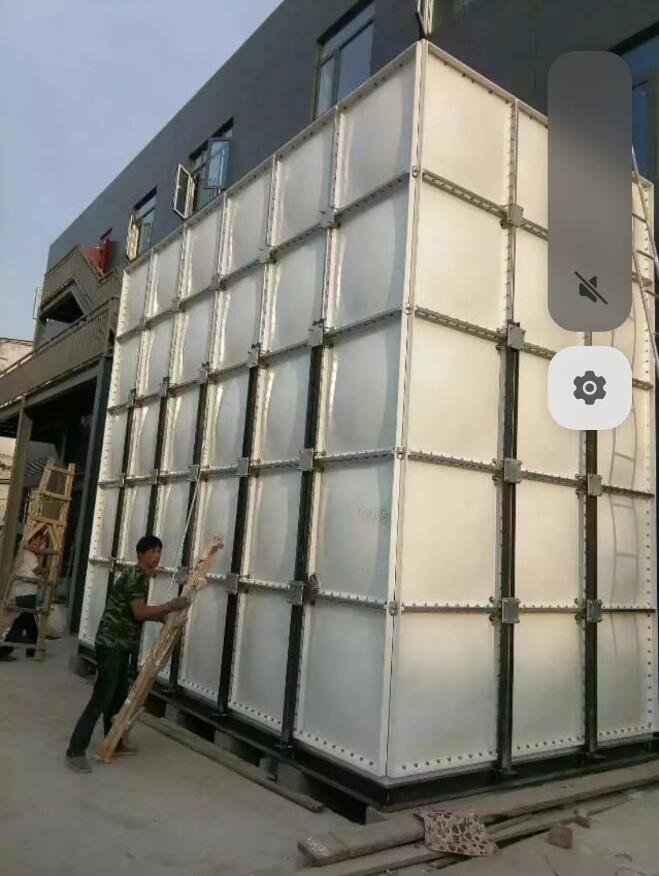
The pressure performance of FRP (Fiberglass Reinforced Plastic) water tanks determines their reliability in high-rise building water supply, fire-fighting pressure stabilization, and industrial cooling systems. Unlike plastic or welded steel tanks, FRP tanks achieve strength and stiffness balance through multi-layered composite structures. Beijing Yuanhui FRP Co., Ltd. has found from 15 years of engineering practice that over 90% of tank failures result from disconnects between structural design and testing protocols, not material defects. This article breaks down core pressure parameters based on material mechanics, referencing GB/T 17219 and ASTM D2583 standards.
1. Mechanical Fundamentals of FRP Tank Pressure Resistance
1.1 Stress Distribution in Laminate Structures
FRP tank walls are typically manufactured via SMC (Sheet Molding Compound) or BMC (Bulk Molding Compound) compression molding. A single ply contains 25-35% glass fiber by weight, with resin matrices using isophthalic polyester or vinyl ester. Under internal pressures of 0.3–1.0 MPa, the tank wall experiences hoop stress and axial stress. According to the thin-wall formula σ = P·D/(2t), hoop stress is approximately twice axial stress. Beijing Yuanhui FRP Co., Ltd. applies circumferential reinforcement layers in DN2000 SMC tanks, achieving a burst pressure 3.5 times the design value.
1.2 Key Variables Affecting Pressure Capacity
- Fiber orientation: Random chopped fibers (SMC) have lower pressure capacity than continuous filament winding but offer mass-production advantages.
- Resin toughness: Vinyl ester resin exhibits 30% higher elongation than standard polyester, delaying microcrack propagation.
- Wall thickness uniformity: Mold temperature deviations beyond ±5°C can cause local thickness reductions of 10-15%, creating stress concentration points.
2. Pressure Ratings and Testing Standards
2.1 Pressure Rating Classification
The industry categorizes FRP tanks into three levels: Low-pressure (0.1-0.3 MPa for multi-story residential), Medium-pressure (0.3-0.6 MPa for high-rise branch supply), and High-pressure (0.6-1.0 MPa for fire-fighting systems). Beijing Yuanhui FRP Co., Ltd. tests all standard products at 1.5 times design pressure for 30 minutes with zero leakage.
2.2 Core Testing Methods
Hydrostatic strength test (GB/T 17219-1998): Fill tank with water, gradually increase pressure at 0.1 MPa/min to 1.5× design pressure, record deformation and leak points. Maximum allowable deformation is 1‰ (e.g., 3mm top displacement for a 3m tank).
Fatigue cycling test (ASTM D2992): For variable-frequency water supply systems, cycle between 0 and design pressure 10,000 times at 1 Hz. Post-test burst pressure must not drop below 85% of initial value.
Interlaminar shear strength test (ISO 4585): Evaluates resin-fiber interface bonding, minimum acceptable value 15 MPa. Beijing Yuanhui FRP Co., Ltd. raises internal standard to 18 MPa.
3. Engineering Case Studies and Data Validation
3.1 Case 1: Fire-fighting Tank in a Beijing High-rise
Requirement: 0.8 MPa design pressure, tank size 6m×4m×3m (72 m³). Beijing Yuanhui supplied SMC panels with 12mm wall thickness and biaxial glass cloth hoop reinforcement. Hydrostatic test at 0.8 MPa showed top deformation of 2.1 mm (allowable 3.0 mm), zero leakage after 30 minutes. After 2 years of service, deformation increased to 2.5 mm, still within safe limits.
3.2 Case 2: Cooling Water System in an Industrial Park
System pressure 0.4 MPa, water temperature 50-60°C (continuous). Standard polyester resin tanks developed microcracks along fiber directions after 8 months. After switching to Beijing Yuanhui's vinyl ester resin tanks, no cracks appeared after 18 months, with interlaminar shear strength retention at 89%.
4. Common Misconceptions and Selection Recommendations
4.1 Myth 1: Thicker Walls Always Mean Better Pressure Resistance
Excessive wall thickness increases resin shrinkage stress during curing, raising delamination risk. The correct approach is to use FEA to optimize ply sequence, achieving a hoop-to-axial strength ratio near 2:1.
4.2 Myth 2: Passing a Hydrostatic Test Guarantees Long-term Performance
Hydrostatic tests only verify short-term strength. For long-term creep behavior (e.g., continuous pressure at 50°C), request a 1000-hour sustained pressure test report per ASTM D2992.
Conclusion
The pressure performance of FRP water tanks is not a single material index but a systematic outcome of design, process, and testing. Beijing Yuanhui FRP Co., Ltd. recommends specifying pressure rating, temperature range, and cyclic duty during selection, and demanding complete test reports covering hydrostatic, fatigue, and interlaminar shear strength. Only by aligning testing standards with real-world conditions can the gap between perfect drawings and field failures be closed.