FRP Water Tank Modular Assembly: A Complete Guide from Panels to Finished Product
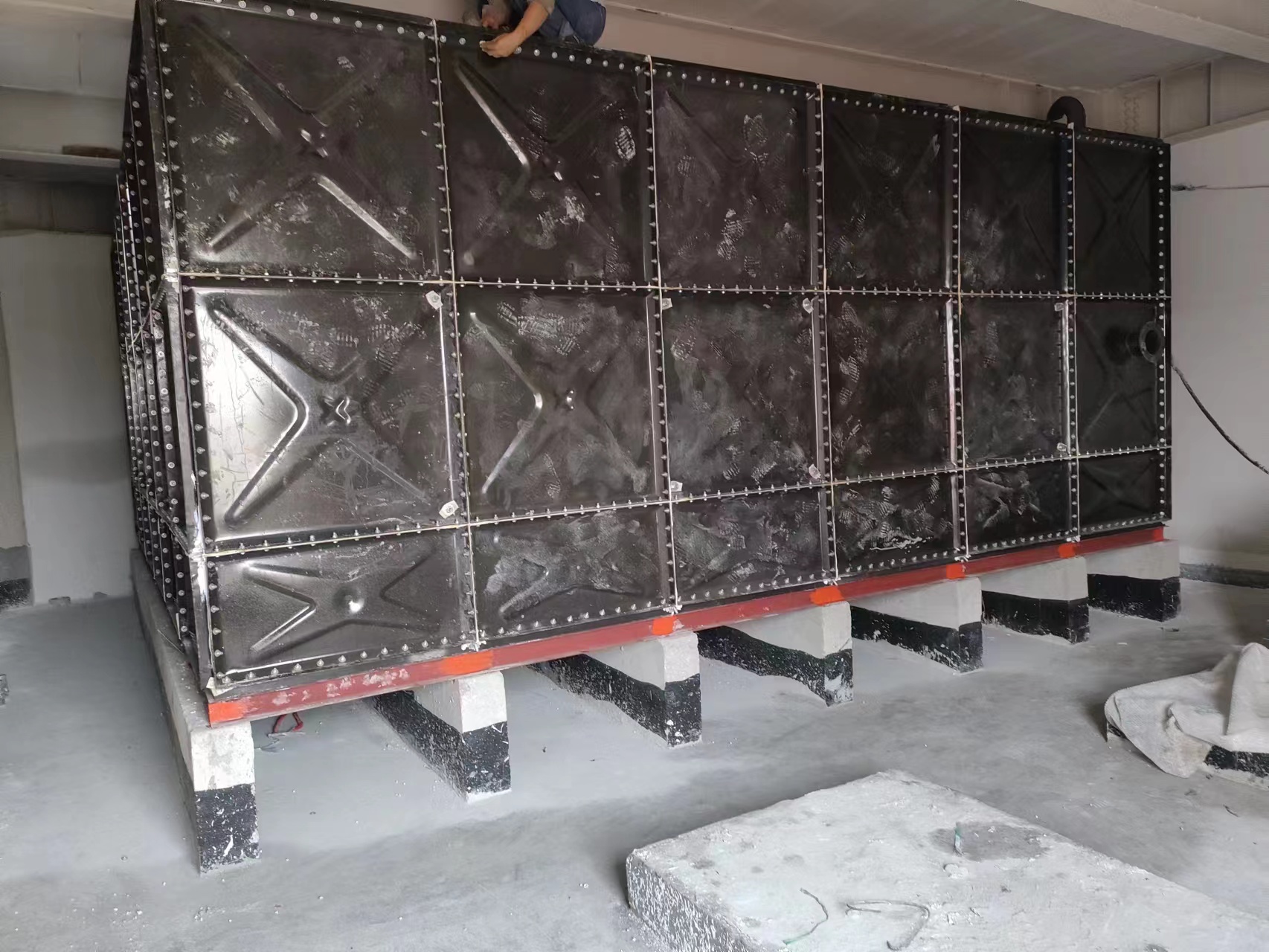
FRP Water Tank Modular Assembly: A Complete Guide from Panels to Finished Product
Modular assembly has become the dominant method for FRP (Fiberglass Reinforced Plastic) water tank construction. Unlike welded steel or concrete tanks, this process uses standardized SMC compression-molded panels that are bolted together on-site with high-strength fasteners and EPDM gaskets. Beijing Yuanhui FRP Co., Ltd. has delivered over 800 modular tanks in northern China, with the largest single unit reaching 3,000 m³ and an assembly time of just 15 days. This article breaks down the process into four key areas: materials, joining, sealing, and installation.
1. SMC Molded Panels: The Building Blocks
Standardization is the foundation of modular assembly. SMC sheets are compression-molded under high temperature and pressure into panels with thicknesses of 5 mm, 8 mm, 10 mm, or 12 mm—each grade corresponds to a specific hydrostatic pressure rating. Beijing Yuanhui uses standard panel sizes of 1 m × 1 m and 1 m × 0.5 m, with each panel weighing between 15 and 25 kg for easy manual handling. The panels feature 5 mm seal grooves and M10 bolt holes with a positional tolerance of ±0.2 mm, ensuring alignment rates above 98% during assembly.
Mechanical properties directly impact tank service life. Per GB/T 17219, SMC panels must have a flexural strength of at least 120 MPa and a Barcol hardness of no less than 45. Beijing Yuanhui conducts batch sampling tests; in the first half of 2024, the pass rate was 99.7%.
2. Bolts and Sealing Gaskets: Preventing Leaks
Panel joints use M10 stainless steel bolts (304 or 316 grade) with PTFE washers. The recommended torque is 35–40 N·m—too high causes local stress concentration, too low leads to loosening. In a food plant project in Tianjin, uneven bolt torque caused seam leakage at a rate of 3.2%. Beijing Yuanhui switched to calibrated torque wrenches for every bolt, reducing the leak rate to 0.15%.
Gaskets are made of EPDM rubber with a Shore A hardness of 65±5 and compression set ≤25%. The wedge-shaped cross-section allows 30–40% compression after installation, accommodating thermal expansion in environments with temperature swings of up to 50°C. In northern China winters, this seal design maintains zero leakage.
3. On-Site Assembly: From Foundation to Full Water Test
The on-site assembly follows six steps:
- Foundation preparation: Concrete base flatness must be ±3 mm/m. Steel channels or galvanized square tubes serve as bottom supports. Beijing Yuanhui used laser leveling at a Hebei project, achieving 100% first-pass acceptance.
- Bottom panel installation: Panels are laid from center outward. Bolts are tightened in two stages: first to 20 N·m, then to 40 N·m. Epoxy mortar fills the gap between panels and foundation to eliminate voids.
- Wall panel installation: Panels are staggered so vertical seams are offset by at least 300 mm. A level checks verticality after each row, keeping deviation ≤2 mm/m.
- Roof and tie rods: The roof uses the same modular panels. Stainless steel tie rods (spaced 1.2 m × 1.2 m) are installed inside to prevent panel deformation under water pressure.
- Accessories: Manholes, ladders, inlet/outlet pipes, and level gauges are installed. Flanged connections use double sealing, and bolt torque follows the manufacturer's specifications.
- Full water test: The tank is filled to design level and left for 72 hours. Total leakage must not exceed 0.01% of tank volume.
4. Common Issues and Process Improvements
Even modular assembly has challenges. Typical problems include:
- Bolt loosening: After 3–6 months, vibration or temperature changes can reduce bolt preload. Beijing Yuanhui applies torque-marking paint on bolt heads so loose bolts are visible during routine inspection.
- Gasket aging: EPDM gaskets exposed to UV last about 10 years; indoor installation extends this to 15 years. Replacement every 5 years is recommended.
- Panel damage: Edge cracks occur during transport or installation. After adding foam corner protectors, Beijing Yuanhui reduced the damage rate from 2.3% to 0.4%.
In 2023, Beijing Yuanhui introduced laser-guided alignment for panel positioning, boosting a 4-person crew's daily output from 25 m² to 40 m² while reducing rework.
Conclusion
Modular assembly of FRP water tanks solves the pain points of traditional tanks—transportation difficulties, long construction times, and high anti-corrosion costs. With standardized panels, precision bolting, and reliable sealing, on-site installation takes one-third the time of conventional methods. For projects with special water quality requirements (e.g., drinking water, purified water) or limited installation space, modular tanks offer greater flexibility. When sourcing, check panel test reports, gasket materials, and installer qualifications, and request a full water test video record if possible.