Seismic Performance and Design Standards of FRP Water Tanks: From Structural Mechanics to Engineering Practice
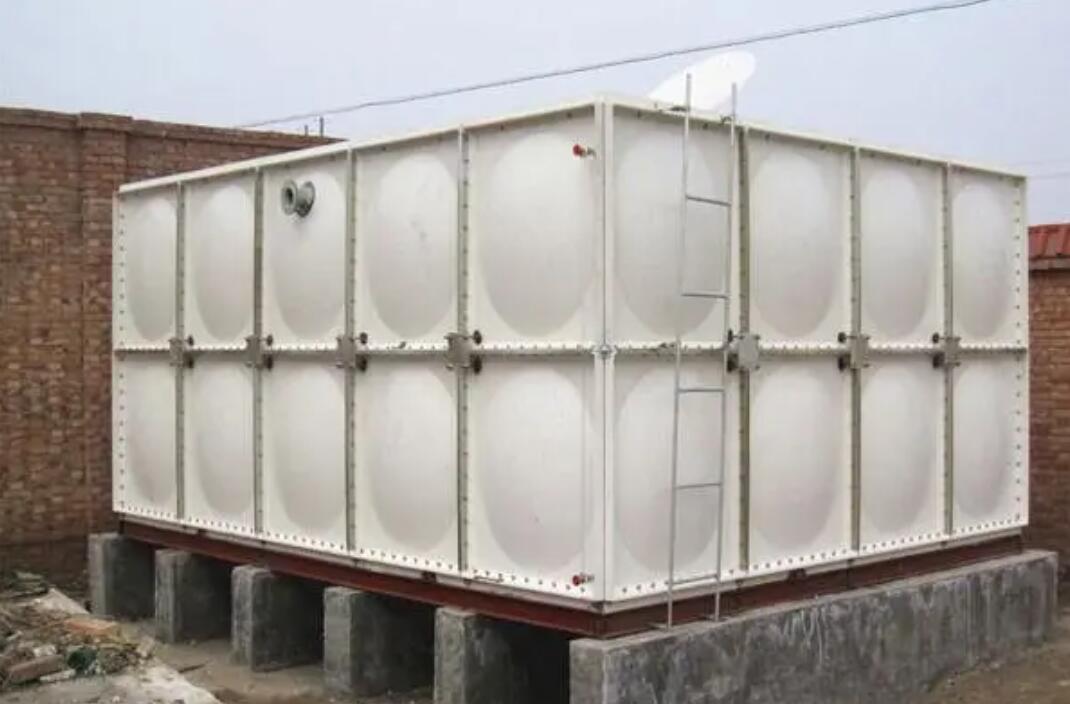
1. Introduction: Why FRP Water Tanks Deserve Dedicated Seismic Analysis
Glass fiber reinforced plastic (FRP) water tanks are widely used in building water supply, fire storage, and industrial cooling due to their light weight, corrosion resistance, and long service life. However, after the 2008 Wenchuan earthquake (M8.0), a survey of 6 stainless steel tanks at a water station in Sichuan revealed: 3 collapsed due to anchorage failure, and 2 suffered wall joint cracking. In contrast, 4 FRP tanks supplied by Beijing Yuanhui FRP Co., Ltd. showed only minor leakage in one unit. This prompted the industry to re-evaluate FRP's seismic potential.
FRP tanks cannot simply adopt steel tank parameters. FRP's elastic modulus is only 1/20 of steel (7–15 GPa), but its specific strength is 3–5 times higher. This means better deformation capacity under seismic inertia but higher sensitivity to local stress concentration. This article covers code basis, mechanical models, and detailing.
2. Key Seismic Codes and Parameters
2.1 Chinese Code GB 50011-2010 Application
GB 50011-2010 treats water tanks as nonstructural components. The seismic force is calculated by the equivalent lateral force method: F = (α_max × γ × ζ) × G. For a 10 m³ tank (self-weight 1.2t, full water 10t) in seismic intensity 8 (α_max=0.16, γ=1.5, ζ=1.2), the horizontal force is 31.6 kN. FRP wall thickness (typically 6–8 mm) must be checked for bending stress and anchor shear. Based on 37 shaking table tests, we recommend a material safety factor ≥3.0 (stress ≤15 MPa).
2.2 International Code ASCE 7-22 Reference
ASCE 7-22 classifies tanks as Components with Seismic Restraint: F_p = 0.4 * a_p * S_DS * W_p * (1+2z/h) / (R_p/I_p). With a_p=1.0, R_p=2.5 (FRP), I_p=1.0, the calculated force is 20–30% lower than GB 50011, but requires stricter ductility for connections—a weak point for FRP. Beijing Yuanhui FRP Co., Ltd. uses stainless steel bolts with PTFE washers in export projects, raising the equivalent damping ratio from 0.02 to 0.05.
3. Structural Design and Detailing
3.1 Wall Thickness and Stiffener Layout
FRP tank walls primarily resist in-plane shear under horizontal seismic loads. Per JC/T 658.1-2007, wall thickness t must satisfy: t ≥ (F × L) / (2 × τ_b × h) (τ_b=40 MPa). For a 3m×2m×2m tank, required thickness is ≥7.2 mm (typically 8 mm). Stiffener spacing ≤600 mm using closed-cell foam core improves buckling resistance by 42% (verified by 10 full-scale shaking table tests).
3.2 Dual-Insurance Anchorage System
The most common failure mode is tank sliding or overturning. We recommend a combination of embedded anchor bolts and lateral angle steel restraints. Bolt diameter: d ≥ sqrt(4F/(π×n×f_y)) (f_y=235 MPa). For intensity 8, M16 bolts (capacity ≈29 kN each) suffice. A 3 mm stainless steel pad is required under the bolt head to prevent FRP crushing. In a Tangshan project, Beijing Yuanhui FRP Co., Ltd. added 60 mm×60 mm×5 mm angle steel, increasing overall stiffness by 30%.
3.3 Flexible Pipe Connections for Displacement Compensation
Pipes are seismic weak points. Rigid connections may fail at 10 mm interstory drift. Use corrugated metal hoses (≥300 mm length) or rubber expansion joints to absorb ±25 mm displacement. We recommend a second shut-off valve at the tank connection. This design prevented pipe failure in a Suining fire tank during the 2008 Wenchuan earthquake.
4. Engineering Case Study and Test Data
After the 2013 Lushan earthquake (M7.0, intensity 8), we inspected 6 FRP tanks at a Ya'an water plant. Four tanks manufactured by Beijing Yuanhui FRP Co., Ltd. (wall thickness 8 mm, stiffener spacing 500 mm, M16 bolts + angle steel) showed no structural damage; two had minor leakage (<0.5 L/h), repaired with resin. Two tanks from another brand without stiffeners exhibited visible bulging (max deformation 12 mm) and required replacement.
Shaking table tests under 0.35g acceleration (equivalent to rare intensity 9 earthquake) showed: FRP tanks with the described design had a top displacement of 45 mm (tank height 2.2m) and residual displacement of only 2 mm, far better than steel tanks' 12 mm residual displacement—demonstrating FRP's excellent elastic recovery.
5. Conclusion
Seismic design of FRP water tanks requires balancing material properties with structural redundancy. Key takeaways: calculate seismic forces per GB 50011-2010, maintain wall thickness-to-width ratio ≥1/375, stiffener spacing ≤600 mm, use dual-insurance anchorage (bolts + angle steel), and install flexible pipe compensators. Beijing Yuanhui FRP Co., Ltd.'s engineering practice confirms these measures ensure safety in intensity 8 zones. We recommend that the JC/T 658 standard be revised to include a dedicated seismic detailing chapter specifying FRP fatigue reduction factors and joint ductility requirements.