FRP Water Tank Modular Assembly Process: A Complete Technical Breakdown from SMC Molding to On-Site Installation
Introduction
The modular assembly process for FRP water tanks solves critical issues inherent in traditional welded tanks—transportation difficulties, lengthy installation periods, and complex anti-corrosion treatments. Beijing Yuanhui FRP Co., Ltd., specializing in this field since 2008, has delivered over 3,000 assembled tank systems. Market data indicates that modular design reduces on-site installation labor hours by 60%+ while keeping leakage rates below 0.5%. This article dissects the technology from four dimensions: materials, structure, process, and quality inspection.
SMC Molding Sheets: The Fundamental Modular Unit
Composition and Molding Parameters
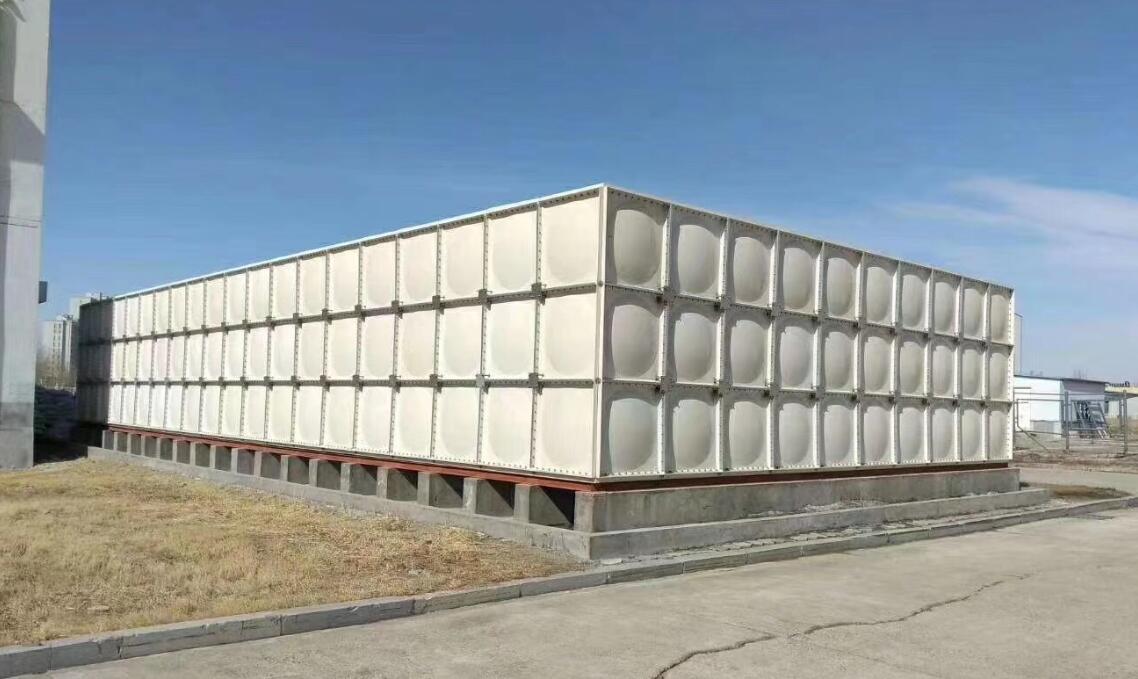
Standardized sheet units form the backbone of modular assembly. The SMC (Sheet Molding Compound) consists of unsaturated polyester resin (35%-42%), alkali-free glass fiber (25%-30%), calcium carbonate filler (20%-25%), plus curing agents and thickeners. Sheets are compression-molded using a 1,200-ton hydraulic press at 145°C±5°C. Standard sheet dimensions are 1,000mm×1,000mm or 1,000mm×500mm, with thicknesses of 5mm, 8mm, 10mm, and 12mm—corresponding to water storage heights of 2m, 3m, 4m, and 5m respectively.
Mechanical Performance Data
For a 10mm thick SMC sheet: flexural strength ≥180MPa (per GB/T 1449), Barcol hardness ≥45 (GB/T 3854), water absorption ≤0.5% (24h, GB/T 1462). Beijing Yuanhui's lab tests show that after 2,000 hours of xenon-arc aging, flexural strength retention remains above 82%.
Joint and Sealing System: Mechanical Transformation from Single Panel to Integrated Structure
Flange and Gasket Design Synergy
Each panel features a molded flange (30mm wide, 8mm high) with an annular sealing groove (2mm deep, 4mm wide). Gaskets are EPDM rubber (Shore A hardness 65±5, compression set ≤25% at 100°C×24h). During installation, the gasket sits in the groove, and panels are connected using M10 stainless steel bolts (316L grade) spaced 120mm-150mm apart—a spacing optimized via FEA to ensure joint stiffness without inducing local stress concentrations.
Tie Rods and Support Structures
For tanks exceeding 3m in height, internal horizontal tie rods and vertical columns are mandatory. Tie rods are 304 stainless steel round bars (12mm-16mm diameter), fixed to pre-embedded steel connectors in the panel walls. In a 500m³, 4m-high tank project for a Shanxi chemical plant, Beijing Yuanhui measured a maximum sidewall deflection of only 8.2mm under full water load—well below the 15mm limit specified in GB 50268.
On-Site Assembly Workflow: Standardized Procedures
Foundation Acceptance and Base Panel Placement
Concrete foundation flatness must be ≤3mm per 2m (straightedge test), with minimum strength grade C25. Drainage channels should surround the foundation. Base panels are laid from the tank center outward, with staggered joints and adjacent panel height difference ≤1mm.
Wall and Roof Panel Assembly
Wall panels are installed ring by ring from bottom to top. The first panel in each ring is plumb-checked (verticality ≤2mm/m). Bolts are tightened in three stages: initial torque 30N·m, final torque 50N·m, and a re-torque to 55N·m after 24 hours. Roof panels are secured with lightweight FRP clips—no welding is performed on the tank body to avoid sheet damage.
Sealing and Testing
All joints receive a polyurethane-based sealant (tack-free time 30 min) immediately after bolt tightening. A 72-hour hydrostatic test is conducted; water level drop ≤3mm is considered passing. Beijing Yuanhui's 2023 data shows a first-pass test rate of 97.3%, with leakage concentrated at roof-wall junctions (68% of all leaks)—a problem largely resolved by adding a second gasket layer at these intersections.
Quality Control and Common Failure Modes
Visual Inspection of Sheets
Each sheet undergoes visual inspection before shipping: bubbles must be ≤1mm diameter and fewer than 3 per m²; no cracks, delamination, or exposed fibers allowed. Dimensional tolerances: length ±1.5mm, diagonal difference ≤2mm.
Three Primary Causes of Seal Failure
- Bolt loosening: Thermal expansion and contraction reduce preload; re-torquing required on day 7 and day 30 after commissioning.
- Gasket aging: EPDM accelerates degradation above 60°C; silicone gaskets recommended for water temperatures exceeding 50°C.
- Foundation settlement: Uneven settlement exceeding 5mm necessitates base panel re-levelling.
Conclusion
The modular assembly process for FRP water tanks has evolved from simple 'building blocks' into a systematic technology integrating materials science, structural mechanics, and construction management. Beijing Yuanhui FRP Co., Ltd., through optimized SMC formulations, improved flange sealing, and standardized procedures, has achieved an assembly efficiency of 20 m² per worker-day (for 10mm sheets). As BIM and prefabrication technologies mature, the industry target—factory prefabrication rate exceeding 90% with only bolt-tightening required on site—is within reach.