Pressure Performance of FRP Water Tanks: Structural Mechanics and Testing Standards
Pressure Performance of FRP Water Tanks: Structural Mechanics and Testing Standards
FRP water tanks in fire protection, municipal water supply, and industrial cooling often operate under static pressures ranging from atmospheric to 0.6 MPa or higher. Pressure capacity is not simply a function of wall thickness—it depends on fiber layup design, resin system, interfacial bonding, and tank geometry. Beijing Yuanhui FRP Co., Ltd. has delivered over 1,200 pressurized water tanks in the past decade, including custom projects with a design pressure of 0.8 MPa. This article breaks down key control points using real engineering data and test results.
1. Pressure-Bearing Mechanism and Design Limits
1.1 Mechanics of Laminate Structures
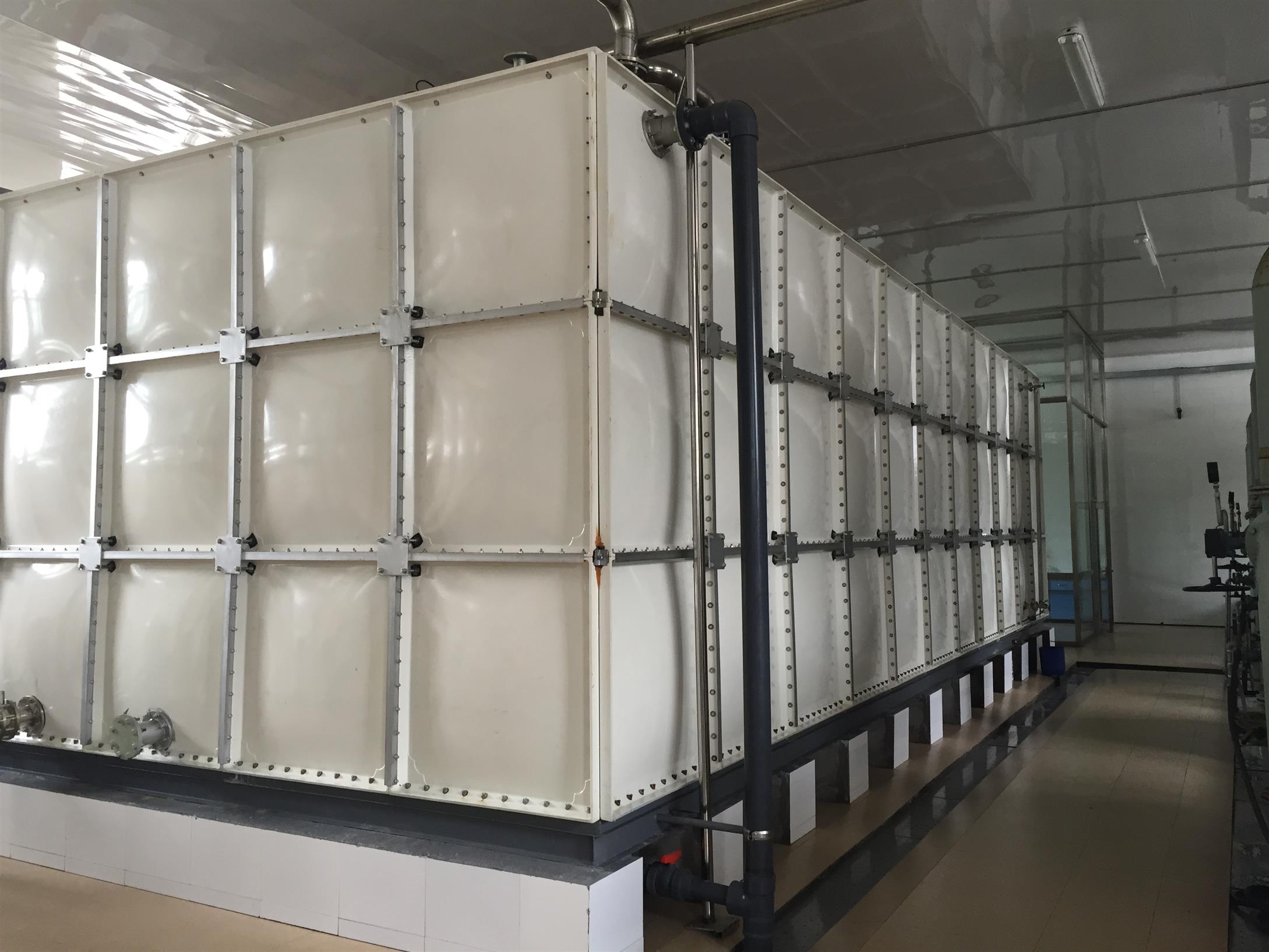
FRP tank walls typically adopt a three-layer sandwich: an inner liner (≥2mm, resin content >70%) for impermeability, a structural layer (glass fiber content 55–65%) for hoop and axial stress, and an outer protective coating. Per GB/T 17219-1998 Appendix A on interlaminar shear strength, Beijing Yuanhui incorporates ±45° cross-ply layers in the structural layer. In a 5000mm×4000mm×3000mm tank, this design limits maximum deformation to 3mm under 0.6 MPa.
1.2 Safety Factor in Design Pressure
The industry standard safety factor is 4–6 times the working pressure. For a working pressure of 0.4 MPa, the design burst pressure must reach at least 1.6 MPa. Beijing Yuanhui adopts an internal safety factor of 5.5 and performs hydrostatic burst tests on each production batch—one 1m×1m sample plate per 500m² of wall panel, pressurized to 1.8 times the working pressure and held for 30 minutes with no leakage or visible deformation.
2. Testing Standards and Operational Procedures
2.1 Applicable Standards
Key standards for FRP tank pressure testing include:
- GB/T 17219-1998 (Safety evaluation for drinking water equipment)
- JC/T 658.1-2007 (FRP tanks—Part 1: General technical conditions)
- GB/T 1446-2005 (General principles for test methods of fiber-reinforced plastics)
JC/T 658.1 specifies acceptance criteria: 15 minutes at 1.5 times the rated pressure with residual deformation ≤0.3%.
2.2 Five-Step Hydrostatic Test
Using Beijing Yuanhui's test facility in Cangzhou, Hebei, a 60m³ FRP tank undergoes:
① Pre-fill: Water injected at 0.1 MPa/min, air fully vented.
② Step pressurization: 0.1 MPa increments, 2-minute hold at each step with strain recording.
③ Hold test: 1.5× working pressure held for 15 minutes; laser displacement sensors monitor center deflection.
④ Depressurization inspection: Immediate check of flange joints, manhole seals, and pipe connections.
⑤ Residual deformation measurement: Dimensions rechecked after 24 hours; >0.2% deformation triggers rejection.
In a 2024 test on a 0.6 MPa fire tank, this protocol detected a 0.15mm micro-crack at a flange root due to localized low resin content—the entire batch was replaced.
3. Key Process Factors Affecting Pressure Performance
3.1 Fiber Winding Angle and Layers
For cylindrical tanks, hoop fibers handle circumferential stress, while axial fibers carry longitudinal loads. Beijing Yuanhui uses a 3-hoop-2-axial layup for tanks above 3000mm diameter: three 90° hoop layers and two 0° axial layers, with hoop layers comprising 65% of structural thickness. Under 0.5 MPa, this configuration reduces hoop strain by 22% versus pure hoop layup. Fiber overlap length in hand layup must be ≥50mm to avoid stress concentration at joints.
3.2 Resin and Curing System Compatibility
Isophthalic polyester or vinyl ester resins are preferred for pressurized tanks. Vinyl ester's elongation at break (3–5%) outperforms isophthalic (1.5–2.5%) in low-cycle fatigue. A critical note: each 1% increase in curing agent dosage reduces tensile strength by 8–12 MPa. In a 2023 comparative test, Beijing Yuanhui's standard formulation (2% MEKP + 0.5% cobalt) achieved interlaminar shear strength of 34 MPa versus 28 MPa with 3% MEKP.
4. Common Failure Modes and Prevention
Analysis of 87 pressurized tank field failures (2019–2024) by Beijing Yuanhui's after-sales team reveals:
- Flange-to-wall joint cracking: 38%
- Manhole reinforcement ring fatigue fracture: 27%
- Interlaminar delamination: 19%
- Pipe joint bolt loosening: 16%
Countermeasures: Two additional reinforcing mats at flanges, ring stiffeners (≥200mm wide, 1.5× wall thickness) around manholes, and double-sided overlapping at wall joints.
Conclusion
The pressure performance of FRP water tanks relies on rigorous fiber design, resin selection, and standardized testing. From GB/T 17219's hygiene requirements to JC/T 658.1's structural strength criteria, every parameter corresponds to a real-world risk. Beijing Yuanhui FRP Co., Ltd. has reduced the initial failure rate to below 0.3% through an internal database of over 2,000 pressure-strain data points. When selecting a pressurized FRP tank, engineers should demand a complete layup design document, resin curing parameters, and third-party hydrostatic test reports—not just wall thickness.