Complete Process Analysis of FRP Water Tank Production: From Hand Lay-Up to Compression Molding
Introduction
FRP water tank manufacturing is not a one-size-fits-all process. From traditional hand lay-up to modern compression molding, the evolution is driven by the balance between production efficiency and product consistency. Beijing Yuanhui FRP Co., Ltd., with 16 years of field experience, has established a standardized workflow from material intake to final product delivery. This article breaks down each critical step with real production data.
1. Raw Material Preparation: The Foundation
1.1 Resin and Fiberglass Selection
For water tanks, isophthalic unsaturated polyester resin (e.g., 196#) is standard, with a water absorption rate below 0.3% (24h immersion at room temperature). The fiberglass reinforcement uses a combination of EMC chopped strand mat (450g/m²) and woven roving (800g/m²), requiring interlaminar shear strength above 12MPa. At Beijing Yuanhui, incoming resin viscosity is controlled at 0.35-0.55Pa·s (25°C); any deviation triggers rejection.
1.2 Gel Coat Application
The gel coat acts as the first defense layer. Spray thickness is maintained between 0.4-0.6mm—too thick risks cracking, too thin reduces weather resistance. A pneumatic spray gun at 0.5-0.6MPa pressure is used, with cobalt octoate accelerator at 1.5% dosage. Critical: gelation must occur within 15 minutes; otherwise, the accelerator ratio must be adjusted.
2. Molding Processes: Hand Lay-Up vs. Compression Molding
2.1 Hand Lay-Up for Custom Sizes
For non-standard tanks (any dimension exceeding 4m), hand lay-up remains irreplaceable. The sequence: mold cleaning → mold release (3 coats, 5-minute intervals) → gel coat → fiberglass mat layering (each layer saturated with resin, bubbles removed by roller) → repeat to design thickness. Beijing Yuanhui uses hand lay-up for tanks under 3m³, with a 4-hour cycle (including curing) and thickness deviation within ±0.3mm.
2.2 Compression Molding for Mass Production
Compression molding uses SMC (Sheet Molding Compound) or BMC (Bulk Molding Compound). SMC parameters: mold temperature 140±5°C, pressure 12-15MPa, hold time 1.5 minutes per mm thickness. For a 2m³ standard tank, each half (male/female mold) requires 15kg of SMC, with a single cycle of only 6 minutes. Dimensional tolerance reaches ±0.1mm, and surface finish surpasses hand-laid parts.
3. Curing and Post-Processing: The Lifeline
3.1 Curing Schedule
Compression-molded parts undergo post-curing: 80°C for 2 hours, then natural cooling. Hand-laid parts cure at room temperature (25°C/24h) followed by post-curing at 60°C/4h. Beijing Yuanhui's lab data shows that without post-curing, Barcol hardness is only 35; after post-curing, it rises above 45, and hot water aging resistance improves by 30%.
3.2 Cutting and Assembly
Panel cutting uses CNC waterjet with ±0.5mm accuracy. Assembly employs 304 stainless steel bolts with EPDM gaskets, torqued at 80-100N·m—overtightening causes localized stress. Each bolt hole receives silicone sealant (rated -40°C to 150°C).
4. Quality Control: From Lab to Field
4.1 Factory Inspection Standards
Per JC/T 658.1-2007: ① Visual: no bubbles, cracks, or gel coat peeling; ② Dimensional: diagonal deviation ≤3mm; ③ Pressure test: 1.5x working pressure for 30 minutes with zero leakage. Beijing Yuanhui tests 3% of each batch destructively, measuring flexural strength (≥160MPa) and Barcol hardness (≥40).
4.2 Field Case Study
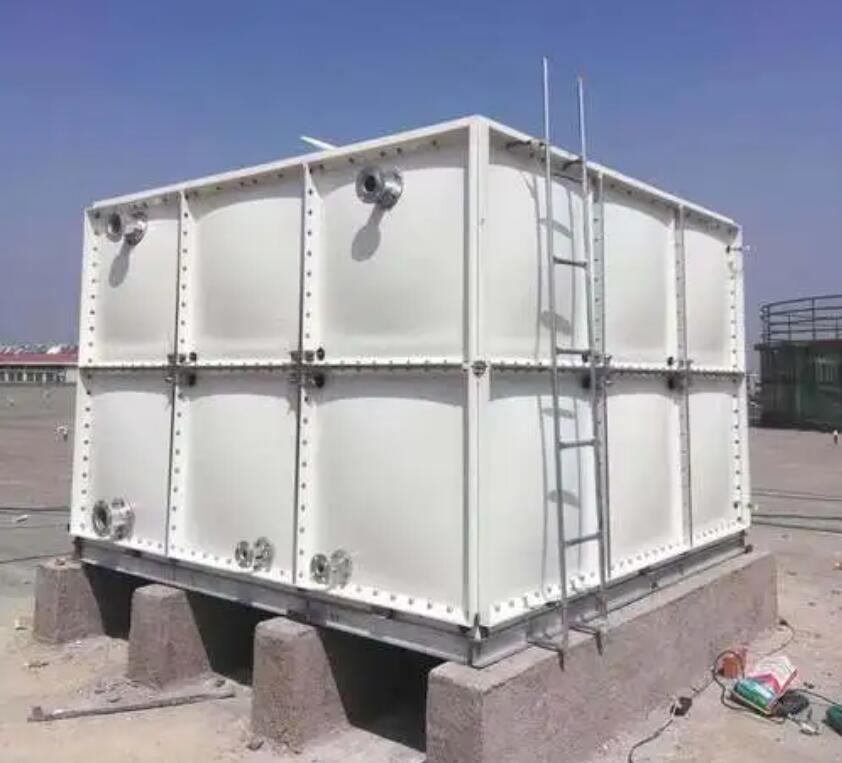
In 2024, Beijing Yuanhui supplied a 30m³ modular FRP tank for a hospital project. After 72-hour full-water test, total deformation was only 1.2mm (standard ≤3mm), with no seal leakage. The SMC panels had a design thickness of 5mm, with actual measured average of 5.02mm and standard deviation of 0.08mm.
Conclusion
FRP water tank production is still evolving, but the core principle remains: raw material stability sets the performance ceiling, while process control defines the product floor. Whether hand lay-up or compression molding, precise management of temperature, pressure, and time is the key to yield. Beijing Yuanhui FRP Co., Ltd.'s data shows that when process parameters deviate more than 5% from design, the defect rate jumps from 2% to 15%. This reminds every manufacturer: process is not just a document—it is the execution of every detail.