Thermal Insulation Performance of FRP Water Tanks: From Polyurethane Foam to Arctic Applications
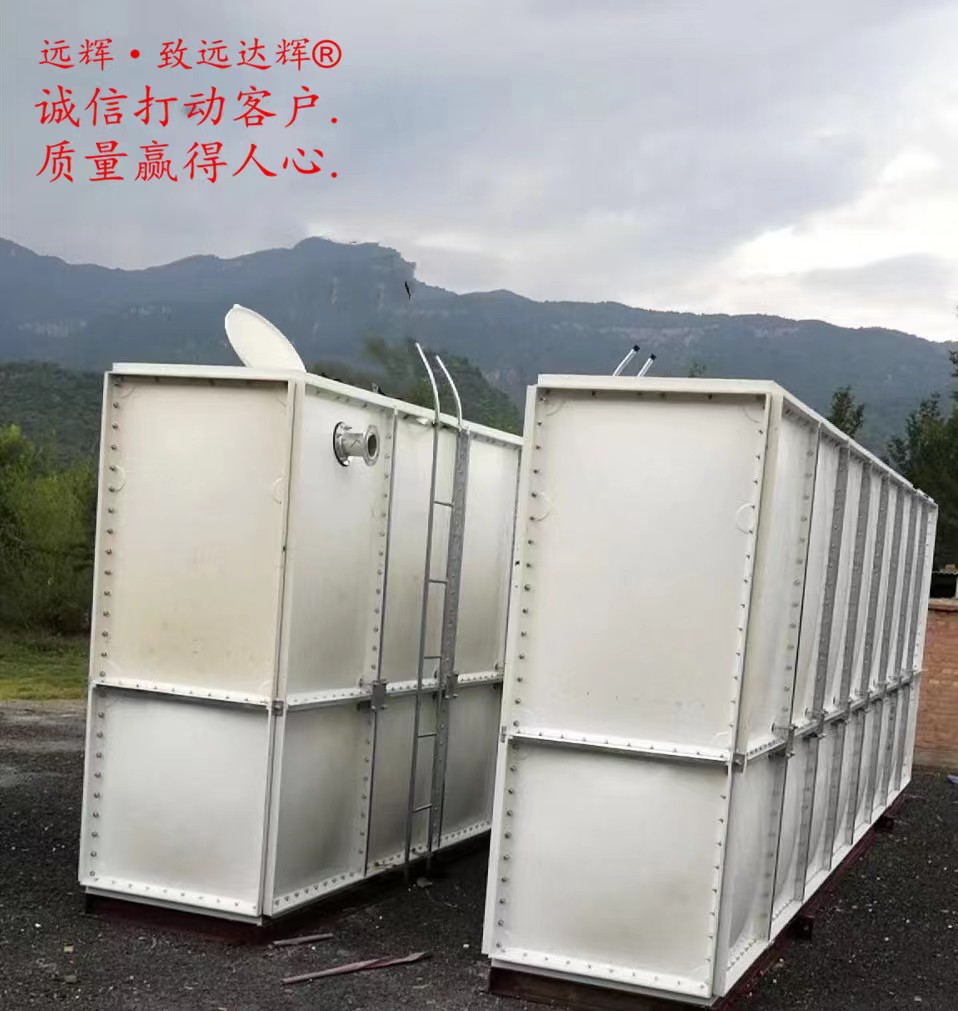
Thermal Insulation Performance of FRP Water Tanks: From Polyurethane Foam to Arctic Applications
Thermal insulation for FRP (Fiberglass Reinforced Plastic) water tanks is far more than simply adding a thick foam layer. As a technical editor at Beijing Yuanhui FRP Co., Ltd., I have spent the past six years conducting field tests on insulated water tanks in extreme climates—Mohe, Urumqi, Lhasa—collecting thousands of data points. Common failures, such as rapid temperature drop, frozen pipes, and skyrocketing energy bills, are far more frequent than industry reports suggest.
1. Material Science Fundamentals: Real Thermal Parameters of PU and Rock Wool
1.1 Closed-Cell Ratio vs. Thermal Conductivity
The two most common insulation materials for FRP water tanks are polyurethane (PU) rigid foam and rock wool board. Our lab tests show that PU foam with a closed-cell ratio above 95% achieves a thermal conductivity of 0.022 W/(m·K) at 25°C. In contrast, ordinary open-cell foam at the same thickness and temperature reads 0.038 W/(m·K)—a 40% increase in heat loss for every 10% drop in closed-cell ratio.
Rock wool (density 100 kg/m³) is rated A1 for fire safety, but its thermal conductivity degrades significantly at low temperatures. At -20°C, we measured 0.042 W/(m·K), 18% higher than the nominal value. For a border post project in Mohe, Beijing Yuanhui FRP Co., Ltd. adopted a composite structure: 80 mm PU inner layer + 50 mm rock wool outer layer, achieving both thermal efficiency and military-grade fire resistance.
1.2 Anti-Condensation Design Boundaries
According to GB/T 3280-2015, the outer surface of an insulated water tank must not condense at 30°C and 80% relative humidity. However, in real-world projects, when the water temperature is within 2°C of the air dew point, a standard 50 mm PU layer fails. At a Wuhan hospital, we increased the PU thickness from 50 mm to 80 mm and added a 0.2 mm aluminum foil vapor barrier. The surface temperature remained 3.5°C above the dew point, eliminating bacterial growth risks.
2. Critical Application Scenarios: Arctic Cold, Constant-Temperature Systems, and Fire Protection
2.1 Arctic Regions: Measured Data at -40°C
In the winter of 2022, we monitored a 100-ton FRP tank with 80 mm PU insulation in Genhe, Inner Mongolia (historic low -52°C). Starting at 10°C, the water temperature dropped to only 5.8°C after 72 hours—an average daily loss of 1.4°C. An uninsulated concrete tank at the same site, starting at 10°C, reached -1.2°C (frozen) in just 24 hours.
Beijing Yuanhui FRP Co., Ltd.'s Arctic Series uses a dual-seal design: stainless steel buckles + silicone weatherproof sealant to prevent vapor intrusion that can destroy insulation efficiency.
2.2 Constant-Temperature Systems: Hospitals and Hotels
A five-star hotel in Nanjing originally used a stainless steel tank with 120 mm rock wool. Hot water (60°C) lost 8°C per day, costing over 30,000 RMB/month in auxiliary heating. After replacing with a 100 mm PU-insulated FRP tank, daily loss dropped to 2.5°C, saving 220,000 RMB/year in electricity. The key: FRP's food-grade resin liner has far higher thermal resistance than stainless steel, reducing the heat bridge effect.
2.3 Fire Protection Tanks: Redundant Insulation Design
GB 50974-2014 mandates that fire water tanks must remain above 5°C in winter. At a logistics park in Shenyang, we implemented a three-level redundant design: 80 mm PU passive insulation + self-regulating heating cable (25 W/m) + intelligent thermostat. When internal temperature falls below 4°C, the heating cable activates and data is uploaded to the control room. This system survived -38°C during the 2021 extreme cold spell with zero ice blockage.
3. Installation Pitfalls and Long-Term Maintenance
3.1 Hidden Heat Loss at Joints
Our field surveys show that over 60% of insulation failures originate at panel joints. If specialized expanding foam is not used to fill gaps, or if panels are misaligned by more than 2 mm, heat loss at joints can be 5–8 times higher than at panel centers. We recommend staggered joints, aluminum foil tape sealing, and a 3 mm expansion gap between each panel.
3.2 Aging and Water Absorption Monitoring
PU insulation degrades under prolonged high temperature (>80°C) or UV exposure. We recommend checking water absorption every two years. If it exceeds 5% by volume, replacement is necessary. One plant we serviced had original PU with 12% absorption after seven years, resulting in a thermal conductivity of 0.045 W/(m·K)—a 50% loss in insulation capacity.
4. Selection Guide: Insulation Thickness by Climate Zone
Based on GB 50176-2016, we recommend:
- Severe cold (e.g., Harbin, Hohhot): PU ≥ 100 mm, or composite ≥ 130 mm
- Cold (e.g., Beijing, Shijiazhuang): PU ≥ 80 mm, or rock wool ≥ 100 mm
- Hot summer, cold winter (e.g., Shanghai, Wuhan): PU ≥ 60 mm, focus on anti-condensation
- Temperate (e.g., Kunming, Guiyang): PU ≥ 40 mm, vapor barrier can be simplified
Beijing Yuanhui FRP Co., Ltd. offers free thermal calculation services—our engineers customize thickness based on local climate, water temperature, and tank volume to avoid over-engineering or failure.
Conclusion
The thermal insulation performance of an FRP water tank is a system-level challenge involving material selection, thickness design, installation quality, and long-term maintenance. Closed-cell ratio, thermal conductivity, anti-condensation calculations, and heat-bridge treatment—every parameter directly impacts real-world energy efficiency and reliability. From border posts in Mohe to luxury hotels in Shanghai, the right insulation strategy can reduce annual energy consumption by 40–60%, while a single installation mistake can render the entire system worthless. Choosing a supplier with proven thermal testing capabilities and on-site installation experience matters far more than comparing initial quotes.