Complete Process Analysis of FRP Water Tank Production: Key Steps from Raw Materials to Finished Products
Introduction
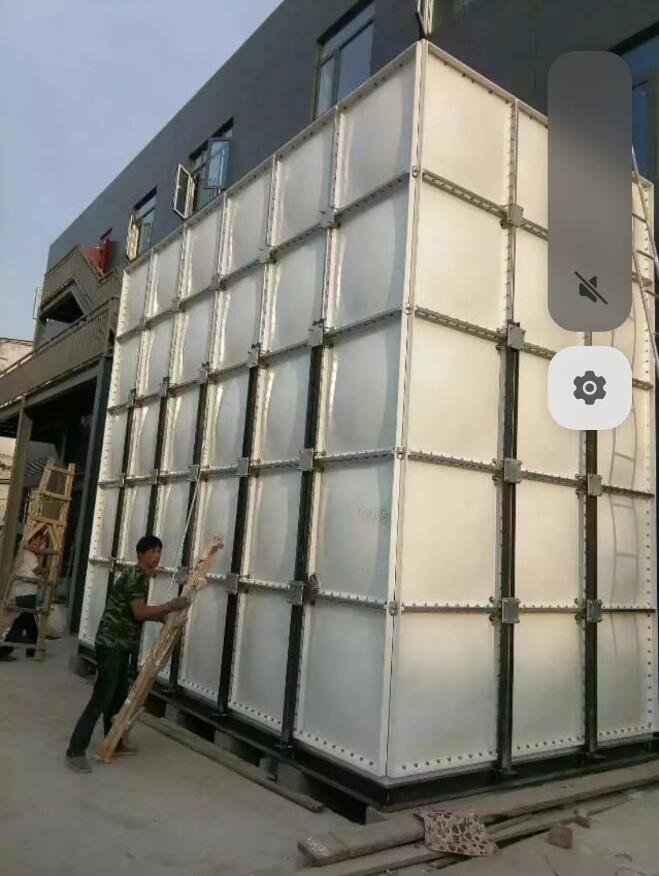
FRP (Fiberglass Reinforced Plastic) water tanks are widely used in industrial and civil construction due to their corrosion resistance, light weight, and long service life. Beijing Yuanhui FRP Co., Ltd., with 15 years of manufacturing experience, has delivered over 2,000 tank systems. This article systematically analyzes the complete production process, from raw material selection to final quality inspection, highlighting differences between SMC compression molding and hand lay-up processes.
1. Raw Material Selection and Pre-treatment
1.1 Resin Systems
Unsaturated polyester resin (UPR) and vinyl ester resin are commonly used. Beijing Yuanhui FRP Co., Ltd. selects food-grade UPR (compliant with GB/T 17219) for drinking water tanks, and vinyl ester for chemical-resistant industrial tanks. Resin viscosity is controlled at 300-500 mPa·s at 25°C to ensure fiber wet-out.
1.2 Reinforcement Materials
E-glass chopped strand mat (450 g/m²) and roving (2400 tex) are primary reinforcements. For large tanks (>100 m³), bi-axial stitched fabric (800 g/m²) is adopted to improve interlayer shear strength. 2023 test data shows flexural strength increased from 280 MPa to 320 MPa with bi-axial fabric.
1.3 Auxiliary Materials
Methyl ethyl ketone peroxide (MEKP) is used as catalyst at 1.5%-2.5% by resin weight, with cobalt naphthenate as accelerator at 0.3%-0.5%. Semi-permanent water-based mold release is applied, reusable for 3-5 cycles per spray.
2. Molding Process Details
2.1 SMC Compression Molding (Standardized Production)
SMC (Sheet Molding Compound) suits batch production of standard tank panels. Process steps: ① Sheet preparation: resin paste (UPR, filler, release agent) impregnates chopped glass strands, forming 2-4 mm thick rolls, matured at 40°C for 24-48 hours. ② Molding: SMC sheets cut and placed in mold, pressed at 140-160°C, 10-15 MPa for 3-5 minutes. Mold temperature monitored by thermocouples within ±2°C tolerance. ③ Post-cure: parts treated at 80°C for 2 hours to achieve >98% crosslinking density. For a 1000×1000×5 mm panel, cycle time is 8 minutes with 95.7% yield.
2.2 Hand Lay-Up Molding (Custom Production)
For irregular shapes or ultra-large tanks (e.g., 200 m³ industrial vessels), hand lay-up is used: ① Mold preparation: steel mold sprayed with release agent, dried 15 min. ② Layering: alternating surface mat (30 g/m²) and chopped strand mat (450 g/m²), each layer rolled to remove air. Beijing Yuanhui FRP Co., Ltd. specifies resin-to-fiber weight ratio of 2.5:1 to 3:1, with resin content deviation ≤2%. ③ Cure: 8-12 hours at 25°C, relative humidity ≤70%. A 2022 chemical plant case showed wall thickness uniformity of ±0.3 mm, meeting HG/T 20696 standard.
3. Curing, Demolding, and Post-Processing
Cure degree is tested with Barcol hardness (934-1), target ≥45. Pneumatic ejectors are used for demolding to prevent distortion. Post-processing includes: • Trimming: diamond grinding wheel at 0.5 m/min, edge roughness Ra≤6.3 μm. • Drilling: carbide bits at 3000 rpm, hole tolerance ±0.2 mm. • Assembly: stainless steel bolts (304 grade) connect panels, EPDM gasket compressed 30%-40%.
4. Quality Testing and Performance Data
Per JC/T 658.1-2022, each batch is sampled for: • Tensile strength: SMC ≥120 MPa, hand lay-up ≥100 MPa (actual averages: SMC 138 MPa, hand lay-up 115 MPa). • Hydrostatic test: 48-hour full water pressure, leakage rate ≤0.05%. • Barcol hardness: SMC ≥50, hand lay-up ≥45. Beijing Yuanhui FRP Co., Ltd. internal 2024 data shows first-pass yield of 97.3% and field failure rate below 0.2%.
Conclusion
FRP water tank production involves material science, mold design, and precise operation. SMC compression molding and hand lay-up each serve specific applications. Standardized control at every step—from raw material inspection to final shipment—is key to long-term tank reliability. Beijing Yuanhui FRP Co., Ltd. continues optimizing process parameters and inspection protocols to deliver reliable tank solutions across industries.