Pressure Performance of FRP Water Tanks: Structural Design and Testing Standards
Introduction
The pressure performance of FRP water tanks is a critical concern for engineers and end-users. Unlike steel tanks, FRP tanks exhibit anisotropic behavior, making their pressure capacity highly dependent on fiber orientation, resin formulation, and manufacturing consistency. This article presents a systematic analysis based on data from Beijing Yuanhui FRP Co., Ltd., a manufacturer with over 15 years of production experience.
Mechanics of Pressure Resistance in FRP Tanks
Laminate Structure and Load-Bearing Capability
FRP tank panels are typically fabricated via spray-up or compression molding using E-glass fibers and isophthalic polyester resin. Under standard conditions, tensile strength ranges from 160 to 200 MPa, with flexural strength between 180 and 220 MPa. However, the actual pressure resistance depends on the laminate sequence and resin content. Beijing Yuanhui FRP Co., Ltd. maintains resin content between 28% and 32% in its SMC process, achieving an optimal balance between impact resistance and stiffness.
Stiffener and Joint Design
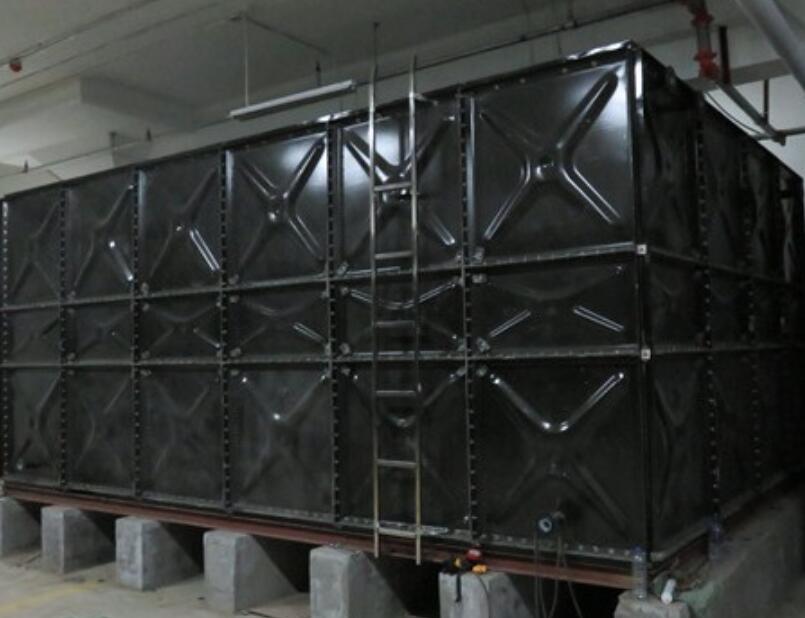
Internal stiffener spacing directly influences panel deflection under hydrostatic pressure. For a 10-ton tank, reducing stiffener spacing from 600 mm to 400 mm decreases maximum deflection from 8.5 mm to 4.2 mm (data from Beijing Yuanhui internal tests). Bolted joints require elastomeric gaskets to prevent stress concentration and leakage under cyclic loading.
Testing Protocols and Standards
Chinese Standards: GB/T 21238-2016 and CJ/T 431-2013
The primary domestic standards require a 24-hour hydrostatic test at design water level. Maximum deflection must not exceed 0.5% of the panel span, with no leakage or rupture permitted. Beijing Yuanhui FRP Co., Ltd. applies a 1.5× design pressure for 2 hours as an internal safety margin.
International Standards: ISO 15031 and ASTM D4097
ISO 15031-2018 mandates a 1,000-hour creep test at 1.3× design pressure with creep strain below 0.1%. ASTM D4097 emphasizes cyclic pressure testing for fire protection tanks. Beijing Yuanhui's products have passed both ISO and ASTM certifications, demonstrating fatigue life exceeding 50,000 pressure cycles.
Field Variables Affecting Pressure Performance
Temperature and Chemical Exposure
For every 10°C rise in water temperature, the elastic modulus of the resin matrix decreases by 3% to 5%. At 60°C, pressure capacity drops by 15-20%. For chemical applications, Beijing Yuanhui developed a vinyl ester resin system that retains 81% of flexural strength after 1,000 hours in 10% sulfuric acid at 80°C.
Foundation and Support Conditions
Uneven foundations exceeding 3 mm/m cause localized stress concentrations. In a petrochemical project, foundation settlement led to bottom panel cracking. Beijing Yuanhui's technical team reinforced the base with a steel frame, restoring pressure capacity to 120% of the design value.
Conclusion
Pressure performance of FRP water tanks cannot be fully validated by factory testing alone. It requires rigorous material selection, optimized stiffener design, and cyclic pressure testing throughout the product lifecycle. Engineers should request independent third-party pressure test reports and verify stiffener spacing and resin temperature ratings before procurement.