FRP Water Tank Modular Assembly Process: Complete Technical Analysis from SMC Molding to On-Site Installation
Introduction
Modular assembly of FRP water tanks is far more than bolting panels together. Each stage—from SMC compression molding to gasket selection, bolt torque control, and on-site adaptation—determines the tank's long-term reliability. Beijing Yuanhui FRP Co., Ltd. has installed over 800 modular FRP tanks across North China. This article breaks down the technical logic of this process based on real production and field experience.
1. Precision Control of SMC Molded Panels
1.1 Mold Design and Shrinkage Compensation
Geometric consistency of individual panels is the foundation of modular assembly. SMC material shrinks 0.15%–0.3% linearly during cooling after molding. Beijing Yuanhui uses CNC-machined molds with pre-compensated cavity dimensions to keep panel tolerances within ±0.5 mm. For example, a nominal 1000 mm × 1000 mm panel is molded to 1001.5 mm × 1001.5 mm (post-shrinkage), ensuring uniform joint gaps on site and avoiding local stress concentration.
1.2 Flange Flatness and Sealing Groove
Flange flatness directly affects sealing performance. Our internal QC data require flatness ≤0.3 mm/m; otherwise, uneven gasket compression occurs after bolt preloading. The sealing groove is molded in one shot with a depth of 3.0 mm ± 0.1 mm and width of 12.0 mm ± 0.2 mm, ensuring the EPDM gasket fully embeds and compresses uniformly. Compression ratio is controlled between 35%–45%—too low causes leakage, too high accelerates gasket aging.
2. Sealing System and Bolt Torque Management
2.1 Gasket Material Selection
For potable water tanks, gaskets must comply with GB/T 17219-1998. Beijing Yuanhui selects EPDM with tensile strength ≥12 MPa, elongation at break ≥300%, and volume change ≤5% after 672 hours immersion in 80°C hot water. For industrial tanks, NBR or silicone can be used, but chloride-induced corrosion of stainless steel bolts must be evaluated.
2.2 Bolt Torque Gradation and Locking
M12 or M14 stainless steel bolts (304 or 316L) are standard. Based on extensive testing, recommended torque for M12 is 45–55 N·m, and for M14 65–75 N·m. Insufficient torque leads to sealing failure; excessive torque may crack the panel flange (especially in winter when SMC becomes brittle). A digital torque wrench is used, with bolts tightened in three passes from center outward. After assembly, torque mark paint is applied for visual inspection.
3. On-Site Assembly Procedure
3.1 Foundation Inspection and Leveling
Concrete foundation flatness must be ≤±2 mm over the full length. A laser level checks the surface; local depressions are filled with high-strength grout. For tanks over 100 m³, anti-slip grooves or embedded steel plates are required to prevent sliding under full load. In a Shandong project, a 5 mm depression caused 3 mm panel misalignment, delaying the schedule by 2 days. Since then, Beijing Yuanhui mandates three-party sign-off (owner, supervisor, contractor) before assembly begins.
3.2 Bottom-Side-Roof Layer Assembly
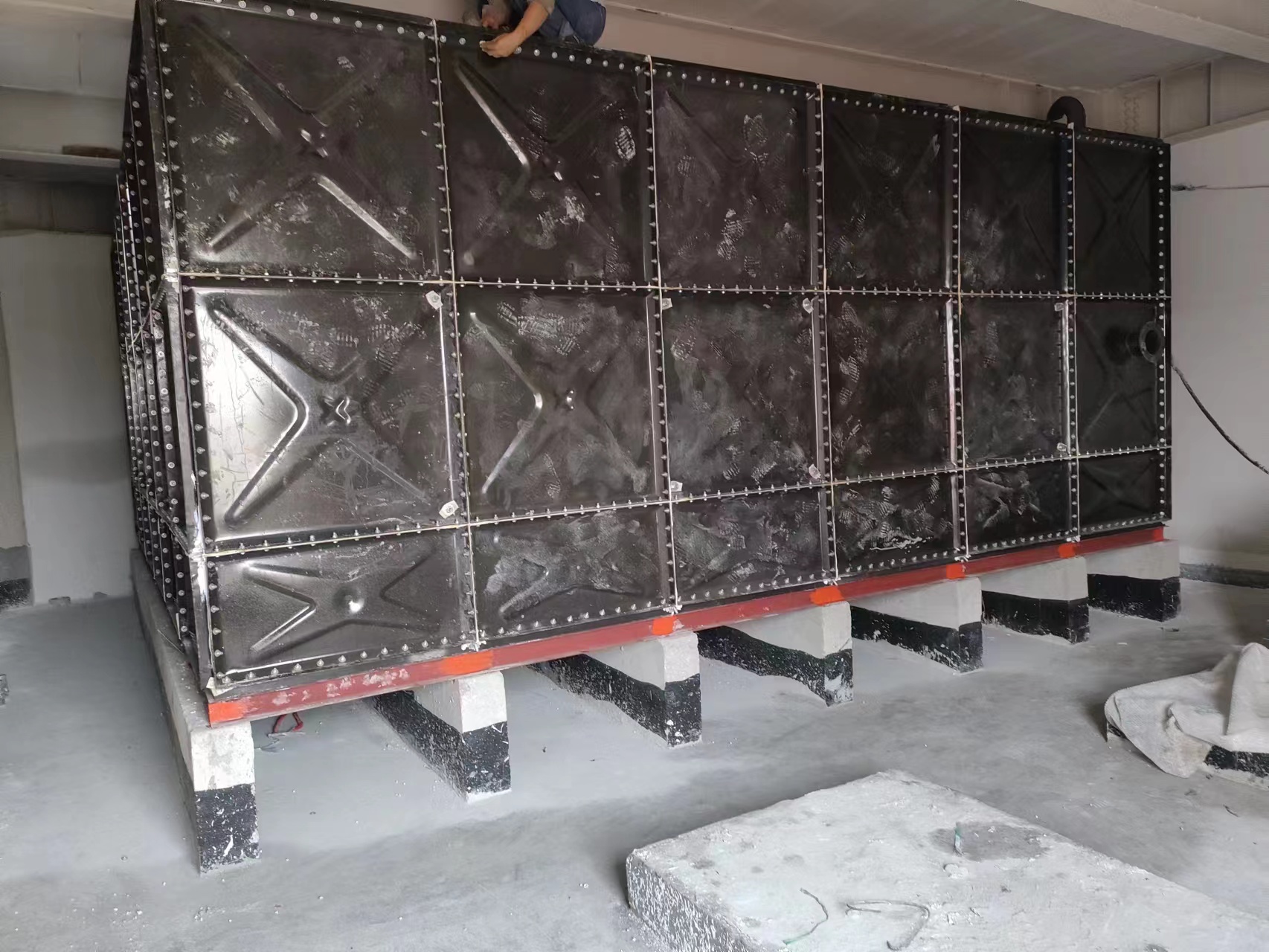
The sequence is: bottom panels (reinforcement ribs facing upward) → side panels (connected via corner brackets) → roof panels. Gaskets are placed between each panel, bolts are inserted, and pre-tightened. For side panels over 3 m high, internal tie rods (304 stainless steel round or flat bars) are installed to resist outward bulging. Rod spacing depends on height: ≤1.2 m for 3 m tanks, ≤0.9 m for 4 m tanks. In a Beijing residential fire tank (120 m³, 6 m × 5 m × 4 m), 86 tie rods were used, each bearing approximately 2.8 tons.
3.3 Pipe Connections and Manhole
Inlet, outlet, overflow, and drain connections are either molded-in or field-cut. Field cuts require a specialized hole saw, with edges ground and coated with resin. The manhole (typically 600 mm × 600 mm) uses a double-seal cover with stainless steel trim. In a Hebei electronics plant project, poor manhole sealing led to algae growth; the fix was a hinged cover with silicone gasket.
4. Quality Control and Defect Prevention
4.1 Leak Testing
After assembly, the tank undergoes a 48-hour full water test. Any visible drip or wet spot must be rectified. Ambient and water temperatures are recorded, as large temperature swings (≥15°C daily) can cause temporary leakage due to panel expansion/contraction.
4.2 Bolt Loosening and Panel Deformation
During the first three months of service, bolt torque is checked bi-weekly because gasket creep may reduce preload. Quarterly checks follow. For soft or pure water tanks, EPDM gaskets may harden—replacement is recommended every 5 years. Panel deformation risk increases under high temperature + high water load; SMC flexural strength at 60°C drops to ~70% of room-temperature value. Beijing Yuanhui applies a safety factor of 1.5 in design.
Conclusion
Modular assembly gives FRP tanks a clear installation speed advantage over welded stainless steel tanks (roughly 40% shorter lead time for the same capacity), but demands higher panel precision, sealing system quality, and field work discipline. By optimizing mold compensation, building a bolt torque database, and enforcing three-party inspection, Beijing Yuanhui FRP Co., Ltd. raised the first-pass leak test pass rate from the industry average of 85% to 96%. For owners and EPC contractors, selecting a supplier with mature process control is more critical than simply comparing panel thickness or unit price.