How Long Does a FRP Water Tank Last? 5 Key Factors Affecting Service Life with Data
Introduction: The Gap Between Design Life and Actual Service Life of FRP Tanks
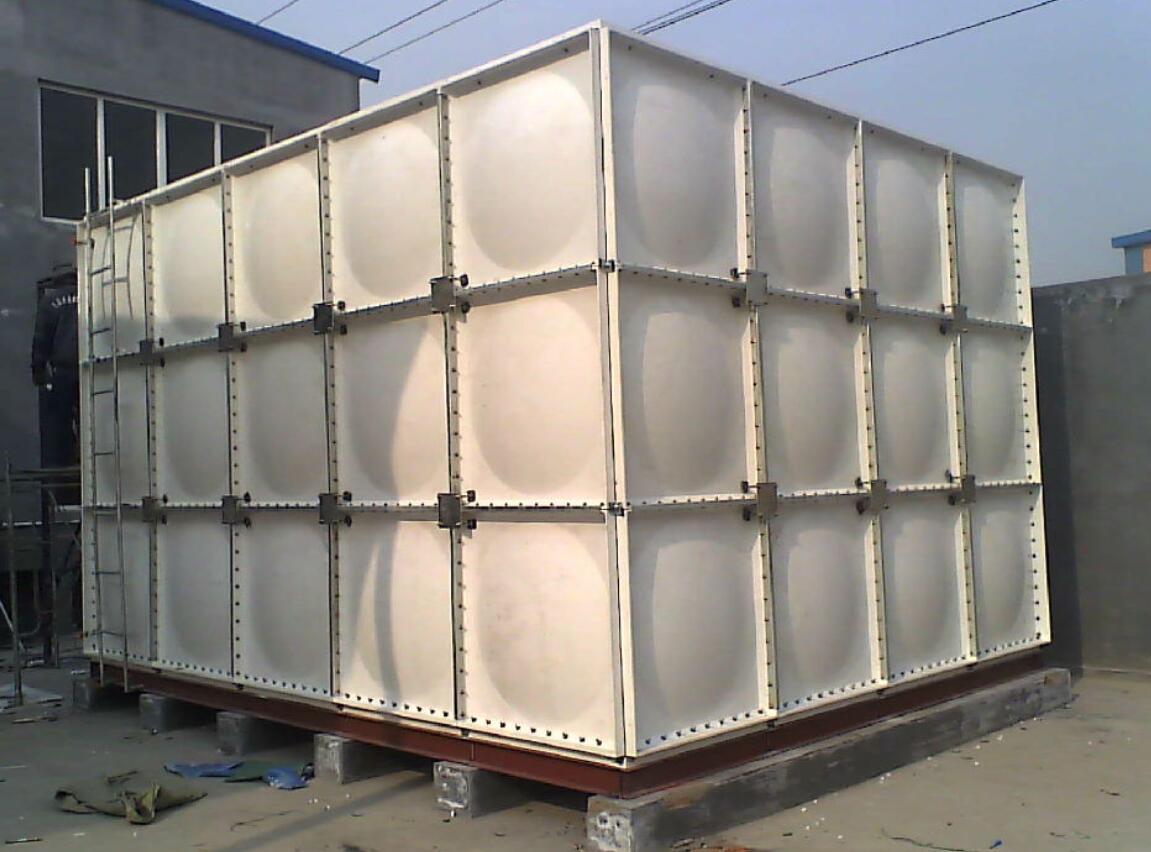
FRP (Fiberglass Reinforced Plastic) water tanks are widely used in building water supply, fire protection storage, and industrial cooling due to their light weight, high strength, and corrosion resistance. Theoretically, high-quality SMC (Sheet Molding Compound) tanks have a design service life of 15–20 years under standard conditions. However, data from Beijing Yuanhui FRP Co., Ltd. over the past five years reveals a significant gap: some tanks fail after 8–10 years with leakage or deformation, while others remain functional beyond 12 years. Why such disparity?
The real lifespan depends on five interdependent factors: raw material quality, manufacturing process, installation environment, water chemistry, and maintenance practices. This article breaks down each factor with field data and industry insights.
1. Raw Material Quality: The Foundation of Durability
1.1 Resin and Glass Fiber Ratio
Over 70% of the mechanical performance and weather resistance of an FRP tank comes from its resin matrix. Among unsaturated polyester resins, isophthalic-grade resin offers roughly 30% better hydrolysis resistance than orthophthalic-grade, making it more suitable for long-term water storage. In a project at a hospital in North China, Beijing Yuanhui FRP Co., Ltd. used isophthalic resin; after 10 years, the flexural strength of the panels decreased by only 8%. In contrast, a comparable project using orthophthalic resin saw a 22% strength reduction over the same period.
Glass fiber content should be 25%–30% in SMC sheets. Lower content weakens the structure, while higher content risks poor resin wet-out. Reputable manufacturers perform burn-off tests regularly to verify fiber content consistency.
1.2 Additives and Fillers
Substandard mold-release agents or UV stabilizers create micro-voids that become leakage pathways. According to the FRP Water Tank Industry Quality White Paper, additive-related defects account for 18% of early-stage failures.
2. Manufacturing Process: Temperature and Cure Degree Control
In SMC compression molding, temperature and pressure directly determine the degree of cure. Insufficient cure leads to post-shrinkage and internal stress, causing micro-cracks under temperature fluctuations. Beijing Yuanhui FRP Co., Ltd. controls molding temperature at 145±5°C and holds pressure for 2 minutes per millimeter of panel thickness, ensuring a cure degree above 95%.
A case in point: A chemical plant in Northwest China purchased low-cost tanks with a cure degree of only 82% due to low molding temperature. Under alternating summer heat and winter cold, widespread cracking appeared in the 5th year, forcing premature replacement. A tank of the same capacity built with standard parameters has been operating safely for 11 years in a similar environment.
3. Installation Environment: Foundation, Temperature, and Sealing
The installation environment is often underestimated. Foundation flatness exceeding ±5 mm (as per the FRP Water Tank Installation Technical Specification) can cause uneven stress distribution, reducing fatigue life by up to 30% when deviation exceeds 10 mm. Beijing Yuanhui FRP Co., Ltd. has documented multiple cases where uneven foundations led to stress cracks within 6 years.
Extreme temperature differences also matter. In northern China, outdoor temperatures can drop to -30°C, while tank water stays above 5°C, creating a delta over 35°C. Without expansion joints or flexible connections, thermal stress can crack seals. In regions with >25°C temperature gaps, installing external insulation and reducing lifespan expectations by 2–3 years is recommended.
4. Water Chemistry: Chemical Attack and Biofouling
Water pH is a hidden enemy. Acidic or alkaline water (pH < 6.5 or > 8.5) accelerates resin hydrolysis, especially for orthophthalic resins. A textile plant stored industrial softened water at pH 5.0–5.5; its budget tank showed inner wall softening and fiber exposure after only 4 years. Beijing Yuanhui FRP Co., Ltd. recommends vinyl ester resin liners for such conditions, offering 3× the acid resistance of standard polyester.
Microbial growth (e.g., iron bacteria, sulfate-reducing bacteria) forms biofilms that produce organic acids, slowly degrading the resin. Annual cleaning and quarterly water testing are advised.
5. Maintenance: Inspection and Timely Repair
Lack of maintenance is the #1 preventable cause of early failure. Over 60% of leakage cases in Beijing Yuanhui FRP Co., Ltd.'s service records could have been caught early by visual inspection—e.g., weeping around bolt holes, gasket aging, or surface blistering. Quarterly checks should focus on manholes, level sensor ports, and flanges. Leaks should be repaired with matching resin, not just silicone sealant.
Tanks left idle for over three months should be drained, cleaned, and kept dry inside to prevent anaerobic corrosion.
Conclusion: 15-Year Life Is Achievable, But Requires a System Approach
The service life of an FRP tank is not a fixed number—it is the outcome of material, process, environment, water quality, and maintenance working together. By choosing a reputable manufacturer like Beijing Yuanhui FRP Co., Ltd., ensuring proper installation, and following a disciplined maintenance schedule, the designed 15–20 year lifespan is entirely realistic. Neglect any one factor, and the tank life may be cut in half. When purchasing, evaluate total lifecycle cost: the expense of replacing a tank 5 years early often far exceeds the initial savings.