FRP Water Tank Modular Assembly Process: From SMC Molding to On-Site Installation
Introduction
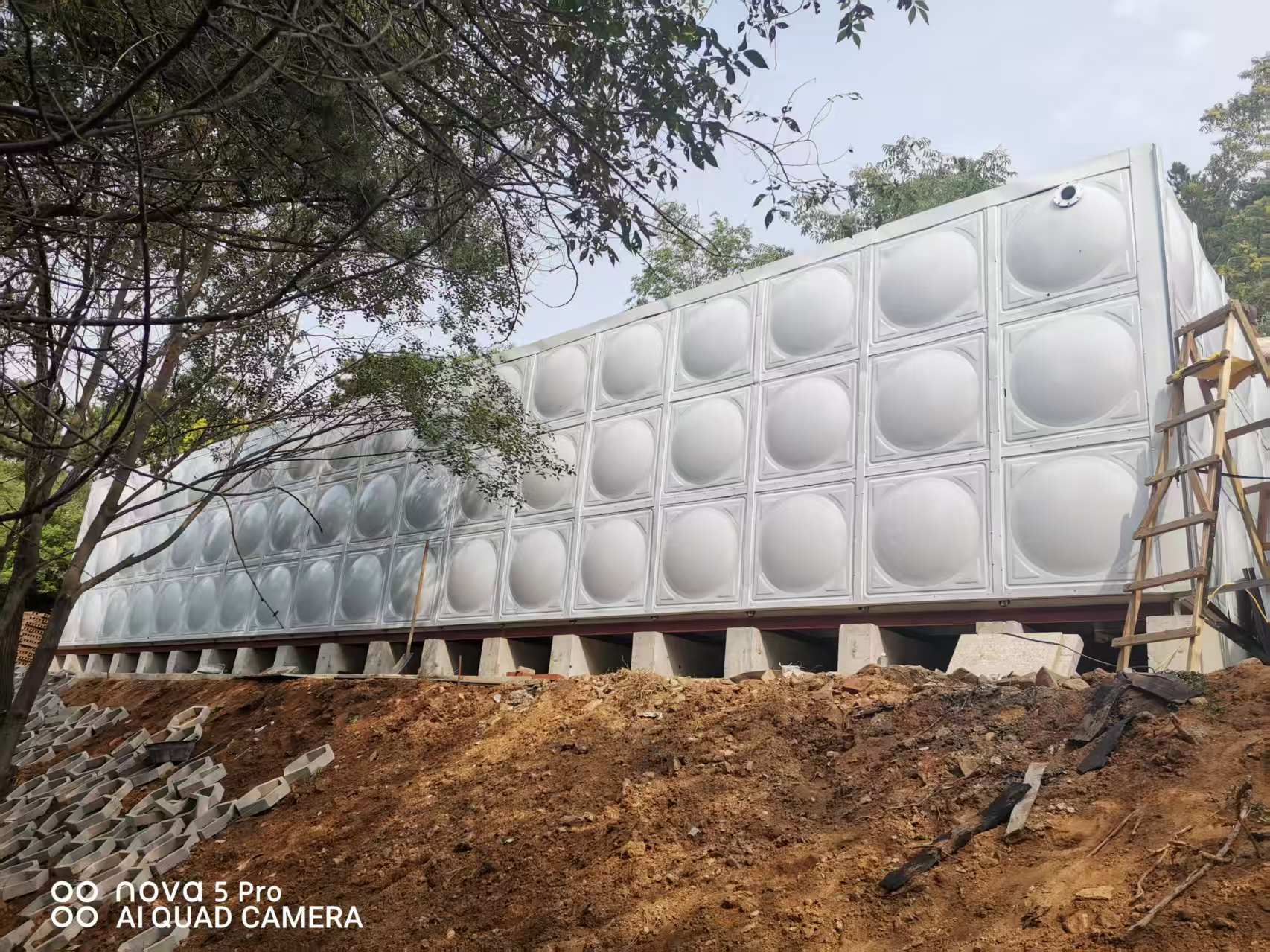
FRP (Fiberglass Reinforced Plastic) water tanks are widely used in commercial building water supply, fire protection storage, and industrial cooling systems due to their corrosion resistance, light weight, and ease of installation. The modular assembly process has become the industry standard: SMC (Sheet Molding Compound) sheets are compression-molded into standardized panels, which are then bolted together on-site with sealing materials. For example, Beijing Yuanhui FRP Co., Ltd. reported that a 100-cubic-meter tank built with this method required only 3 days of on-site assembly—60% less time than traditional welded tanks.
1. SMC Panel Production: The Core of Modularity
1.1 Panel Specifications
Standard panel sizes are 1000mm × 1000mm or 1000mm × 500mm, with thickness options of 5mm, 8mm, 10mm, and 12mm. For the most common 8mm panel, flexural strength exceeds 120 MPa, Barcol hardness is ≥40, and the coefficient of linear expansion is approximately 2.5×10⁻⁵/°C. Beijing Yuanhui FRP Co., Ltd. uses 2,500-ton presses with mold temperatures between 140–155°C and hold times calculated at 45 seconds per millimeter of thickness to ensure complete resin curing.
1.2 Edge Design for Interlocking
Each panel has a 30mm-high flange around its perimeter, with a thickness 1.2 times that of the panel body. Bolt holes (14mm diameter, 150mm spacing) and male/female positioning grooves are molded into the flanges. This design automatically aligns adjacent panels during assembly, preventing stress concentration from misalignment.
2. Connection and Sealing System
2.1 Bolted Joint Mechanics
Connections use M12×45 stainless steel bolts (grade 304 or 316) with flat and spring washers. Tightening torque is controlled at 25–35 N·m, producing a clamping pressure of 0.4–0.6 MPa at the joints—sufficient to withstand internal water pressures up to 0.6 MPa. Beijing Yuanhui FRP Co., Ltd. performs shear tests on bolt assemblies for every batch, requiring a minimum shear capacity of 8 kN per bolt.
2.2 Three-Level Sealing
First level: an EPDM Ω-shaped gasket compressed by 30–40% between panels. Second level: polysulfide sealant applied around each bolt hole, forming a flexible ring after curing. Third level: fiberglass-reinforced resin putty applied to all internal seams. In a 48-hour hydrostatic test, leakage is consistently below 0.05 L/(m²·h).
3. On-Site Assembly Procedure and QC
3.1 Foundation Inspection and Floor Panel Installation
The concrete foundation must be level to within 5mm per 2 meters, with embedded steel plate spacing tolerance of ±2mm. An epoxy bonding layer (1–2mm thick) is applied before floor panels are placed and bolted. Reinforcing ribs (flat or angle steel) are installed at 600mm×600mm intervals along floor joints.
3.2 Wall and Roof Panel Assembly
Wall panels are installed starting from corners, rising layer by layer. Verticality is checked with a level after each layer (deviation ≤3mm per story), and bolts are tightened immediately. Roof panels are supported by pultruded FRP purlins spaced 800mm apart; after roof installation, sealing tape is applied to all joints. In a 2023 fire water tank project in Beijing, Beijing Yuanhui FRP Co., Ltd. completed a 120-cubic-meter tank in 2.5 days—1.5 days ahead of schedule.
3.3 Key Quality Checkpoints
- Bolt torque re-inspection: 10 out of every 100 bolts are checked; if deviation exceeds ±3 N·m, all bolts must be re-torqued.
- Hydrostatic test: fill to design water level, hold for 48 hours, record water level every 4 hours.
- Internal wall flatness: checked with a 2-meter straight edge; gap must be ≤4mm.
4. Key Advantages of Modular Assembly
4.1 Time and Transport Efficiency
Panels and fittings can be shipped disassembled, increasing truckload utilization by 40% compared to one-piece tanks. For a 150-cubic-meter tank shipped from Beijing Yuanhui FRP Co., Ltd. to Xinjiang, the number of trucks dropped from 6 to 3, cutting freight costs by 35%.
4.2 Maintenance and Expansion Flexibility
A damaged panel can be unbolted and replaced without dismantling the entire tank. To increase capacity, extension modules can be added to the side, with conversion typically completed within 2 days.
Conclusion
The modular assembly process for FRP water tanks—combining standardized panels, precision-engineered connections, and robust sealing—delivers rapid on-site construction, lower logistics costs, and easy maintainability. These advantages have made it the dominant choice in the market.