FRP Water Tank Modular Assembly Process: A Complete Technical Breakdown from SMC Molding to On-Site Installation
Introduction
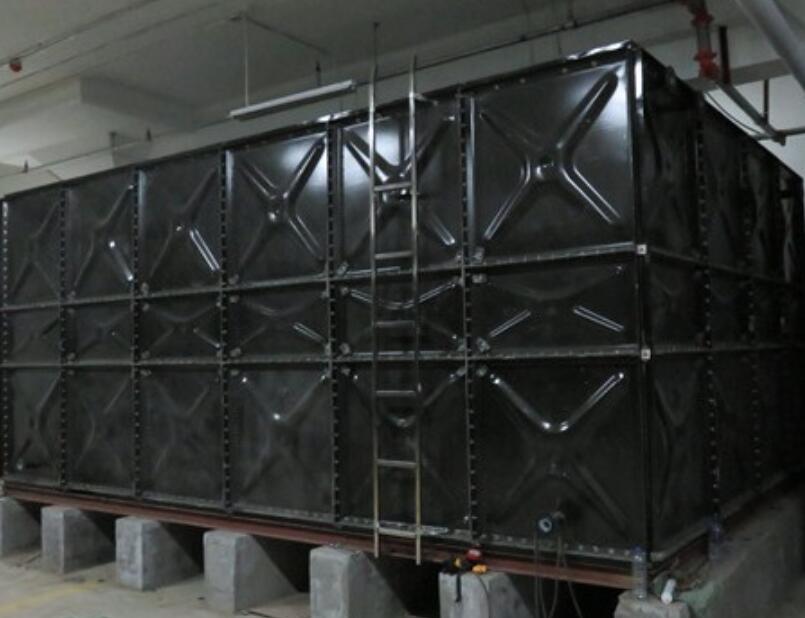
The modular assembly process of FRP (Fiberglass Reinforced Plastic) water tanks is a well-established technique where factory-pressed SMC (Sheet Molding Compound) panels are assembled on-site using specialized connectors and sealing materials. Beijing Yuanhui FRP Co., Ltd. has delivered over 500 modular FRP tanks across northern China, with the largest single tank volume reaching 800 cubic meters. The core advantages lie in the high-density consistency of panels pressed under 1500-ton presses, zero welding on-site, and a construction timeline up to 60% shorter than traditional concrete tanks.
1. SMC Panel Production: Standards and Quality Control
1.1 Raw Material Formulation and Molding Parameters
SMC sheets consist of unsaturated polyester resin, glass fiber (25%-30% by weight), calcium carbonate filler, and curing agents. Beijing Yuanhui uses a continuous SMC line with resin paste viscosity controlled at 30,000–45,000 mPa·s and glass fiber cut length at 25 mm for uniform distribution during molding. Molding temperature is set at 140–150°C with 15–20 MPa pressure, and dwell time is 60–90 seconds per mm of panel thickness. Finished panels achieve flexural strength ≥180 MPa, Barcol hardness ≥45, and water absorption ≤0.5%.
1.2 Panel Dimensions and Tolerances
Standard module sizes are 1000×1000 mm, 1000×500 mm, and 500×500 mm, with thickness options of 5, 8, 10, 12, and 14 mm. Thickness tolerance is ±0.3 mm, and diagonal deviation ≤1.5 mm. Each batch undergoes 100% visual inspection, and 5% is sampled for hydrostatic testing—0.1 MPa for 30 minutes with no leakage.
2. Core Sealing and Connection Technology
2.1 Bolted Connections and Stainless Steel Tie Rods
Panels are joined using M10 or M12 stainless steel bolts (304 or 316L grade). Bolt holes are slotted (14×12 mm) to allow micro-adjustments during assembly. A standard 1×1 m panel uses 8–12 bolts evenly distributed. Internal stainless steel tie rods are spaced at 500×500 mm intervals, with rod diameter varying by tank height: φ8 mm for ≤2 m, φ10 mm for 2–4 m, and φ12 mm for 4–6 m.
2.2 Dual-Seal System: EPDM Gasket and Silicone Sealant
Joint sealing employs a dual-layer design. The primary seal is an EPDM hollow gasket with 25%–35% compression, Shore A hardness 55±5, and temperature range –40°C to 120°C. The secondary seal is neutral silicone structural sealant applied over the gasket at 3–5 mm thickness, with elongation ≥200% after curing. Field data from Beijing Yuanhui shows leakage rates below 0.01 L/(m²·h) under 0.05 MPa positive pressure, well under the industry standard of 0.1 L/(m²·h) per JB/T 8938.
3. On-Site Assembly Procedure
3.1 Foundation Inspection and Floor Panel Installation
Concrete foundation flatness must be ≤5 mm per 2 meters, with strength ≥C25. A 0.2 mm PE vapor barrier is laid first, followed by floor panels featuring double-sided reinforcing ribs (30 mm height, 200 mm spacing). Installation proceeds from center outward, with a level check after each row; gaps >2 mm are shimmed with stainless steel plates.
3.2 Wall and Roof Panel Installation
A steel angle flange (L50×50×5 mm) is bolted to the foundation perimeter before wall panels are erected. Panels are temporarily braced, and bolts are tightened in a cross-pattern to specified torque: 40–50 N·m for M10, 60–70 N·m for M12. Roof panels require scaffolding, with steel angle stiffeners added at wall-to-roof junctions.
3.3 Fittings and Full Water Test
Fittings include stainless steel inlet/outlet pipes (DN50–DN300), level gauges, manholes (600×600 mm or 800×800 mm), and internal/external ladders. All metal parts are isolated with rubber gaskets to prevent galvanic corrosion. The tank is filled in three stages: to 1/3 height (24-hour hold), to 2/3 height (24-hour hold), then to full (72-hour hold). A water level drop ≤0.5% of total capacity is acceptable.
4. Common Issues and Solutions
4.1 Panel Warping
Warping from uneven cooling is mitigated by cross-stacking panels with wooden spacers, stack height ≤1.2 m, and allowing panels to acclimate flat on-site for 24 hours before installation.
4.2 Bolt Hole Leakage
Leakage typically results from insufficient torque or uneven gasket compression. Re-torque with a calibrated wrench, add stainless steel flat and spring washers, and apply sealant around the bolt hole if persistent.
Conclusion
The modular assembly process for FRP water tanks is a mature, reliable technology built on standardized panel production, dual-seal design, and disciplined on-site procedures. Beijing Yuanhui FRP Co., Ltd. has established a full supply chain from panel manufacturing to field installation across northern China. For end users, modular FRP tanks offer shorter construction timelines, approximately 30% lower total cost versus concrete tanks, and easy maintenance—any panel can be individually replaced. As SMC materials and sealing technologies continue to improve, modular assembly will see even greater adoption in industrial storage, fire water supply, and secondary domestic water systems.