Detailed Analysis of FRP Water Tank Lining Anti-Corrosion Technology: Material Selection, Construction Processes, and Engineering Cases
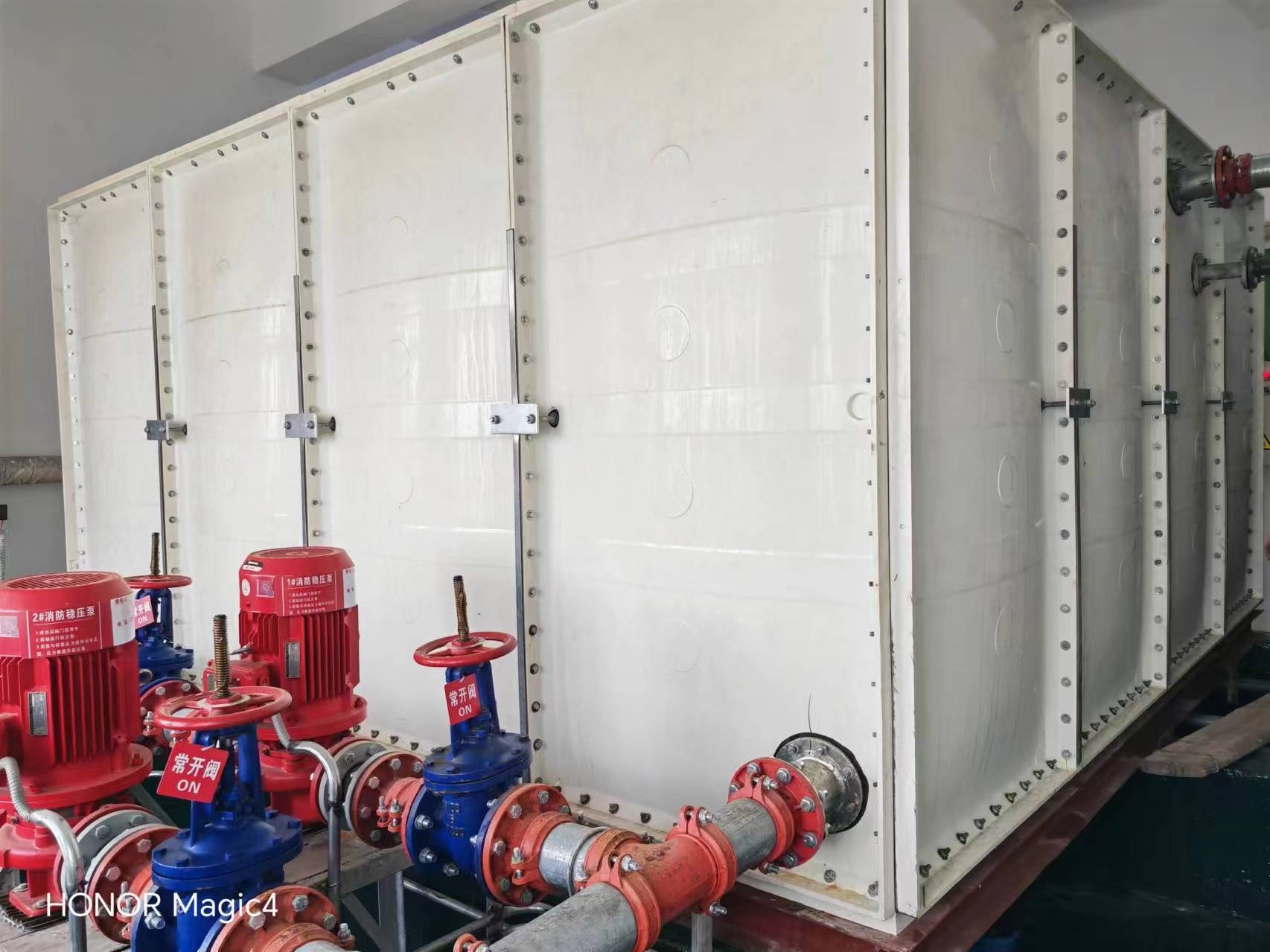
Introduction: The Critical Role of Lining in FRP Tank Longevity
FRP water tanks are widely used for potable water, industrial process water, and fire protection storage. However, most premature failures originate from the degradation of the inner anti-corrosion lining. According to the Technical Specification for FRP Water Tanks (CECS 157:2018), approximately 65% of repair cases are attributed to lining corrosion or leakage. Beijing Yuanhui FRP Co., Ltd. implemented 37 municipal water tanks in Northern China, none of which reported leakage within a 10-year operational period, thanks to rigorous lining protocols. This article dissects the core technologies of FRP tank lining from material, process, and testing perspectives.
1. Material System Selection for Anti-Corrosion Linings
1.1 Resin Matrix: From Orthophthalic to Vinyl Ester
The lining layer directly contacts stored water; resin selection determines the corrosion resistance baseline. Orthophthalic polyester resin, while cost-effective, exhibits poor hydrolysis resistance—its degradation rate triples in water above 60°C. Isophthalic polyester improves water resistance by ~40%, while vinyl ester resin performs optimally under alternating acidic and alkaline conditions. In a fire-fighting tank project for a chemical plant in Tianjin, Beijing Yuanhui FRP Co., Ltd. compared Barcol hardness retention after 90-day immersion: orthophthalic retained only 62%, isophthalic 78%, and vinyl ester 95%.
1.2 Reinforcement Design: Composite of Chopped Strand Mat and Surface Mat
The lining design follows the principle of a "resin-rich layer + anti-seepage layer." The first layer uses 30-45 g/m² surface mat with resin content controlled at 75%-85%, forming a 0.3-0.5 mm resin-rich barrier. The second layer uses 300-450 g/m² chopped strand mat at 65%-75% resin content. This structure effectively blocks capillary leakage paths. Laboratory data show that single-layer surface mat structures have a leakage rate of approximately 0.08 mL/(m²·h), while composite structures reduce it to below 0.01 mL/(m²·h).
2. Five Critical Control Points in Lining Construction
2.1 Mold Surface Preparation: Choosing Release Agents
Mold surface roughness (Ra) must be controlled within 0.8 μm. Semi-permanent release agents combined with high-melting-point (≥120°C) mold wax are recommended to minimize pinhole defects in the lining. Beijing Yuanhui FRP Co., Ltd. recorded a pinhole density reduction from 2.3 to 0.4 per dm² after adopting semi-permanent release agents.
2.2 Gel Coat Application: Dual Control of Thickness and Cure Degree
Gel coat thickness should be maintained between 0.4-0.6 mm. Too thin compromises corrosion resistance; too thick risks cracking. When spray-applied, use a nozzle diameter of 2.0-2.5 mm and spray pressure of 0.4-0.6 MPa, with each pass not exceeding 0.3 mm. The cure degree must exceed 90% before the next layer is applied to prevent whitening or delamination.
2.3 Lamination Process: Managing Voids and Wrinkles
Each reinforcement layer must be rolled with a de-airing roller at a speed of 0.3-0.5 m/s. The interval between layers should be less than 60% of the resin gel time to ensure interlayer adhesion. In a Chengde project, Beijing Yuanhui FRP Co., Ltd. observed a 22% drop in interlaminar shear strength when the interval exceeded 40 minutes.
2.4 Curing and Post-Curing: Temperature and Time Coordination
After room-temperature gelation, post-curing is essential: heat to 60-80°C, hold for 2-4 hours, then slow-cool to ambient. Post-curing increases crosslink density by 15%-20% and raises the glass transition temperature (Tg) by 8-12°C. For potable water tanks, post-curing also reduces residual styrene content to below 0.01%, complying with GB/T 17219.
2.5 Interface Treatment Between Lining and Structural Layer
After curing, the lining surface must be abraded (Ra 20-40 μm) before applying the bonding resin layer to prevent interface peeling. Laboratory peel tests show that untreated interfaces have a peel strength of only 0.8 N/mm, while abraded interfaces exceed 2.5 N/mm.
3. Anti-Corrosion Performance Testing and Engineering Case
3.1 Accelerated Corrosion Tests
Industry-standard tests include: 10% sulfuric acid boil test (4 hours), 10% sodium hydroxide immersion at ambient temperature (720 hours), and hot water immersion at 95°C (1000 hours). Beijing Yuanhui FRP Co., Ltd. subjected vinyl ester lining samples to these tests; surfaces showed no blistering or delamination, and flexural strength retention was ≥85%.
3.2 Large-Scale Water Plant Case in Northern China
Location: Cangzhou, Hebei Province. Tank volume: 500 m³. Medium: surface water after coagulation and sedimentation (pH 6.8-7.5, residual chlorine 0.3-0.5 mg/L). The lining used vinyl ester resin with a 450 g/m² chopped strand mat composite structure; construction took 21 days, with a lining thickness of 3.5 mm. After three years of service, inspection revealed a fully intact lining surface, Barcol hardness retention of 92%, and no evidence of microbial adhesion.
Conclusion
The core of FRP water tank anti-corrosion lining technology lies in rigorous material selection and construction discipline. Vinyl ester resin combined with a chopped strand mat/surface mat composite, paired with proper post-curing, can extend the tank design life from 8-10 years to 15-20 years. Engineering practice from Beijing Yuanhui FRP Co., Ltd. demonstrates that quantitative control over mold preparation, gel coat thickness, and layup intervals is the key to avoiding premature failure. It is recommended that buyers require suppliers to provide complete lining process documentation and third-party corrosion test reports when selecting FRP water tanks.