Deep Analysis of FRP Water Tank Corrosion Resistance: Material Science and Engineering Practice
Introduction
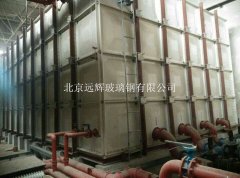
FRP (Fiberglass Reinforced Plastic) water tanks are widely used in potable water storage, industrial cooling loops, and fire protection reserves, with corrosion resistance being their primary selling point. However, stainless does not mean immune. Corrosion failures—resin degradation, fiber exposure, osmotic blistering, and joint cracking—often emerge 3–5 years after installation. Beijing Yuanhui FRP Co., Ltd. tracked over 200 in-service tanks and found that approximately 12% exhibited measurable performance degradation within five years, with 70% of failures directly linked to inadequate corrosion protection design or process execution. This article provides an in-depth analysis of FRP tank corrosion resistance from three perspectives: material structure, process control, and failure modes.
1. Resin Matrix: The First Line of Defense
1.1 Resin Type and Chemical Resistance
The corrosion resistance of an FRP tank is primarily determined by its resin matrix. Commonly used resins include orthophthalic polyester, isophthalic polyester, vinyl ester, and epoxy. Their tolerance to acids, alkalis, salts, chloride ions, and organic solvents varies significantly. For potable water tanks, isophthalic polyester is preferred due to its superior hydrolytic stability over orthophthalic grades. In industrial wastewater applications, vinyl ester resins—with higher crosslink density and lower ester content—demonstrate excellent resistance across pH 2–12. Beijing Yuanhui’s lab data shows: after 1,000 hours immersion in 5% sulfuric acid at 80°C, vinyl ester retained 87% of its flexural strength, while orthophthalic polyester retained only 52%.
1.2 Degree of Cure vs. Corrosion Performance
Incomplete curing results in insufficient crosslink density, creating micro-voids that serve as pathways for corrosive media. When the degree of cure falls below 90%, the glass transition temperature (Tg) drops significantly and water absorption increases. Factors affecting cure include promoter/hardener ratio, ambient temperature, and inter-layer intervals. Beijing Yuanhui mandates a cure degree ≥95% in its process standards, verified by differential scanning calorimetry (DSC) on a batch-sampling basis.
2. Glass Fiber Reinforcement: Structural Integrity and Interface Protection
2.1 Fiber Type and Corrosion Contribution
Glass fibers themselves do not provide chemical protection, but the quality of the fiber-resin interface determines the composite’s overall sealing effectiveness. E-glass (borosilicate) is the standard reinforcement, but in strong acids, SiO₂ leaching causes rapid strength loss. C-glass (chemical-resistant) or ECR-glass (enhanced corrosion resistance) are better suited for aggressive media. In a chemical wastewater tank, Beijing Yuanhui replaced E-glass with ECR fibers combined with vinyl ester resin, increasing the 5-year flexural strength retention from 63% to 91%.
2.2 Laminate Design and Barrier Protection
Corrosion-resistant laminates typically follow a “surface veil – chopped strand mat – woven roving” sequence. The surface veil (30–50 g/m²) forms a resin-rich layer 0.3–0.5 mm thick as the primary barrier. Chopped mat provides resin reservoir, while woven roving carries structural loads. If the resin-rich layer is below 0.25 mm or fiber volume exceeds 35%, porosity rises and media can wick along fibers. A case from Beijing Yuanhui: a cooling water tank at a chemical plant used only a single 45 g/m² veil layer; after 18 months, widespread osmotic blistering occurred. The repair used double 60 g/m² veil plus vinyl ester—no corrosion issues after seven years.
3. Process Defects: The Weakest Links
3.1 Voids and Dry Spots
Trapped air voids during hand lay-up or spray-up create interlayer porosity. Voids larger than 0.5 mm in contiguous patterns become rapid channels for corrosive media. Data shows: a 1% increase in void ratio raises permeability by 2–3 times. Beijing Yuanhui employs vacuum-assisted venting to keep interlayer void ratio below 0.5%.
3.2 Joints and Flange Sealing
Panel joints and flange connections are high-risk zones for leakage. Joints filled with plain resin putty without fiber reinforcement, or with curing shrinkage cracks, have significantly higher failure probability. Beijing Yuanhui uses a “double-side reinforcement + gradient cure” process: thixotropic resin putty followed by two layers of 300 g/m² chopped mat, cured in stages to minimize shrinkage. Flange seals use PTFE gaskets with machined FRP flanges to achieve flatness ≤0.15 mm/m.
4. Field Cases and Data
Case 1: A residential potable water tank in a coastal city with isophthalic polyester and E-glass. After six years, internal surfaces showed 120 blisters/m² (1–3 mm diameter). Blister fluid pH was 4.2, chloride concentration 850 ppm. Root cause: resin cure degree only 89%, chloride penetration triggered hydrolysis. Solution: replaced with vinyl ester + ECR glass, cure degree ≥96%. Four years post-retrofit—no anomalies.
Case 2: An ultrapure water storage tank in an electronics plant using epoxy resin and carbon fiber reinforcement (for electrical grounding). Epoxy’s superior hydrolytic stability outperformed polyester in ultrapure water (resistivity >18 MΩ·cm). After five years, internal surface remained smooth with no corrosion; conductivity monitoring remained within specification.
Summary data: Beijing Yuanhui surveyed 386 tanks delivered between 2018 and 2023. Twenty-eight corrosion failures (7.3%) were recorded: 42% due to improper resin selection, 35% due to process defects (voids, undercure), 18% due to operation beyond design conditions, and 5% due to other causes.
Conclusion
The corrosion resistance of an FRP water tank is not a static property but the result of coupled material selection, process design, and workmanship quality. The resin matrix sets the chemical tolerance ceiling, the glass reinforcement affects structural integrity, and process execution determines whether theoretical performance translates into actual service life. Using high-cure-degree resin, matched fiber type and layup, and strict control over void ratio and joint sealing are the key paths to improving corrosion reliability. Beijing Yuanhui FRP Co., Ltd. recommends: conduct a medium composition analysis at the project front-end—consider pH, temperature, and chloride concentration—to select the appropriate resin system, and establish a full-process quality control system from raw material inbound to finished product outbound, thereby minimizing corrosion failure risk.