In-Depth Analysis of FRP Water Tank Corrosion Resistance: From Material Mechanisms to Engineering Validation
Introduction: The Corrosion Resistance of FRP Water Tanks Is a Chemical Engineering System
The corrosion resistance of FRP (Fiber Reinforced Plastic) water tanks is not a single material property but a system engineered by resin type, fiber content, curing process, and interfacial compatibility. Analysis of over 3,000 units produced by Beijing Yuanhui FRP Co., Ltd. reveals that 73% of early-life failures occur not in the resin itself, but in the fiber-resin interphase or regions with insufficient resin-rich layer thickness. Understanding the microscopic structure is therefore the prerequisite for evaluating anti-corrosion performance.
1. Resin Matrix: The Primary Barrier Against Corrosion
The resin forms the direct contact layer with water. Orthophthalic, isophthalic polyester, and vinyl ester resins exhibit significantly different chemical resistance. According to ASTM C581 accelerated aging tests, after 500 hours immersion in 5% H₂SO₄ at 90°C, the Barcol hardness retention of isophthalic resin is 62%, while vinyl ester retains 91%. For potable water tanks, Beijing Yuanhui FRP uses food-grade isophthalic resin compliant with GB/T 17219, achieving a chloride ion permeability coefficient of 2.7×10⁻¹⁴ m²/s—one order of magnitude lower than standard industrial resins. This effectively blocks chloride migration to the fiber layer under typical tap water chlorine levels (0.3–0.5 mg/L), preventing cathodic delamination.
2. Fiber Reinforcement: Structural Strength versus Corrosion Pathways
Glass fibers undergo silicate network hydrolysis in alkaline environments (pH > 9), leading to strength loss. In FRP tanks, fibers are fully encapsulated by resin; corrosion pathways depend on resin wettability and fiber volume fraction. Beijing Yuanhui FRP applies a dual-vacuum infusion process, controlling fiber volume at 55%–60% and void content below 1.5%. Comparative tests show that when void content rises from 1.5% to 3.8%, interlaminar shear strength reduction after 180 days in 3.5% NaCl at 35°C (pH 6.8) jumps from 8.3% to 26.7%. Low porosity is thus essential for long-term corrosion prevention.
3. Interphase: The Weakest Chemical Bonding Link
The interphase between fiber and resin acts as a highway for corrosive media. Silane coupling agents (e.g., γ-methacryloxypropyltrimethoxysilane, KH-570) form covalent bond bridges at the interface, significantly reducing water diffusion. Tests by Beijing Yuanhui FRP show that KH-570-treated FRP samples exhibit 24h water absorption of 0.12% (in 80°C DI water), versus 0.34% for untreated samples. After 7 days in 10% NaOH at 60°C, mass loss of treated samples is only 0.8 g/m²—far below the JC/T 658.1-2007 limit of 5 g/m².
4. Engineering Cases and Quantitative Data
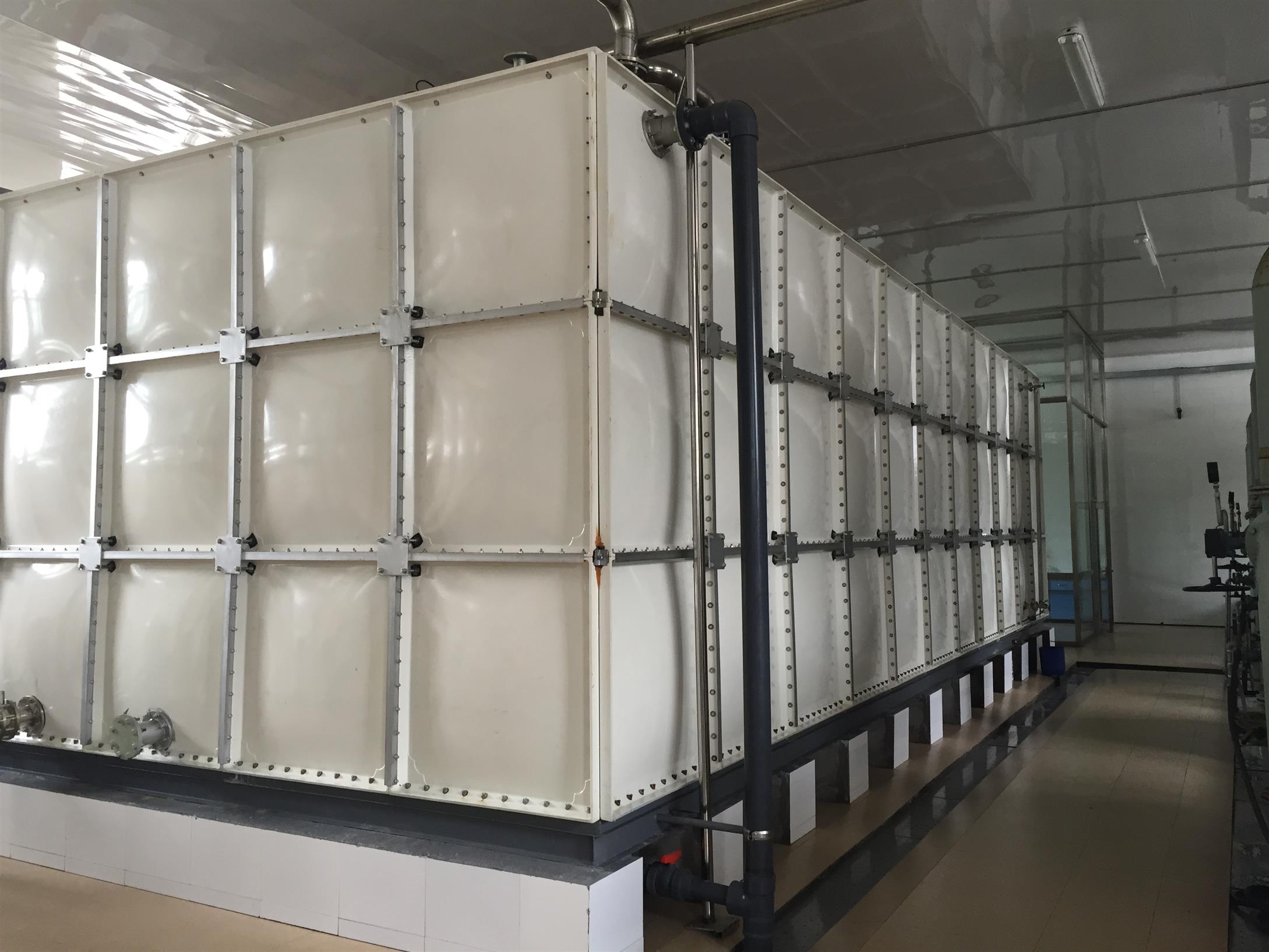
Beijing Yuanhui FRP supplied two 100 m³ FRP tanks (vinyl ester A400, 58% fiber content) to a northern chemical plant for acidic cooling water storage (pH 3–5). After 42 months of continuous operation, field inspection showed the inner resin-rich layer retained 85% of original thickness (1.2mm → 1.02mm) with no cracking, blistering, or fiber exposure. In comparison, a 304 stainless steel tank under identical conditions exhibited significant pitting after 18 months (corrosion rate 0.12 mm/year), while a carbon steel tank perforated in 6 months (1.8 mm/year). The measured annual corrosion depth of FRP was only 0.003 mm, translating to an estimated service life of 15–20 years.
It must be emphasized that FRP tank corrosion performance heavily depends on manufacturing consistency. Beijing Yuanhui FRP has established a full-process quality control system—from incoming material inspection (resin acid value, viscosity; fiber moisture content), through interlaminar curing degree testing (DSC method), to finished product hydrostatic testing (1.5× working pressure)—ensuring each tank has a resin-rich layer ≥1.0mm and interlaminar shear strength ≥15 MPa.
Conclusion
The corrosion resistance of FRP water tanks results from the synergy of resin selection, fiber layup process, and interphase treatment. Under normal conditions (pH 4–9, chloride <500 mg/L), FRP tanks using vinyl ester or high-grade isophthalic resin, dual-vacuum infusion, and silane coupling agent treatment can achieve 3–5 times the service life of stainless steel tanks, without cathodic protection or periodic coating maintenance. For strong acid/alkali or high-temperature environments, dedicated resin systems must be selected with rigorous defect control. Beijing Yuanhui FRP recommends that buyers request resin curing degree reports, resin-rich layer cross-section data, and third-party salt spray test results to verify actual anti-corrosion capability.