Complete Production Process of FRP Water Tanks: 18 Key Steps from Raw Materials to Delivery
Introduction
FRP (Fiberglass Reinforced Plastic) water tanks are widely used in secondary water supply, fire storage, and industrial cooling due to their light weight, corrosion resistance, and 30-year design life. Beijing Yuanhui FRP Co., Ltd., for instance, produces over 100,000 tank components annually, serving markets across North China and Southeast Asia. This article breaks down the full manufacturing workflow, focusing on SMC compression molding vs. hand lay-up, with quantifiable process parameters.
1. Raw Material Preparation and Ratio Control
1.1 Resin System
Unsaturated polyester resin (UPR) grades 191# (general) and 196# (heat-resistant) are standard. For food-grade tanks, Beijing Yuanhui uses isophthalic resin with styrene emission ≤35% (per GB/T 8237-2005). The resin-to-MEKP catalyst ratio is 100:1.5-2.5, with cobalt naphthenate accelerator at 0.5-1.0%. Gel time is controlled at 20-40 minutes at 25°C.
1.2 Reinforcement Materials
E-glass chopped strand mat (300-450 g/m²) and 2400tex roving are used. Moisture content in fibers must be ≤0.1% to ensure bonding. Beijing Yuanhui maintains raw material storage at 22±2°C and ≤60% RH.
2. Molding Processes: SMC vs. Hand Lay-up
2.1 SMC Compression Molding
Standard panels (1m×1m, thickness 4-12mm) are produced by SMC. The sheet is cut with 10% oversize, heated to 140-150°C in a mold, and pressed at 12-15 MPa. Holding time = 1 min per mm thickness (e.g., 8 min for 8mm). Surface flatness ≤0.3mm/m; cycle time 30 min per shot.
2.2 Hand Lay-up / Spray-up
Custom shapes (corners, flanged openings) use hand lay-up. Mold release (PVA or silicone) is applied first, then gel coat (0.3-0.5mm) for weather resistance. Layers of mat and resin are rolled to eliminate air bubbles (target ≤2 bubbles/m²). Post-cure at 60°C for 4 hours achieves Barcol hardness ≥35.
3. Curing, Demolding, and Trimming
Room-temperature cure takes 24 hours at 25°C. Below 15°C, infrared lamps or ovens are used with a heating rate ≤5°C/min. After demolding, parts rest for 48 hours to relieve stress. Diamond-blade trimming ensures edge roughness Ra≤3.2μm. Beijing Yuanhui requires panel diagonal tolerance ≤2mm and warpage ≤1.5mm/m.
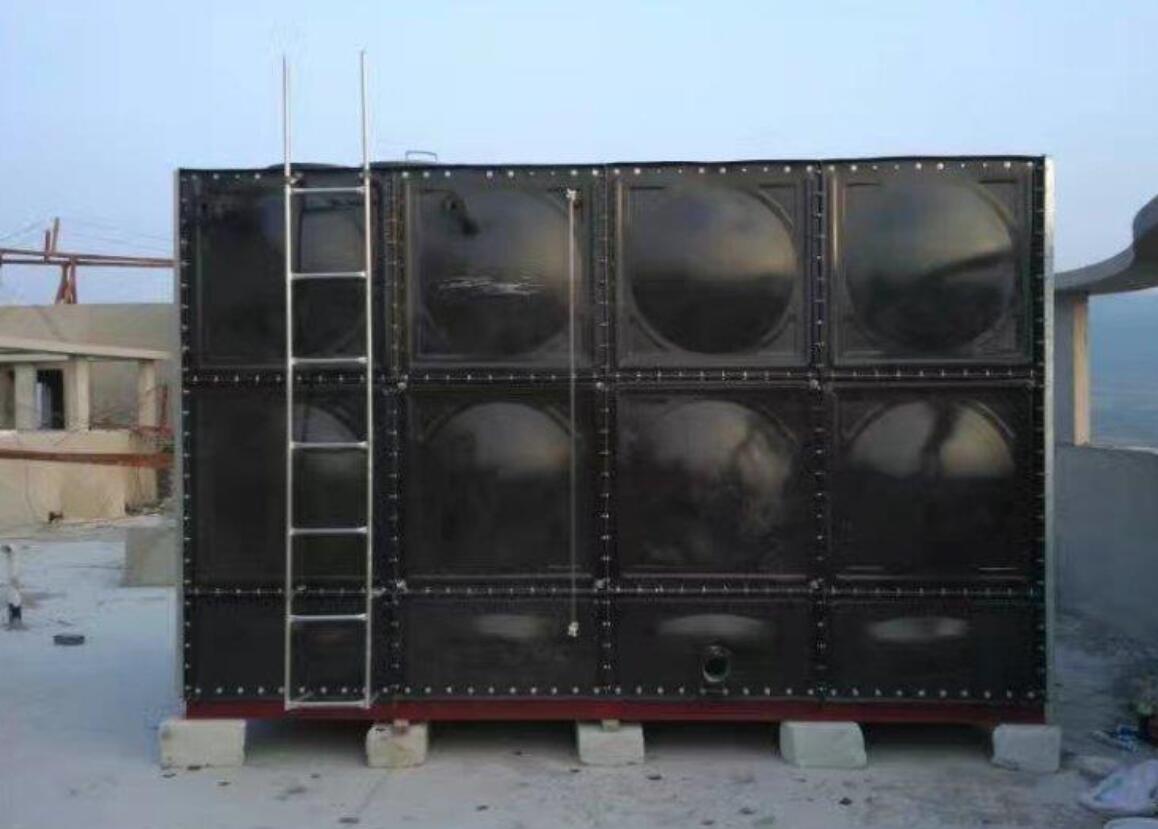
4. Assembly and Sealing
Panels are joined with M10 stainless steel bolts at 120-150mm spacing, torqued to 80-100 N·m. Food-grade silicone gaskets (Shore A 50±5, compression set ≤20%) are used. Final hydrostatic test: fill to design level, hold 24h, water drop ≤3mm. Beijing Yuanhui also performs 1.5× design pressure test for 10 minutes with zero leakage.
Conclusion
FRP tank production integrates material science, tooling, and precision assembly. Each step—from resin ratio to final pressure test—directly impacts quality and longevity. Beijing Yuanhui FRP Co., Ltd. combines SMC and hand lay-up to achieve an annual capacity of 20,000 m³ of tanks, with full-chain QC including fiber content testing (ASTM D2584 ignition test). Understanding these details helps buyers evaluate supplier capability and product reliability.