FRP Water Tank Lining Anti-Corrosion Technology: Material Selection, Construction Process & Service Life Management
Introduction
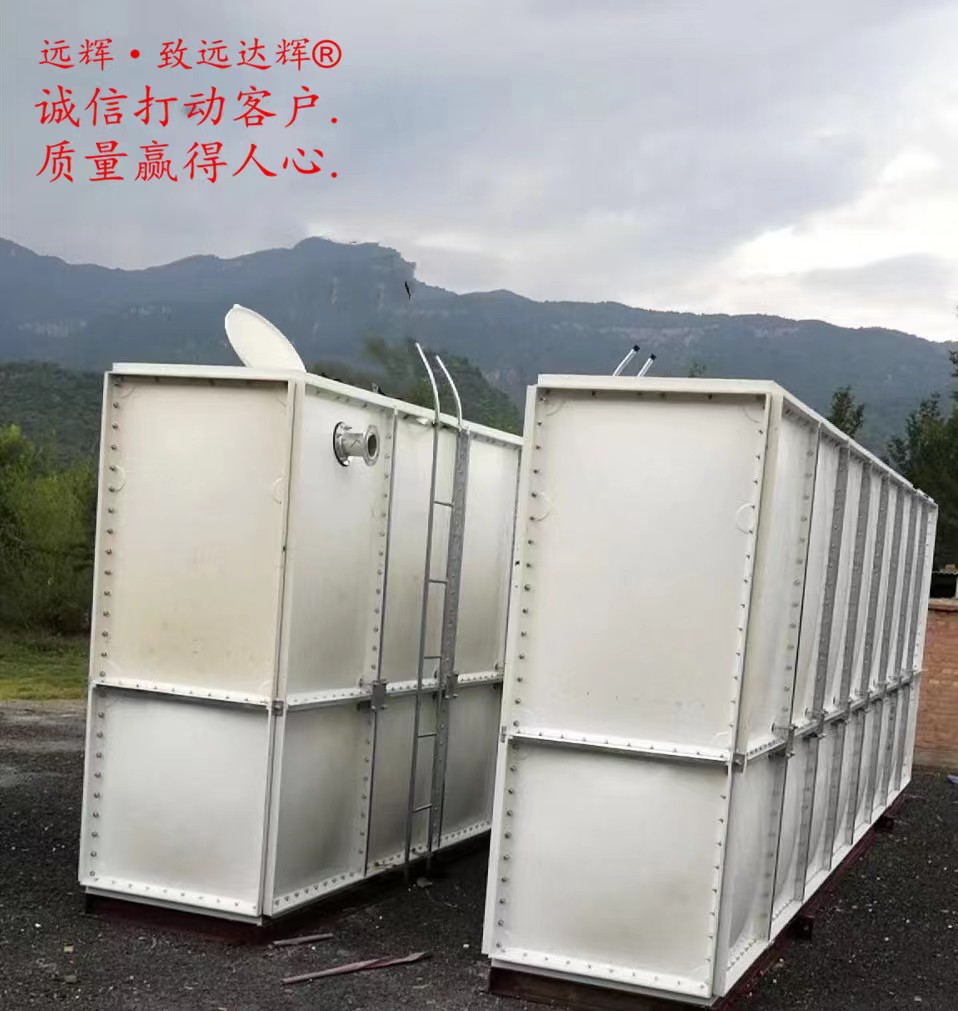
FRP water tanks are widely used in potable water supply, fire protection, and industrial cooling systems. However, when the inner lining is exposed to chloride ions, microorganisms, or acidic/alkaline media, the resin matrix may undergo hydrolysis, permeation, or swelling. In 2023, Beijing Yuanhui FRP Co., Ltd. inspected 32 tanks in service for over 5 years in northern China, finding that about 19% exhibited localized blisters or resin softening. Anti-corrosion lining technology directly determines actual service life—an improper resin system or construction process can reduce the design life from 15 years to 3 years.
1. Resin System Selection: The Fundamental Logic of Anti-Corrosion
1.1 Limitations of Bisphenol A Type Unsaturated Polyester Resin
General-purpose resins perform stably under 60°C in neutral water, but when pH drops below 4 or exceeds 10, ester bond hydrolysis accelerates exponentially. A case in a chemical plant showed that a tank using orthophthalic resin stored sulfuric acid wastewater—after 6 months, the lining cracked.
1.2 Applicable Scenarios of Vinyl Ester Resin
Vinyl ester resin has 3–5 times higher hydrolysis resistance than general-purpose resin due to fewer ester bonds at the ends of molecular chains. In a project in Jiuquan, Beijing Yuanhui used phenolic epoxy vinyl ester resin (e.g., Derakane 411-350). After 720 hours of immersion in 15% HCl at 65°C, the Barcol hardness retention rate was still 82%.
1.3 Food-Grade and Potable Water Resins
Living water tanks must use resins certified to GB/T 17219 and NSF/ANSI 61. Beijing Yuanhui used isophthalic food-grade resin—the measured TOC leaching was below 0.5 mg/L, far below the national limit of 2.0 mg/L.
2. Construction Process Control: From Hand Lay-Up to Vacuum Infusion
2.1 Surface Preparation Standard
Before lining application, the substrate must reach ISO 8501-1 Sa2.5 (near-white metal) with a roughness of Rz 50–85 μm. Inspection records from Beijing Yuanhui show that insufficient roughness reduces adhesion strength by 40%.
2.2 Laminate Structure Design
The anti-corrosion layer typically consists of three layers: a resin-rich layer (0.3–0.5 mm with surface mat), an intermediate reinforcement layer (chopped strand mat + woven roving), and an anti-permeation layer (C-glass mat or carbon fiber mat). In fire-fighting tanks, Beijing Yuanhui adopted a 0.4 mm resin-rich layer + 0.8 mm reinforcement + 0.2 mm anti-permeation layer—no bubbles appeared after 24-hour leak testing.
2.3 Post-Curing Treatment
The lining must achieve over 90% degree of cure before service. Beijing Yuanhui uses a gradient temperature curing: 40°C/2h → 60°C/3h → 80°C/2h, resulting in a final cure degree of 94%, outperforming the conventional 80°C constant curing for 8 hours.
3. Typical Failure Modes and Preventive Measures
3.1 Osmotic Blistering
When resin is under-cured or contains soluble impurities, water molecules permeate and create osmotic pressure, causing blisters. In a Qinghai project, Beijing Yuanhui reduced the blister defect rate from 8.7% to 0.3% by switching to low-hydrolysis resin and controlling cure degree above 92%.
3.2 Fiber Exposure and Micro-Cracks
Trapped air bubbles or a resin-rich layer thinner than 0.2 mm during hand lay-up can expose fibers. Vacuum-assisted resin infusion (VARI) eliminates over 99% of bubbles—actual surface porosity of VARI products measured by Beijing Yuanhui was only 0.8%.
4. Online Inspection and Life Prediction
Beijing Yuanhui recommends a full lining integrity check every 12 months, including DC potential difference (pinhole detection), ultrasonic thickness measurement (≥80% of original thickness), and Barcol hardness test (retention rate ≥70%). Based on the Arrhenius accelerated aging model, when the annual degradation rate at 65°C is below 0.03 mm/year, the remaining safe service life can be estimated at 8–12 years.
Conclusion
FRP water tank lining anti-corrosion requires systematic control over resin selection, construction process, and maintenance inspection. For potable water tanks, choose food-grade vinyl ester resin and strictly follow the post-curing procedure; for industrial wastewater tanks, perform simulated immersion tests for verification. Beijing Yuanhui FRP Co., Ltd. recommends specifying lining thickness, cure degree, and inspection standards in procurement contracts to prevent premature tank failure due to lining failure.