Thermal Insulation Performance of FRP Water Tanks: From Polyurethane Foam to Extreme Climate Applications
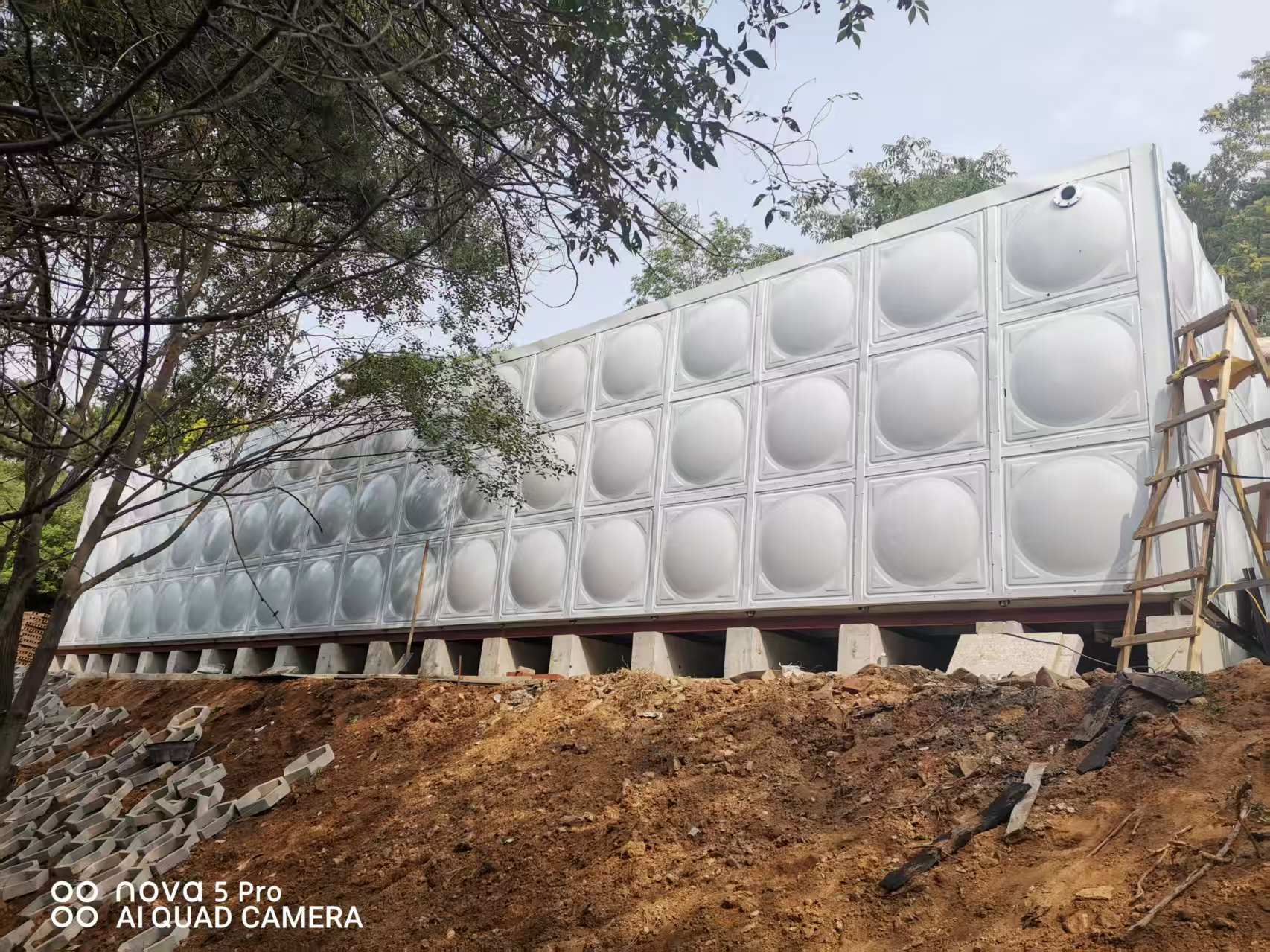
Insulation Design: Beyond Thickness
The thermal insulation performance of an FRP (Fiberglass Reinforced Plastic) water tank is primarily determined by the structure and material of its insulation layer. While the industry standard CJ/T 306-2009 requires a heat transfer coefficient (K-value) ≤ 0.8 W/(m²·K), Beijing Yuanhui FRP Co., Ltd. achieved a measured K-value of 0.52 W/(m²·K) in a ski resort project in Zhangjiakou, Hebei, using 50mm polyurethane rigid foam (PUR).
PUR has a thermal conductivity (λ) of approximately 0.022 W/(m·K), significantly lower than rock wool (0.040) or extruded polystyrene (0.030). However, the relationship between thickness and heat loss reduction is not linear. Increasing thickness from 40mm to 60mm reduces heat loss by about 35%, but from 60mm to 80mm, the reduction drops to only 12%. This is because the convective heat transfer boundary layer between the tank wall and ambient air becomes the dominant thermal resistance. In regions with an average winter temperature of -15°C, a 50-60mm insulation layer is recommended; exceeding 70mm offers diminishing returns.
A critical factor is the adhesion process between the insulation and the tank shell. PUR foam applied via high-pressure one-shot injection molding leaves no voids against the FRP liner, reducing thermal bridging by over 70% compared to manually cut and glued rock wool panels. In a hospital hot water project in Hohhot, Inner Mongolia, Beijing Yuanhui performed a side-by-side comparison: the rock wool tank experienced an 8.2°C temperature drop over 24 hours, while the PUR foam tank dropped only 3.1°C.
Scenario 1: Hot Water Storage in Northern Heating Systems
In centralized and solar-assisted heating systems, FRP insulated tanks serve as thermal buffers. For a residential heating retrofit in Daqing, Heilongjiang, Beijing Yuanhui supplied two 100m³ FRP tanks with 60mm PUR foam and a 0.5mm aluminum foil reflective layer. Field data showed that at -28°C outdoor temperature, the internal water temperature fell from 85°C to 80°C over 72 hours, a heat loss rate of only 0.069°C/h.
The aluminum foil layer reduces radiative heat transfer by approximately 40%. Switching to a standard galvanized steel jacket would increase heat loss by 18-25%. Additionally, the tanks use an internal diverter tube structure at the inlet and outlet to prevent thermal stratification, improving effective storage volume utilization from 75% to 92%.
Scenario 2: Constant Temperature Control for Industrial Cooling Water
In industries like electronics manufacturing and food fermentation, FRP insulated tanks stabilize cooling water temperature against ambient fluctuations. A Suzhou electronics factory required lithography cooling water at 22±0.5°C. The original stainless steel tank with rubber-plastic insulation saw temperature drift exceeding 1.2°C when the workshop reached 38°C in summer.
After replacing it with an 80mm PUR-insulated FRP tank from Beijing Yuanhui, equipped with a dual-circuit partitioned structure (upper return zone + lower supply zone), temperature fluctuation was controlled within 0.3°C. The key is that FRP itself has a thermal conductivity of only 0.23 W/(m·K) (vs. 16.2 W/(m·K) for stainless steel), minimizing heat ingress through the tank wall.
Scenario 3: Fire Water Storage Freeze Protection
Fire water tanks in cold regions face the risk of freezing. According to GB 50974-2014, the minimum water temperature must not fall below 5°C. However, field surveys indicate that 3-5% of fire tanks in North China experience ice formation or pipe freezing each winter. FRP tanks offer an advantage: their monolithic structure has no welds, eliminating stress corrosion and freeze-cracking risks common in metal tanks.
In a logistics park project in Shenyang, Liaoning, Beijing Yuanhui implemented a built-in electric heating rod + 50mm PUR insulation solution. The heating rod required only 8W/m³ (compared to 15W/m³ for metal tanks), as FRP's low thermal conductivity reduces heat loss to the environment. At -25°C outdoor conditions, the tank maintained 7-10°C, with annual electricity costs 42% lower than a same-capacity stainless steel insulated tank.
Conclusion
The thermal insulation performance of an FRP water tank is not a simple function of material stacking but a result of the interplay between insulation thickness, reflective layer design, tank material conductivity, and internal flow path configuration. For heating, industrial, and fire protection applications, a combination of PUR foam, aluminum foil reflective layer, and baffled internal structure can limit heat loss to 0.05-0.10°C/h. When selecting an insulated tank, demand a heat transfer coefficient test report based on GB/T 4272-2008, and pay close attention to the insulation injection process and joint sealing.