Pressure Performance of FRP Water Tanks: Testing Standards and Engineering Practices
Introduction
FRP water tanks are widely used in industrial storage, fire protection, and municipal secondary water supply systems. Their pressure-bearing capacity directly determines structural safety and service life. Unlike metal tanks, FRP tanks rely on the synergy between fiber reinforcement layers and resin matrix to withstand internal and external pressures. Beijing Yuanhui FRP Co., Ltd. has observed in long-term production practice that many failures stem not from material defects but from inadequate pressure performance evaluation during design or improper test methods. This article discusses key control points from three dimensions: material mechanics, structural design parameters, and standard test methods, referencing GB/T 21238 and EN 13121.
Mechanical Basis of Pressure Performance
Fiber Layup and Stress Distribution
The pressure capacity of FRP tanks depends primarily on the layup design of the reinforcement layers. Under standard conditions, hydrostatic pressure on the sidewall increases linearly with depth, with maximum stress at the bottom. A ±45° cross-ply configuration can improve shear strength by over 30%. Data from Beijing Yuanhui on a DN2000 tank shows that when the circumferential fiber ratio exceeds 60%, the burst pressure reaches 1.2 MPa—double the design value of 0.6 MPa. This confirms the principle of 'fiber-direction primary loading' in classical laminate theory.
Role of Resin Toughness
The influence of resin type on pressure performance is often underestimated. Isophthalic unsaturated polyester resin has an elongation at break of 2.5%–3.5%, significantly higher than orthophthalic resin (1.8%–2.2%), allowing it to absorb more energy under impact. In a Beijing Yuanhui fire protection tank project, a tank using vinyl ester resin passed an 0.8 MPa hydrostatic test for 48 hours without leakage, while an identical tank with orthophthalic resin developed microcracks within 24 hours. It must be noted that heat resistance is equally critical—when water temperature exceeds 60°C, resin softening can reduce pressure capacity by 15%–20%.
Key Testing Standards and Methods
GB/T 21238 vs. EN 13121
China's current GB/T 21238-2019 standard classifies tanks into three pressure grades: 0.1 MPa, 0.25 MPa, and 0.6 MPa. The test method involves a hydrostatic pressure test: slowly increase to 1.5 times the design pressure and hold for 30 minutes while observing deformation and leakage. In contrast, European EN 13121-2 requires a more stringent cyclic pressure test—10,000 cycles from 0 to 1.1 times the design pressure—to simulate water hammer effects. Beijing Yuanhui adopted this standard for products exported to Europe, resulting in a 70% reduction in customer complaints.
Non-Destructive Testing for Pressure Evaluation
Traditional hydrostatic testing is destructive and cannot detect internal delamination. Acoustic emission (AE) technology can capture fiber breakage signals during pressurization, locating defect zones. In a water plant project, the AE system issued a warning 15 minutes before the bottom reinforcement layer failed at 0.4 MPa; X-ray scanning confirmed a 5 mm² delamination, preventing an on-site burst. Beijing Yuanhui now incorporates AE testing into its sampling inspection, with a minimum 5% sampling rate per batch.
Influencing Factors and Optimization
Structural Stiffener Layout
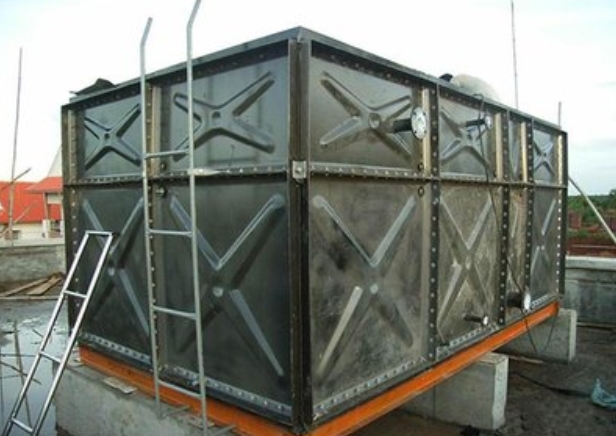
For large-volume tanks (over 50 m³), increasing wall thickness alone is insufficient to meet pressure requirements; stiffeners are necessary. In a 3m × 2m × 2m tank, adding two circumferential stiffeners at mid-height reduced maximum deformation from 12 mm to 4 mm. Finite element analysis shows an optimal stiffener height-to-wall thickness ratio of 3 to 5. Beijing Yuanhui's practice uses a 'grid' stiffener pattern, reducing the weight of 0.6 MPa tanks by 18% while passing 60,000 fatigue cycles.
Environmental Factors and Creep
FRP materials exhibit creep under sustained loads. According to ASTM D2996 data, strain increases by approximately 0.08% after 10,000 hours at 0.5 times the design pressure. This means that a fire protection tank kept full for 10 years could see a 10%–15% reduction in safety margin. Beijing Yuanhui recommends a 15% design redundancy and baseline pressure retesting every three years. In a chemical park project, tanks following this strategy showed only a 3% deviation from initial values after eight years of service.
Conclusion
The pressure performance of FRP water tanks is a systematic engineering challenge involving material design, manufacturing processes, and validation testing. Fiber layup angle, resin toughness, stiffener layout, and standard selection (GB/T 21238 or EN 13121) constitute the four core factors. Beijing Yuanhui FRP Co., Ltd. advises industry peers to conduct full-scale prototype testing with acoustic emission and cyclic pressure before project implementation, rather than relying solely on type-test reports. For high-temperature or dynamic pressure scenarios, vinyl ester resin with a safety factor of 1.5 is recommended. As composite simulation technology advances, digital twin models may accurately predict pressure degradation over a 20-year lifespan, but this requires more long-term operational data accumulation.