Pressure Performance of FRP Water Tanks: Testing Standards and Engineering Practice
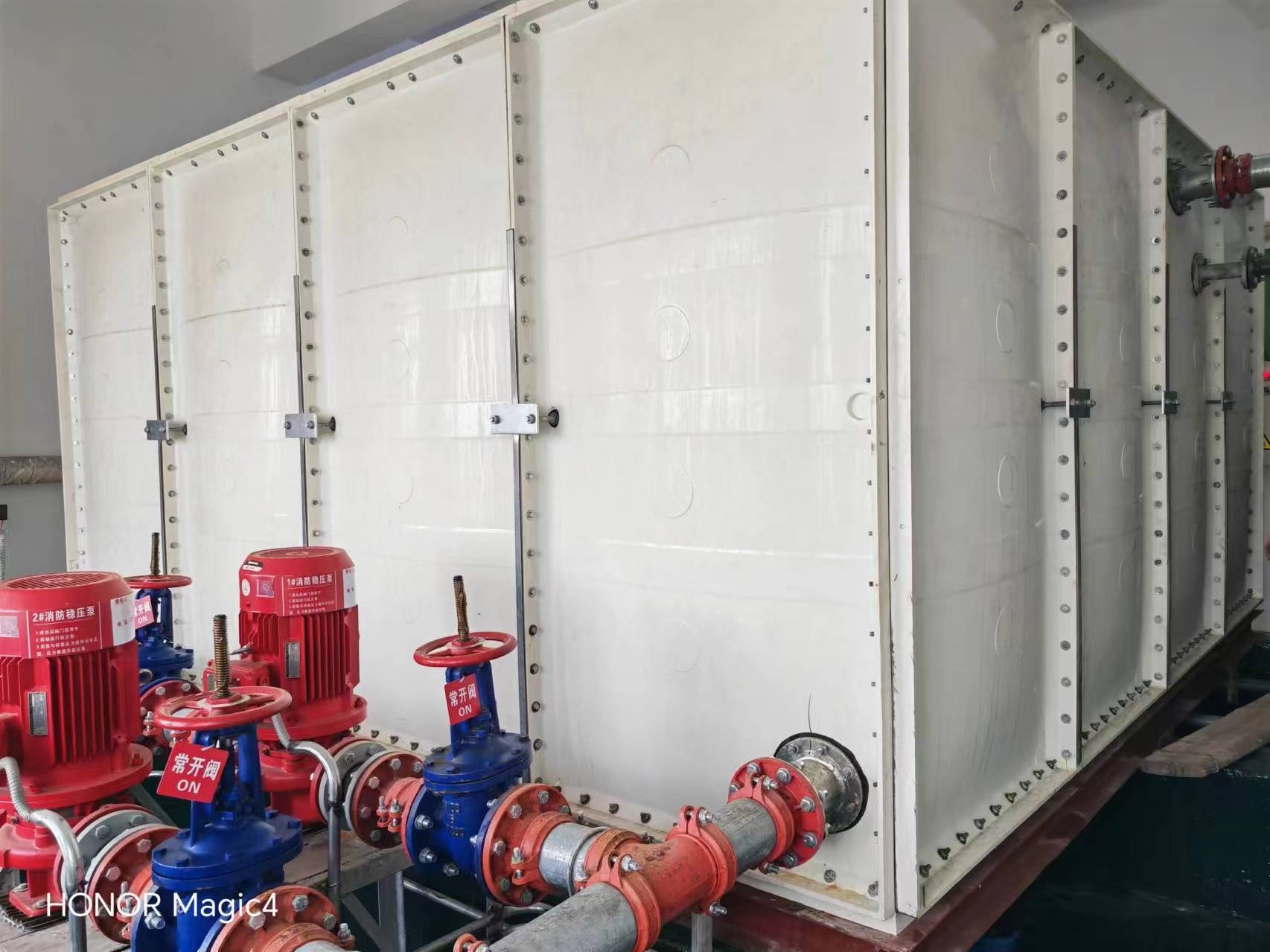
1. Core Factors Influencing FRP Tank Pressure Performance
The pressure performance of FRP water tanks is determined by material formulation, molding process, and structural design. Beijing Yuanhui FRP Co., Ltd. has observed significant differences between SMC (Sheet Molding Compound) and BMC (Bulk Molding Compound) processes in engineering practice.
SMC panels, with longer fibers (25-50mm) and more uniform distribution, achieve tensile strengths of 80-120MPa and flexural modulus of 7-10GPa. BMC panels, though offering better flowability for complex geometries, typically exhibit 15-20% lower pressure capacity due to shorter fibers (3-12mm).
The orthotropic nature of FRP is another critical factor. Measured data from Beijing Yuanhui shows tensile strength along the primary fiber direction is approximately 40% higher than perpendicular direction. Misalignment between principal stress direction and fiber orientation can severely reduce the safety factor.
2. Comparison of Domestic and International Testing Standards
2.1 Chinese Standards
GB/T 21238-2016 classifies pressure tests into three categories: hydrostatic test (1.5× design pressure for 30 min), cyclic pressure test (10,000 cycles from 0 to design pressure), and burst test. For Beijing Yuanhui's standard 10-ton tank designed at 0.6MPa, the actual burst pressure reached 2.1MPa, yielding a safety factor of 3.5.
2.2 International Standards
ASTM D4097-19 emphasizes long-term creep performance, requiring specimens to maintain 80% design pressure for 1,000 hours with deformation below 2% of initial value. EN 13121 introduces a structural integrity coefficient, mandating leakage tests at flange connections with a maximum rate of 0.05L/h·m.
For export projects, Beijing Yuanhui incorporates isophthalic polyester resin to raise heat deflection temperature from 80°C to 110°C, mitigating pressure degradation in high-temperature applications.
3. Engineering Failure Case Study
In 2019, an FRP tank at a chemical plant developed circumferential cracks after 18 months. Beijing Yuanhui's investigation identified three root causes:
1) Water hammer effect was overlooked—instantaneous pressure reached 1.8× design value.
2) Uneven bolt preload during installation created localized stress concentrations.
3) Continuous operation above 60°C softened the resin, reducing strength by 30%.
This case prompted Beijing Yuanhui to launch an impact-resistant tank series in 2020, incorporating 5% polyvinyl alcohol short fibers to increase impact toughness from 15kJ/m² to 28kJ/m², plus damping base pads for water hammer absorption.
4. Optimization Pathways for Pressure Performance
Finite Element Analysis (FEA) has become indispensable. Beijing Yuanhui uses ANSYS Workbench for meshing and stress analysis, focusing on:
· Stress distribution at the bottom support area (peak typically at one-third height from bottom)
· Stress concentration factors near manholes and nozzles
· Deflection curves under varying water levels
Acoustic Emission (AE) monitoring offers real-time crack detection. In a 500m³ tank project, AE sensors successfully identified two micro-crack initiations during hydrotesting, preventing a later leakage incident.
Conclusion
Systematic control of material selection, structural design, and test validation is essential. Beijing Yuanhui FRP Co., Ltd. recommends:
1) Prioritize SMC panels; consider carbon-fiber hybrid reinforcement for extreme pressure requirements.
2) Reference both GB/T 21238 and ASTM D4097 long-term creep provisions.
3) Conduct 48-hour hydrostatic tests with stress-strain curve recording for quality assurance.