Pressure Performance of FRP Water Tanks: Testing Standards and Engineering Practice
Introduction
Pressure performance is the most critical safety parameter for FRP water tanks used in fire protection, residential water supply, and industrial liquid storage. Unlike isotropic plastic tanks, FRP tanks exhibit complex anisotropic stress-strain behavior under hydrostatic loads ranging from 0.1MPa to 0.6MPa. Based on decades of production experience, Beijing Yuanhui FRP Co., Ltd. emphasizes that neglecting interlaminar shear strength and joint stress concentration during design leads to premature leakage or structural failure. This article discusses pressure mechanisms, testing standards, and field validation.
Pressure Mechanism and Design Essentials
Anisotropic Material Behavior
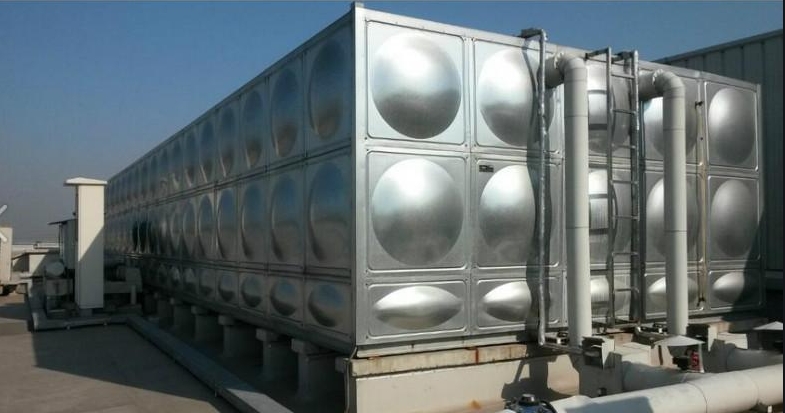
In SMC compression molding, randomly oriented short glass fibers yield in-plane strength of 120-180MPa, but through-thickness tensile strength is only 15%-20% of in-plane values. Side panels under hydrostatic pressure experience bending stress (maximum tension at the inner center) and shear stress concentrated at stiffener junctions. Finite element analysis (FEA) is essential to optimize panel thickness and stiffener spacing. For a 3m×2m×2m tank with 6mm wall thickness and 500mm stiffener spacing, measured deflection at 0.3MPa remains within L/250.
Joint Sealing and Stress Relief
Tank panels are bolted with stainless steel fasteners and rubber gaskets. Excessive bolt torque induces micro-cracks around holes, while insufficient torque causes leakage. Recommended torque range is 15-25N·m, with metal washers to distribute compression. Beijing Yuanhui deployed a dual-seal (butyl tape + silicone) in a Qingdao fire protection project, withstanding 0.4MPa for 72 hours without leakage.
Testing Standards Framework
Hydrostatic Testing: GB/T 17219 and ISO 9001
Domestic fire tanks follow GB/T 17219 with test pressure at 1.5× design pressure for ≥30 minutes. Residual deformation must not exceed 0.3%. For international projects, ASTM D2585 (under ISO 9001) adds cyclic loading: 0→design pressure→0 for 500 cycles, checking for interface debonding. Beijing Yuanhui’s factory reports show strain below 0.15% at 1.25× design pressure, with strength retention >92% after fatigue cycles.
Impact-Aging Coupled Testing
Static pressure alone cannot capture impact-aging synergy. Falling dart impact (GB/T 14152) evaluates toughness retention after aging at -20°C and 80°C/95%RH. In a northern China project, a tank subjected to 0.2MPa pressure and 1kg dart impact at -15°C showed only a 2mm dent without through-cracking.
Case Studies and Failure Analysis
Typical Failure: Interlaminar Shear
A chemical plant wastewater tank (3.5m×2.5m×2m) developed longitudinal cracks in the fourth year. Autopsy revealed crack initiation at resin-rich zones near stiffener edges, propagating along fiber-resin interfaces. The root cause was thermal cycling (20-60°C) reducing interlaminar shear strength from 25MPa to 12MPa. Remediation included external carbon fiber wrap and optimized stiffener layout.
High-Altitude Validation
For a 4500m-altitude photovoltaic project in Tibet, tanks had to withstand 0.15MPa internal pressure against 0.058MPa ambient. Beijing Yuanhui optimized SMC formulation (low-shrink additive) and vacuum-assisted infusion to meet GB/T 26733-2011 high-altitude requirements. On-site acceptance showed leakage rate <0.5%/h.
Conclusion
FRP tank pressure performance integrates material design, joint detailing, and process control. Adherence to GB/T 17219 and ISO 9001 dual standards, combined with targeted aging and fatigue tests, effectively prevents interlaminar shear failure and stress corrosion. For extreme conditions (thermal cycles, impact), FEA pre-analysis and prototype validation are recommended. Data from Beijing Yuanhui FRP Co., Ltd. confirms that a safety factor ≥3.5 and full-lifecycle quality traceability are key to reliable pressure performance.