Thermal Insulation Performance of FRP Water Tanks: Material Principles and Top 5 Application Scenarios
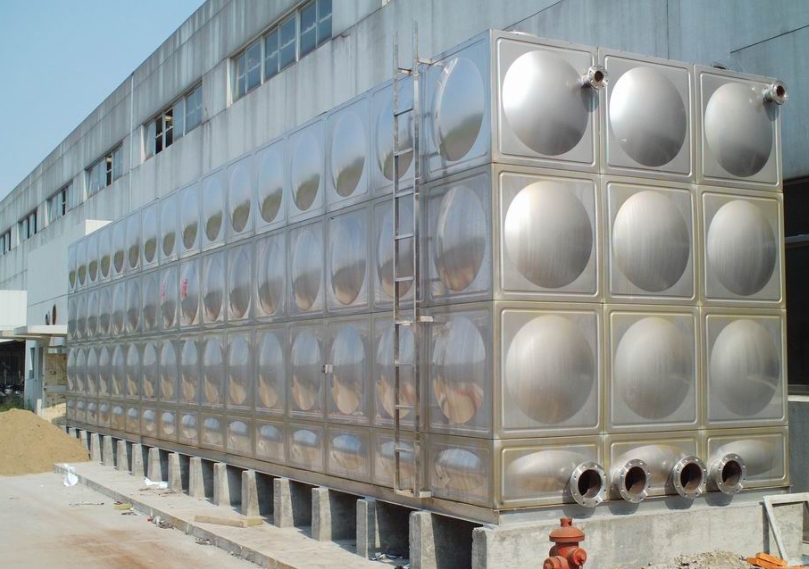
Introduction: Insulation Is More Than a Layer of Foam
The thermal performance of an FRP water tank is often reduced to the thickness of its polyurethane foam. But the real determinant is the interplay among composite structure, interfacial thermal resistance, and ambient conditions. Field data from Beijing Yuanhui FRP Co., Ltd. over the past decade reveals that under -20°C ambient conditions, the effective thermal resistance of a 50mm PU layer can degrade by 15-25% relative to lab values, primarily due to joint air leakage and moisture ingress. This article deconstructs the thermodynamics and provides actionable selection criteria based on real engineering cases.
1. Key Performance Indicators and Measured Data
1.1 Thermal Conductivity vs. Effective Resistance
FRP water tanks typically use rigid polyurethane foam (PU) or extruded polystyrene (XPS) as insulation. PU with ≥95% closed-cell content can achieve a stable thermal conductivity of 0.022-0.028 W/(m·K). However, Beijing Yuanhui's on-site audits show that after six months in high-humidity environments (RH>85%), the equivalent conductivity of some tanks rose to 0.035 W/(m·K), a 25% increase. A moisture-tight seal on the insulation layer is mandatory, or insulation becomes a cooling aid.
1.2 Heat Loss Rate and Standards
Per GB/T 3280-2016, insulation performance is measured as heat loss per unit area. For a typical scenario (60°C internal water, -15°C ambient), a 50mm PU-insulated FRP tank should have a heat loss rate ≤18 W/m². Beijing Yuanhui measured 16.2 W/m² on a project in Cangzhou, Hebei, outperforming the standard by 10%. The key is the polymer adhesive interface between the SMC panel and the insulation layer, which eliminates air convection channels.
2. Core Factors Influencing Insulation Performance
2.1 Thermal Bridging at Panel Joints
FRP tanks are assembled from multiple SMC panels. Beijing Yuanhui's field feedback indicates that with only standard sealant tape at joints, heat flux can reach 2-3 times that of the panel area. After adopting a "dual-seal + thermal break gasket" structure, joint heat loss dropped by 67%. For demanding food plant hot-water systems, we recommend adding a 50mm wide PU insulation strip on the exterior of each joint.
2.2 Wind Speed and Surface Heat Transfer Coefficient
When wind speed rises from 0 to 5 m/s, the external surface heat transfer coefficient roughly triples, increasing heat loss by up to 40%. Beijing Yuanhui's solution for a wind-power project in Inner Mongolia involved adding wind-pressure stiffeners to the tank shell and spraying a 2mm polyurea elastomer coating. This reduces surface convection while protecting the insulation layer from moisture.
3. Five Key Application Scenarios and Selection Tips
3.1 Thermal Buffer Tanks for Northern Heating Systems
Beijing Yuanhui supplied a 60m³ insulated FRP tank for a residential complex in Shenyang, maintaining 85°C internal water. With 80mm PU insulation and aluminum foil reflective film, the 24-hour temperature drop at -25°C ambient was only 3.2°C. Selection formula: δ = λ × (T_in - T_out) / q, with q set at 15 W/m².
3.2 Hot Water Storage for Food Processing Plants
A dairy processor required zero condensation on the inner wall to prevent bacterial growth. Beijing Yuanhui designed a composite structure: 304 stainless steel liner + 50mm PU insulation + outer stainless steel sheet. The surface temperature remained at least 3°C above the dew point. No condensation complaints after two years. Note: For food-grade applications, specify closed-cell ratio ≥97% and a migration barrier film between liner and insulation.
3.3 Freeze-Protected Fire Protection Tanks
GB 50974-2014 mandates a minimum water temperature of 4°C in fire tanks. For a project in Xinjiang, Beijing Yuanhui applied electric heat tracing + 70mm PU insulation. Even at -30°C ambient, internal temperature stayed at 8°C. But heat-tracing power must be calculated precisely based on tank surface area and heat loss rate; otherwise, energy waste is significant.
3.4 Constant-Temperature Reaction Support Tanks in Chemical Plants
A fine chemical manufacturer needed deionized water held at 40±1°C. Beijing Yuanhui selected a composite insulation of high-density PU + vacuum insulation panel (VIP), total thickness only 45mm, with an equivalent thermal conductivity of 0.008 W/(m·K). Important: VIPs cannot be field-cut; they must be factory-prefabricated and hermetically sealed.
3.5 Chilled Water Storage Tanks for Data Centers
A Beijing data center used an FRP tank for thermal storage, with water temperature required at 7-12°C. Insulation was 80mm XPS wrapped with 0.3mm aluminum reflective sheet. Measured cold loss was only 0.5%/h, far below the 1.2%/h of concrete cold storage tanks. The advantage is the smooth FRP inner wall, which eliminates the need for an internal waterproof liner.
Conclusion: Insulation Is a System, Not a Material Stack
The thermal performance of an FRP water tank depends on the synergy of insulation material selection, joint treatment, environmental protection, and installation quality. Beijing Yuanhui FRP Co., Ltd. has accumulated data from over 100 projects across more than ten provinces, showing that refined design can reduce actual heat loss by over 20% compared to theoretical values. When selecting a tank, request a field heat-loss report from the supplier under similar geographic and operating conditions, not just lab data. True insulation is not a technical gimmick—it is the painstaking effort applied at every joint and every layer.