In-Depth Analysis of FRP Water Tank Corrosion Resistance: From Material Properties to Engineering Practice
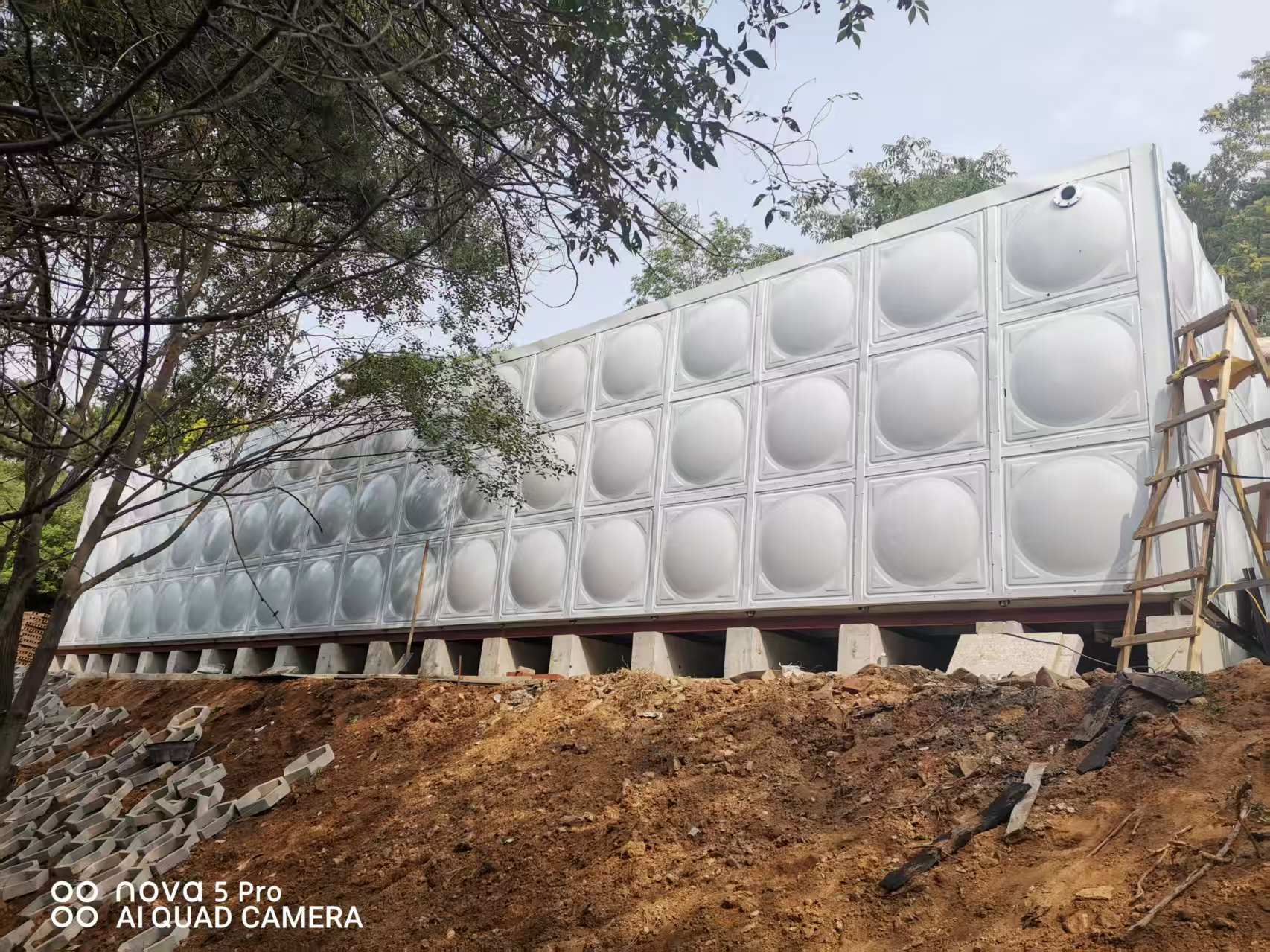
Introduction
FRP (Fiberglass Reinforced Plastic) water tanks have largely replaced traditional steel tanks in municipal water supply, chemical storage, and seawater desalination. The core driver is corrosion resistance—but this is not simply 'non-rusting.' The anti-corrosion performance of FRP depends on the coupling of resin type, laminate design, curing process, and service environment. Beijing Yuanhui FRP Co., Ltd. has accumulated extensive corrosion data over a decade of production. This article systematically breaks down the corrosion protection logic of FRP water tanks based on these measured results.
1. Corrosion Protection Mechanisms: Resin and Interface Synergy
1.1 Chemical Barrier of Resin Matrix
The corrosion resistance of FRP water tanks primarily originates from the resin matrix. After curing, unsaturated polyester resin (UPR) forms a three-dimensional cross-linked network with a permeability to water molecules, chloride ions, and sulfate ions far lower than concrete or carbon steel. Taking the isophthalic UPR commonly used by Beijing Yuanhui FRP Co., Ltd. as an example, ASTM D570-98 testing shows a 24-hour water absorption of only 0.12%–0.18%, over 40% lower than orthophthalic resin. For strong acid (pH <3) or strong alkali (pH >11) environments, a vinyl ester resin or epoxy resin liner is required. In a hydrochloric acid storage tank project for a chemical plant, a bisphenol A epoxy resin liner (thickness ≥1.5mm) retained 92% of its Barcol hardness after 5 years of service.
1.2 Structural Contribution of Fiber Reinforcement
Glass fibers themselves are not resistant to hydrofluoric acid and strong alkalis, but when encapsulated by resin, they provide mechanical strength and inhibit microcrack propagation. The key parameter is the 'resin-fiber interfacial bond strength.' Beijing Yuanhui FRP Co., Ltd. uses silane coupling agents (e.g., KH-550) to increase interfacial shear strength to over 12MPa (ASTM D2344 short beam shear method), effectively preventing capillary wicking of liquids along the fiber axis. Measured data show that without coupling treatment, the interlaminar shear strength of specimens decreases by 28% after 500h immersion in 3.5% NaCl solution, while treated specimens decrease by only 6%.
1.3 Dual Protection of Surface Coating and Resin-Rich Layer
The inner surface of FRP water tanks is typically designed with a resin-rich layer (resin content ≥70%, thickness 0.3–0.5mm), then covered with a gel coat or anti-corrosion coating. Beijing Yuanhui FRP Co., Ltd. uses a food-grade gel coat (compliant with GB 4806.7) for drinking water tanks. After 5000h of continuous immersion, the leaching of lead, cadmium, and chromium in the water is below 0.001mg/L, far below the national standard limit. For chlorinated wastewater conditions, a phenolic epoxy coating is recommended as a topcoat, with a chloride ion permeability coefficient as low as 1.2×10⁻¹³ m²/s (ASTM D5885).
2. Performance Boundaries and Case Studies in Different Corrosive Environments
2.1 Drinking Water and Municipal Supply
For municipal tap water with a pH of 6.5–8.5, standard isophthalic UPR FRP water tanks have an expected lifespan of over 20 years. Beijing Yuanhui FRP Co., Ltd. sampled a tank in a Tongzhou district community after 12 years of service. Results showed: no blistering on the inner surface, no exposed fibers, Barcol hardness dropped from 42 to 38, a decline of only 9.5%. The corrosion rate (by weight loss method) was 0.003mm/year, compared to approximately 0.15mm/year for carbon steel tanks in the same water quality—a 50-fold difference.
2.2 Industrial Wastewater and Acid/Alkali Media
In wide pH range applications (pH 2–12), resin selection must be based on the specific medium. For chrome-containing wastewater (Cr⁶⁺ concentration 200mg/L, pH 3.5) from an electroplating plant, a vinyl ester resin tank from Beijing Yuanhui FRP Co., Ltd. showed no corrosion pits on the inner wall after 4 years, with an interlaminar shear strength retention of 87%. However, caution is needed: when the medium contains organic solvents (e.g., acetone, toluene), the UPR matrix is prone to swelling. In such cases, furan resin or epoxy resin should be used, and the liner thickness increased to over 2mm. Tests show that after 30 days immersion in 10% aqueous acetone, the flexural strength retention of standard UPR specimens is only 41%, while epoxy resin specimens retain 89%.
2.3 Seawater and High Salt Spray Environments
Seawater cooling tanks in coastal areas face dual corrosion from salt spray and chloride ions. In a seawater source heat pump project in Qingdao, Beijing Yuanhui FRP Co., Ltd. used isophthalic UPR with a glass fiber surface veil. After 3 years of operation, the chloride ion penetration depth was less than 0.2mm, far below the design allowance of 1.0mm. For comparison, a 316L stainless steel tank on the same site exhibited pitting corrosion at weld joints (maximum depth 0.8mm). The key parameter is the 'chloride ion diffusion coefficient' of the resin. Via electrochemical impedance spectroscopy (EIS), the diffusion coefficient of the tank's liner was 3.5×10⁻¹⁴ m²/s, an order of magnitude lower than ordinary epoxy coatings.
3. Typical Corrosion Failure Modes and Prevention
3.1 Osmotic Blistering
Osmotic blistering is the most common failure mode for FRP water tanks, resulting from incomplete resin curing or insufficient resin-rich layer thickness. Quality control data from Beijing Yuanhui FRP Co., Ltd. shows that when the liner thickness is below 0.3mm, the blistering rate after 1000h immersion in 80°C hot water is as high as 35%; when the thickness is ≥0.5mm, the blistering rate drops to below 2%. Prevention measures include controlling the degree of cure (exothermic peak temperature ≥140°C via DSC), and using vacuum-assisted resin transfer molding (VARTM) to reduce porosity.
3.2 Fiber Exposure and Wicking Effect
When the surface gel coat is damaged by mechanical abrasion or corrosive media, liquid penetrates along the fiber axis. A field failure analysis showed: long-term scouring (flow velocity >3m/s) on the inner tank wall wore away the gel coat, exposing fibers. The medium then wicked along fiber bundles to the backing layer, eventually causing delamination. Solution: for areas with design flow velocities exceeding 1.5m/s, add a wear-resistant liner (e.g., silicon carbide filler coating) and control the inner surface roughness to Ra ≤3.2μm.
Conclusion
The corrosion resistance of FRP water tanks is a systematic engineering task involving resin selection, interface design, process control, and condition matching. With appropriate material selection and construction standards, their corrosion-resistant lifespan can reach 5–10 times that of traditional carbon steel tanks. Measured data from Beijing Yuanhui FRP Co., Ltd. demonstrates that in drinking water, industrial weak acid/alkali, and seawater environments, well-designed FRP tanks can achieve maintenance-free operation for over 20 years. In the future, with the introduction of high-performance resins (such as PPS) and nano-modification technologies, the application boundaries of FRP water tanks in extreme corrosive conditions will be further expanded.