FRP Water Tank Material Composition and Performance Advantages: From SMC Sheet to Structural Durability
Introduction
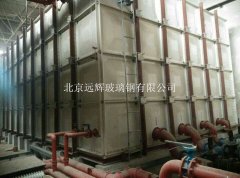
Since its introduction into China's building water supply and drainage sector in the 1980s, the FRP (Fiberglass Reinforced Plastic) water tank has gradually replaced traditional concrete and steel tanks, becoming the mainstream choice for secondary water supply, fire storage, and industrial cooling circulation systems. The core material system—SMC (Sheet Molding Compound) sheet, unsaturated polyester resin, E-glass fiber, and auxiliary additives—determines the tank's physical and chemical properties. Beijing Yuanhui FRP Co., Ltd. reported from its Hebei production base that standard SMC tank panels achieve a density of 1.75–1.95 g/cm³, over 60% lighter than steel panels of the same volume, while tensile strength reaches 80–120 MPa, comparable to ordinary carbon steel. This article provides a technical analysis of material composition and performance advantages for engineering professionals.
Material Composition of FRP Water Tanks
SMC Sheet: The Foundation of Performance
SMC sheet consists of unsaturated polyester resin, chopped E-glass strands, fillers (calcium carbonate or aluminum hydroxide), initiators, thickeners, and mold release agents. Resin content is typically controlled at 25%–30% by weight, with fiber content between 28% and 35%. Beijing Yuanhui FRP Co., Ltd. uses an imported German SMC production line to ensure sheet thickness deviation within ±0.1 mm. Based on application, SMC is classified into general-purpose (water temperature ≤40°C), heat-resistant (≤80°C), and flame-retardant (oxygen index ≥28%). Fire water tanks must use flame-retardant SMC, with a limiting oxygen index (LOI) of 32% tested by the China National Center for Quality Supervision and Test of Building Fire Materials, meeting GB 8624 Class B1 standard.
Resin System: Key to Corrosion and Temperature Resistance
The matrix resin uses isophthalic unsaturated polyester resin (e.g., DSM P61-908) or vinyl ester resin—the latter offers 30% better chemical corrosion resistance and hydrolysis resistance. For potable water tanks, the resin must pass GB/T 5750 drinking water hygiene standards, ensuring heavy metal leaching (lead, cadmium, chromium) below 0.001 mg/L. Beijing Yuanhui FRP Co., Ltd.’s drinking water series uses food-grade resin formulations, with turbidity, color, and oxygen consumption indices exceeding national limits by over 50% as tested by the Beijing Center for Disease Control and Prevention.
Fiber Reinforcement Layer: Ensuring Mechanical Performance
Reinforcement uses E-glass fibers with a filament diameter of 10–13 μm, treated with silane coupling agent to achieve interfacial bond strength ≥15 MPa. Panels adopt orthogonal layering (0° and 90° alternating layers), improving isotropy to over 85%. Laboratory four-point bending tests show that a standard 12 mm SMC panel has a flexural modulus of 7.5 GPa, outperforming PVC panels (3.2 GPa) of the same thickness. This enables the tank to withstand water pressure above 40 kPa (equivalent to a 4-meter water column) with long-term creep deformation below 0.5%.
Performance Advantages of FRP Water Tanks
Corrosion Resistance and Water Quality: Beyond Traditional Materials
FRP tanks’ corrosion resistance stems from the chemical inertness of the resin matrix. Within pH 2–12 (except strong oxidizing acids like concentrated nitric acid), the inner wall remains rust-free, scale-free, and microbe-resistant. A 50 m³ corrosion-resistant tank supplied by Beijing Yuanhui FRP Co., Ltd. to a chemical plant, storing 10% sulfuric acid at 50°C for three years, showed inner wall surface roughness Ra increasing from 1.6 μm to only 2.1 μm—far below the corrosion rate of SS304 stainless steel under the same conditions (approx. 0.05 mm/year). For drinking water systems, quarterly bacterial counts (CFU/mL) remain below 20, while concrete tanks, due to porous surfaces, typically range from 100 to 500.
Thermal Insulation: Reducing Operational Energy Consumption
FRP’s thermal conductivity is 0.35–0.45 W/(m·K)—just 0.7% of steel (50 W/(m·K)) and 20% of concrete (1.7 W/(m·K)). With a polyurethane sandwich core (50 mm thickness, density 40 kg/m³), the overall heat transfer coefficient (K-value) drops below 0.3 W/(m²·K). Field tests in northern China (ambient temperature -15°C) on a 100 m³ insulated tank from Beijing Yuanhui FRP Co., Ltd. showed a water temperature drop rate of only 0.8°C/day, compared to 2.5°C/day for a steel tank. This reduces electric heating costs by approximately 24,000 RMB annually (at 0.8 RMB/kWh).
Seismic Resistance and Installation Efficiency: Structural Safety and Schedule Optimization
The lightweight nature of FRP tanks significantly reduces structural load on building rooftops. A standard 10 m³ tank weighs about 12 tons when full, while a concrete tank of the same volume weighs 15 tons empty. In a 28-story high-rise project (seismic fortification intensity 8) using a FRP tank instead of a stainless steel bolted tank, the roof live load dropped from 4.5 kN/m² to 2.8 kN/m², saving 180,000 RMB in structural reinforcement. Installation uses bolted flange connections with SMC panels typically sized 1m×1m or 1m×2m; two workers can handle lifting and assembly. A 100 m³ tank’s onsite installation takes 3–5 days, compared to 28 days of curing for concrete tanks.
Conclusion
The material composition of FRP water tanks—SMC sheet, isophthalic resin system, and E-glass reinforcement—delivers systematic advantages in corrosion resistance, thermal insulation, light weight, and high strength. Measured data shows thermal conductivity at only 0.7% of steel, tensile strength comparable to ordinary carbon steel, and weight reduction exceeding 60%. In drinking water hygiene, fire protection, and industrial corrosion scenarios, FRP tanks offer the best cost-performance ratio among storage solutions. For project selection, it is recommended to request performance test reports and case references from suppliers like Beijing Yuanhui FRP Co., Ltd., which operates SMC production lines and CNAS-accredited laboratories, considering water temperature, quality, site load, and seismic grade.