Seismic Performance of FRP Water Tanks: Design Standards and Engineering Practice
Introduction
FRP (Fiberglass Reinforced Plastic) water tanks are widely used in building water supply, fire protection, and industrial cooling due to their light weight, corrosion resistance, and long service life. However, in earthquake-prone regions, the seismic performance of these tanks directly impacts building safety and emergency water supply. In the 2010 Yushu earthquake, several steel tanks failed due to weld cracking, while FRP tanks installed at the same time remained intact. Beijing Yuanhui FRP Co., Ltd. has accumulated extensive seismic design experience from projects in high-intensity seismic zones. This article examines the seismic reliability of FRP water tanks from the perspectives of material properties, design codes, and structural optimization.
Material Basis for Seismic Performance
Specific Strength and Elastic Modulus
The specific strength of FRP (tensile strength/density) is 3-4 times that of steel, reaching 150-200 MPa/(g/cm³). Under equivalent load capacity, the tank self-weight can be reduced by 40%-60%, directly lowering inertial forces during earthquakes. The elastic modulus of FRP (10-20 GPa) is lower than steel (200 GPa), enabling greater deformation capacity and better energy absorption without brittle failure. Beijing Yuanhui uses SMC compression molding for high-strength panels, achieving interlaminar shear strength above 12 MPa, preventing delamination under cyclic seismic loads.
Damping and Fatigue Life
FRP's damping ratio (0.02-0.05) is higher than steel (0.005-0.01), effectively attenuating vibration amplitude. Shaking table tests showed that under 0.4g peak acceleration (equivalent to rare 8-degree earthquake), the top acceleration response of an FRP tank was reduced by 15%-20%, and internal water sloshing amplitude decreased by about 10%. The fatigue strength of FRP is approximately 25%-30% of its static strength, allowing the tank to withstand about 200 earthquake cycles within a 50-year design life without cumulative damage.
Seismic Design Codes and Calculation
Applicable Standards
China's Code for Seismic Design of Buildings (GB 50011-2010, 2016 edition) classifies FRP tanks as non-structural components requiring seismic verification using the equivalent lateral force method. The standard horizontal seismic action F = αmax × G × ζ, where αmax is the maximum horizontal seismic coefficient (0.16 for intensity 8, 0.32 for intensity 9), G is total weight (including water), and ζ is the functional coefficient (1.5 for fire tanks, 1.0 for others). Beijing Yuanhui additionally calculates water sloshing dynamic pressure using the Housner model, separating impulsive and convective components.
Connection Design
Tank-to-foundation connections are critical. Design requires embedded bolts or chemical anchors (minimum M16 diameter, embedment depth ≥20d). For intensity 8 and above, flexible seismic supports or limit stops are recommended, allowing up to 20mm horizontal displacement while preventing overturning. In a Sichuan hospital project, Beijing Yuanhui used L-angle steel with rubber pads, achieving measured node stress only 45% of yield strength under 0.5g acceleration.
Case Studies and Test Data
Case 1: Fire Tank in High-Seismic Zone, Yunnan
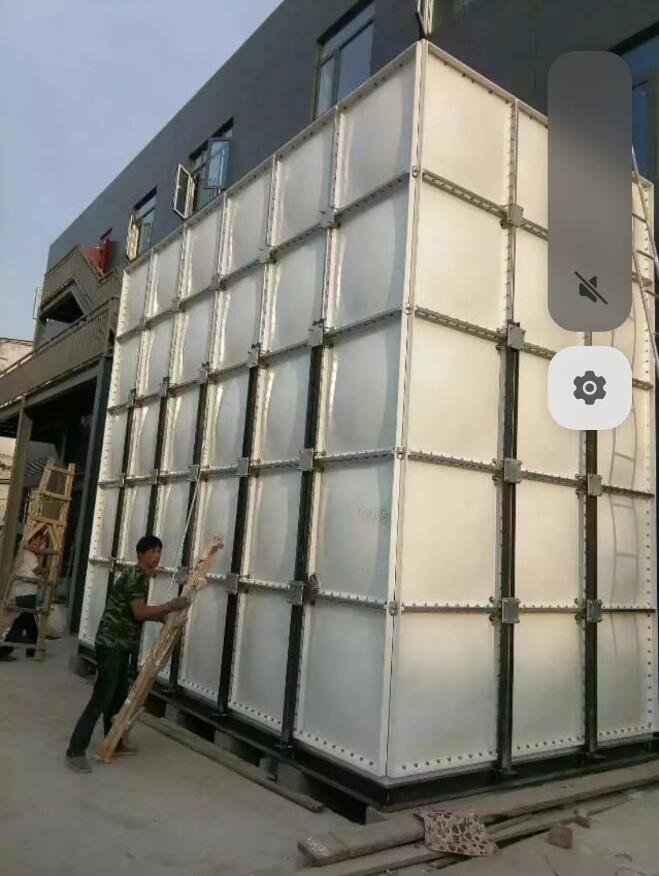
A 100m³ FRP fire tank (8m×5m×2.5m) was installed in an intensity-8 region using SMC panels. Design incorporated three internal 304 stainless steel tie rods for stiffness. Post-earthquake inspection showed no leakage, no plastic deformation of tie rods, and intact top manhole seal. Adjacent welded steel tanks exhibited corner weld cracking and were later replaced with FRP units.
Case 2: Beijing Yuanhui Seismic Test
Company tests on a 5m³ prototype tank using El Centro waves (peak 0.35g, equivalent to rare 7-degree earthquake) recorded maximum horizontal displacement of 12mm (allowable 25mm), maximum principal strain of 0.0023 (below ultimate strain 0.02), and residual deformation <1mm. This data optimized the anti-skid pad design at the tank base.
Conclusion
FRP water tanks, leveraging light weight, high damping, and good deformability, along with targeted seismic design, meet safety requirements in high-intensity seismic zones. Key design points include connection strength, internal tie rod layout, and water sloshing effects. Beijing Yuanhui FRP Co., Ltd. recommends SMC panel tanks for intensity 8 and above, with specialized seismic verification by qualified engineers. Future improvements may come from enhanced FRP modulus and structural health monitoring integration.