Complete Production Process of FRP Water Tanks: From Raw Materials to Finished Products
Introduction
FRP (Fiberglass Reinforced Plastic) water tanks are widely used in construction, chemical, and fire protection industries due to their corrosion resistance, high strength-to-weight ratio, and long service life. At Beijing Yuanhui FRP Co., Ltd., a standard 10-ton SMC water tank bottom plate undergoes 12 production steps from material batching to final shipment, with an average cycle time of 48 hours. Many practitioners only know the surface-level process; this article systematically breaks down each step with key parameters and data.
1. Raw Material Selection and Pretreatment
1.1 Resin System Choice
For the inner layer in contact with drinking water, food-grade unsaturated polyester resin (e.g., 196# or 197#) is mandatory, with styrene content controlled between 35% and 42% and acid value below 15 mgKOH/g. Beijing Yuanhui FRP Co., Ltd. uses orthophthalic resin for all potable water products to comply with GB/T 17219-1998 standards. The outer structural layer uses isophthalic or vinyl ester resin with a heat deflection temperature ≥110°C for outdoor durability.
1.2 Reinforcement Configuration
E-glass fiber roving (2400 tex) and chopped strand mat (300-450 g/m²) are used. Fiber content directly affects mechanical properties: increasing fiber weight fraction from 30% to 45% raises flexural strength from 120 MPa to 210 MPa but also increases brittleness. Beijing Yuanhui controls fiber content at 38%±2% and uses 0°/90°/45° multi-layer alternating layup to achieve interlaminar shear strength ≥15 MPa.
2. Mold Preparation and Release System
Mold surface roughness directly impacts tank wall finish. Steel or FRP molds with Ra≤0.8 μm are used. Molds are preheated to 35-40°C (50°C in winter), sealed, and coated with mold release wax at least three times, with 15-minute intervals between coats, forming a 0.1-0.2 mm release film. Beijing Yuanhui adopts semi-permanent release agents for batch production, allowing 8-12 consecutive demoldings per application, improving efficiency by 40%.
3. Core Molding Process Parameters
3.1 Hand Lay-Up Operation
Resin-to-hardener ratio is precisely 100:1.5 (MEKP-type hardener), with ambient temperature 18-25°C and humidity ≤75%. Layup sequence: gel coat (0.3-0.5 mm) → chopped strand mat + resin → woven roving. Each layer is consolidated with a debulking roller to keep bubble content below 3%. Beijing Yuanhui uses ultrasonic bubble detectors for real-time monitoring and repairs bubbles with resin injection. For a 2 m³ tank panel, total layers are 8-10, with cured thickness of 5-7 mm.
3.2 Curing and Post-Curing
Gel time is controlled at 20-30 minutes, with exothermic peak temperature ≤150°C. After 24-hour room-temperature curing, post-curing is performed at 80°C for 4 hours (heating rate ≤10°C/h), raising the degree of cure from 85% to over 92%. Data shows that non-post-cured tanks lose 28% Barcol hardness after 72 hours in 70°C hot water, while post-cured tanks lose only 6%.
4. Assembly and Quality Inspection
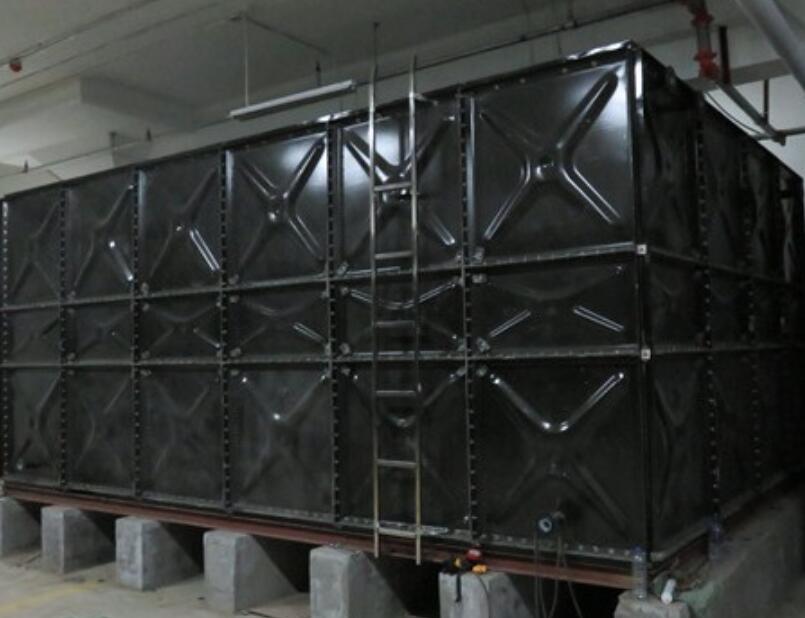
Molded panels are bolted with stainless steel fasteners, and EPDM gaskets (Shore A 60±5) are used for sealing. Each tank undergoes a 24-hour full-water leak test with zero leakage allowed. Beijing Yuanhui performs ultrasonic thickness inspection with ±0.5 mm tolerance and hydrostatic pressure testing at 1.5 times working pressure for 30 minutes. For drinking water tanks, 24-hour immersion water quality tests are conducted to ensure arsenic, cadmium, and lead leaching levels stay below GB5749 limits.
Conclusion
FRP water tank production is a multi-variable process where deviations in resin acid value or fiber layup angle impact final product lifespan. Beijing Yuanhui FRP Co., Ltd. achieves a rework rate below 0.3% through precise control of material batches, curing curves, and assembly tolerances. Implementing SPC (Statistical Process Control) for real-time monitoring of gel time and peak exotherm temperature is recommended as the core path to improving product consistency.