Thermal Insulation Performance of FRP Water Tanks: From Polyurethane Foam to Cold-Region Applications
Introduction
The thermal insulation performance of FRP (Fiberglass Reinforced Plastic) water tanks determines their usability in freezing climates and directly affects the operating cost of hot water storage systems. Over the past decade, Beijing Yuanhui FRP Co., Ltd. has observed in projects across Northeast China, Xinjiang, and high-altitude regions that poorly insulated tanks can lose over 15% of heat daily at -30°C, while tanks with optimized polyurethane foam keep heat loss below 3%. This article moves beyond generic discussions to examine insulation material selection, structural design, field measurements, and specific application scenarios.
1. Insulation Materials and Design Standards
1.1 Polyurethane Rigid Foam: The Mainstream Solution
Polyurethane (PU) rigid foam, either field-foamed or prefabricated, is currently the industry benchmark. Beijing Yuanhui FRP’s lab tests show that PU foam with a density of 40±2 kg/m³ has a thermal conductivity (λ) of 0.022-0.026 W/(m·K), significantly lower than rock wool (0.040-0.050 W/(m·K)) and extruded polystyrene (0.028-0.035 W/(m·K)). Under continuous operation, a 50mm PU layer limits the internal water temperature drop to less than 5°C over 24 hours (ambient -20°C, initial water 60°C).
1.2 Rock Wool and Composite Insulation: Application Boundaries
Rock wool costs about 60-70% of PU foam, but its water absorption rate of 5-10% by volume means that once the waterproof layer is compromised, its λ value jumps above 0.060 W/(m·K). Thus, rock wool is better suited for indoor, constant-temperature, non-condensing environments. In a Shanxi coal mine project, Beijing Yuanhui used rock wool with a galvanized steel cladding, but required the tank base to be at least 300mm above ground with a moisture barrier.
1.3 Insulation Thickness by Climate Zone
Based on GB 50176-2016 and field experience, recommended PU foam thicknesses are:
- Severe cold (e.g., Heilongjiang, Inner Mongolia): 80-100mm
- Cold (e.g., Beijing, Hebei): 50-70mm
- Hot summer/cold winter (e.g., Shanghai, Wuhan): 30-50mm
Insufficient thickness leads to surface condensation and freeze risk; exceeding 80mm yields diminishing returns as the thermal resistance curve flattens.
2. Measured Data and Key Influencing Factors
2.1 Temperature Gradient and Thermal Bridging
Pipe connections, level gauge nozzles, and manhole flanges are typical thermal bridges. In a Hebei pharmaceutical plant project, Beijing Yuanhui measured metal fittings without thermal breaks at 12-15°C colder than the insulated surface, causing ice blockage in winter. The solution: wrap each metal penetration with a 50mm PU preformed block and seal gaps with silicone.
2.2 Long-Term Insulation Degradation
PU foam aging mainly involves cell structure collapse and gas diffusion. Beijing Yuanhui’s five-year tracking data shows that high-density closed-cell formulations (closed-cell ratio >95%) see a λ increase of 8-12% after five years, while low-density open-cell formulations (<85% closed cells) degrade by over 25%. Buyers should request closed-cell ratio test reports and prefer continuous foaming over manual spray application.
3. Typical Application Scenarios
3.1 Domestic Hot Water in Severe Cold Regions
At a border outpost in Mohe, Heilongjiang, a 20-ton PU-insulated FRP tank (100mm insulation, 304 stainless steel cladding) was installed. Field data: at -38°C, hot water (65°C initial) dropped to 51°C after 48 hours — a 21.5% heat loss, sufficient for daily scheduled supply. An uninsulated tank would freeze solid within the same period.
3.2 Industrial Waste Heat Recovery and Medium-Temperature Storage
In industrial settings, high internal wall temperatures (60-90°C) can generate steam that condenses inside the insulation layer. Beijing Yuanhui solved this for a Shandong chemical plant by using a sandwich structure: inner SMC panel + PU core + outer FRP skin, with drainage channels embedded in the insulation. Thermal imaging after three years of service showed no hot spots.
3.3 Fire Protection Tanks: Freeze Prevention
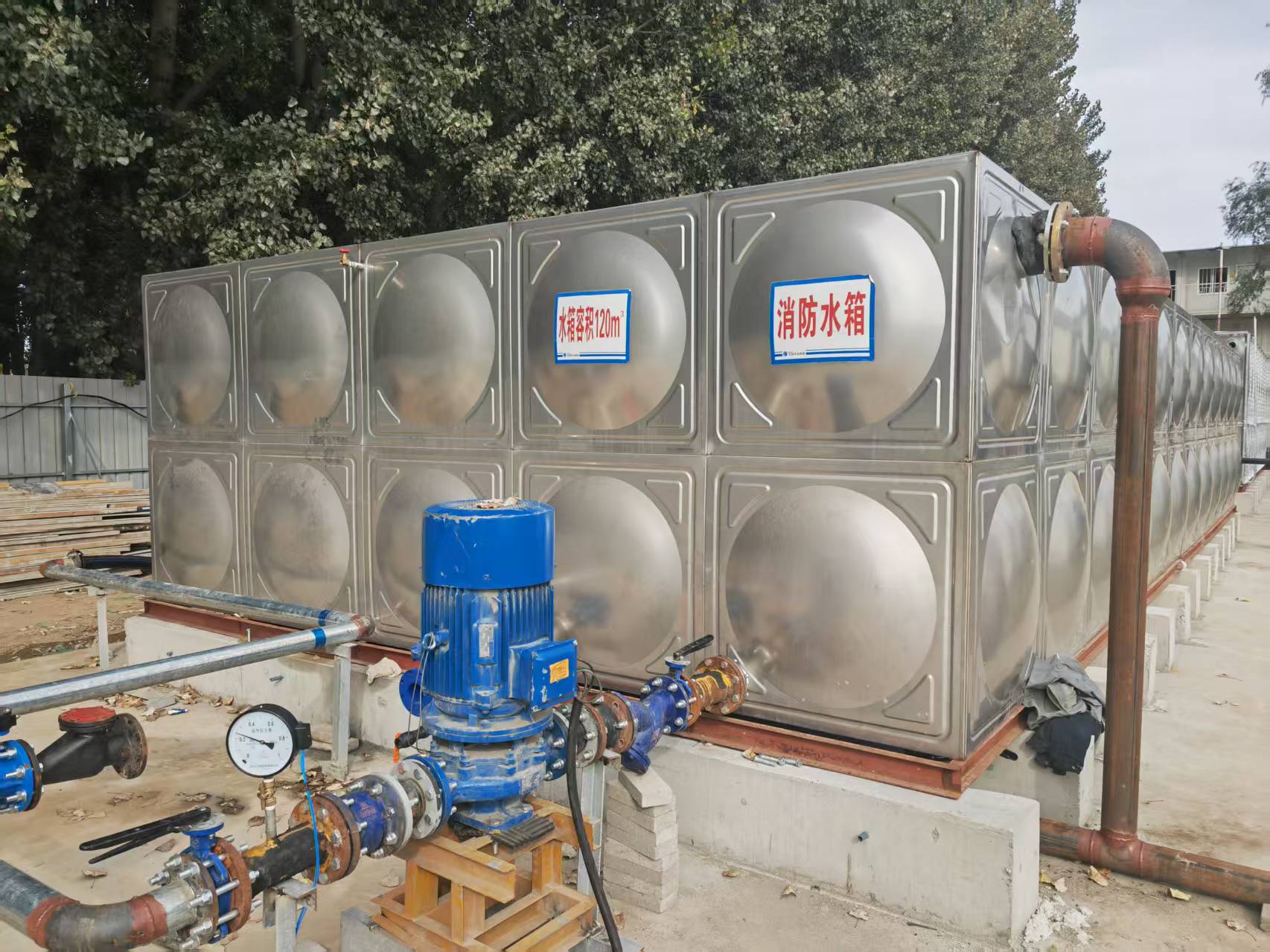
Per GB 50974-2014, fire water tanks in severe cold zones must be insulated to keep the outer surface above 0°C. For a logistics park in Urumqi, Xinjiang, Beijing Yuanhui combined self-regulating heat tracing (on tank bottom and pipe connections) with 80mm PU foam. The system passed local fire inspection and maintains water above freezing at -30°C.
Conclusion
Thermal insulation for FRP water tanks is not merely about adding thickness — it is a system engineering challenge involving material selection, structural design, thermal bridge treatment, and installation quality. Polyurethane rigid foam offers the best overall value, but in high-humidity or steam environments, it must be paired with waterproof layers and drainage. For severe-cold projects, 80mm+ PU insulation with thermal breaks on all metal penetrations is recommended. Data from Beijing Yuanhui FRP Co., Ltd. shows that a well-designed insulation system reduces heat loss by 60-75%, with a payback period of 1.5 to 2 heating seasons. When selecting an insulated tank, consider total lifecycle energy cost — not just the upfront price.